Revenue rose 8.7 percent to £11.45 billion (€13.5bn). Gross margin fell 20 basis points to 47.8 percent reflecting the acquisitions.
Underlying sales at JD Sports Fashion have fallen 2 percent in the first quarter with the retailer warning that US tariffs could force it to raise prices for consumers in America as it posted a fall in annual profits amid continued “volatility” in the global sportswear market.
Profit before tax and adjusting items fell 4 percent to £923 million (€1.09bn), in line with January guidance of £915-£935 million (€1.08-1.1bn) On a reported basis, earnings fell 11.8 percent for the year to February 1 to £715 million (€847.2m) with the drop due to increased costs associated with the acquisitions of Hibbett and Courir, along with more spending on cybersecurity.
Revenue rose 8.7 percent to £11.45 billion (€13.5bn). Gross margin fell 20 basis points to 47.8 percent reflecting the acquisitions.
The results came as the retailer said overall sales are being affected by “slower” conditions in many markets. No guidance was offered for the current financial year, but the consensus is for a 3 percent fall in pre-tax profit to £890 million (€1.05bn), according to a company-compiled poll.
JD Sports said in January that it did not expect any growth in sales at established stores during the year and warned that annual profits would be no more than £935 million (€1.1bn), down from previous hopes of between £955 million - £1.03 billion (€1.13-1.22bn).
US tariff plans, which include a blanket 10 percent levy on all imports, could mean the “cost of goods and services for US customers may rise to some degree”, with this potentially weighing on demand in a key region that generates 40 percent of JD’s sales. The news sent shares in the company down almost 10 percent in London trade.
“We consider this to have the largest potential impact on the group,” it added.
The company is mitigating any potential impact from tariffs by further diversifying the range of countries from which it sources own brand and licensed products.
“The market remains volatile and visibility on the overall potential impact from tariffs is low,” said chief executive Regis Schultz.
JD is facing headwinds from competitors, worries over consumer spending and a fall in demand for Nike products, which account for 45 percent of sales.
Organic sales grew by 3.1 percent in the quarter to May 1 as new openings offset a 2 percent decline in like-for-like sales. North America rose 1.4 percent but like-for-like sales fell 5.5 percent due to pressure on consumer confidence, while Europe increased by 6.5 percent as good weather conditions helped to drive sales in the UK.
All regions grew revenue other than the UK which declined 4.1 percent. Europe increased 9.5 percent, including two months of Courir contributions. North America rose 27 percent taking in six months of Hibbett and Asia Pacific was up 0.4 percent.
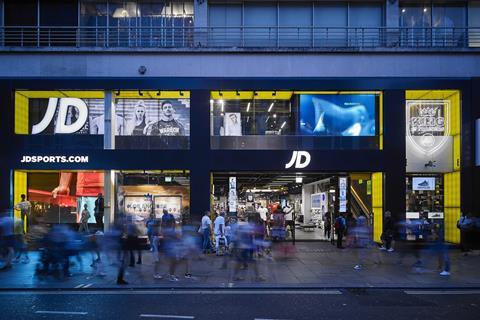
Retail store sales grew 15.7 percent with the online channel down 2.9 percent, reflecting the continued shift back to pre-pandemic shopping habits.
Footwear continued to perform strongly with revenue growth of 15.2 percent to £6.81 billion (€8bn), while apparel sales were up 4.2 percent to £3.55 billion (€4.21bn), driven primarily by acquisitions being mostly footwear-focused. Accessories revenue grew by 4.8 percent to £702 million (€831.7m), giving the group a mix of products delivering a ‘head-to-toe’ offering with footwear at 60 percent, apparel at 31 percent and accessories at 6 percent of revenue.
The company ended the period with 4,850 stores worldwide, up 1,533, due mainly to the acquisitions of Hibbett and Courir, which added 1,485 stores. Across all fascias, 311 stores were opened and 263 stores were closed, including 66 from Finish Line and Macy’s as the store portfolio was rationalised.
Analysts at stockbroker Shore Capital said US weakness “remains a concern”.
“With the impact of tariffs on prices, US consumer confidence and the US economy all still uncertain and with the high exposure the American business has to Nike (which still has work to do on its recovery) we expect this to remain a point of weakness in full-year 2026,” the wrote in a research note.
“However, looking past this and into the medium term, we still view the US brands and JD’s comprehensive geographical presence as a key driver of growth and profit for the business.”