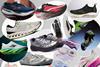
The global athletic shoe market accelerated in 2017 , with a gain of 9.4 percent in dollars to $63.2 billion compared with an increase of 8.8 percent recorded in the previous year, according to an annual SGI survey of the branded market based on the vendors’ revenues from this type of products.
The market grew at a strong rate of 13.4 percent to $16.4 billion in Europe, partly aided by a 1.9 percent increase in the value of the euro against the dollar and by the casual sneaker boom, which has been benefiting many sports brands more than other shoe brands. It rose at an even stronger rate of 21.9 percent in Asia, which reached a level of nearly $16.0 billion, and it is likely to overtake Europe soon in view of its much larger population and its higher economic growth. In the more mature U.S. market, athletic footwear sales rose by 4.1 percent to $23.3 billion last year.
SGI’s annual study of the market relies mainly on publicly available data for the major companies, where the direct-to-consumer segment is representing a growing portion of reported sales, boosting their overall revenues by between 8 and 10 percent and thus contributing slightly to the brands’ sales increases. For other companies, we mostly rely on input from the management. Data reported in other currencies than the U.S. dollar are converted at the average rate calculated by the OECD for each year.
The strong growth of the Asian sports market is benefiting the international brands more than the local players. The four major Chinese brands – Anta, Li Ning, Xtep and 361° - saw their share of the Asian market contract to 15.5 percent last year from 19.3 percent in 2016. Anta and Li Ning performed better than the other two Chinese firms.
Globally, the Nike group remained the leading factor in the footwear segment of the sports market, but it lost market share as the Adidas Group’s footwear sales leaped forward by 24.6 percent, improving its global market share by 2.7 percentage points to 22.1 percent. The biggest gains were recorded by the German group in the U.S., where its market share in footwear rose by 2.9 percentage points to 14.4 percent. Nike’s market share declined by 2.0 percentage points to 36.4 percent on a global basis. In the U.S., Nike’s share remained extraordinarily high at 44.4 percent, but it was 2.5 percentage points lower than in the previous year.
Other major gains in market share at the global level were achieved by Skechers, whose strong international growth pushed it up by 0.4 percentage points to 6.2 percent, and by Puma, where it went up 0.4 percentage points to 3.5 percent. Conversely, Asics’ market share went down by 0.5 percentage points to 4.7 percent and Under Armour’s declined by 0.2 percentage points to 1.6 percent, with a loss of 0.4 percentage points to 3.4 percent in its domestic market.
The battle between the Swoosh and the Three Stripes, which together control 58.5 percent of the global market, seems to be taking a new turn this year, judging from their latest financial reports. Wells Fargo Securities has downgraded the value of Adidas’ shares due to Nike’s regained momentum in North America and the surprisingly rapid deceleration of Adidas in Western Europe in the first quarter. It noted that Adidas started to accelerate in Europe in mid-2014 and that it is being challenged now by Nike at the high end of the market and by Vans at the lower end of the market.
Detailed market share figures by region can be obtained from SGI America’s annual Apparel & Footwear Market Facts Report, which will be available shortly. It can be ordered on www.sginews.com.
On the other hand, the ongoing sneaker boom in Europe, the stabilization of the American retail market, the ongoing strong growth in China and the deployment of advanced digital strategies by the majors will likely ensure that the global athletic footwear market will continue to grow at a rapid pace in 2018.