MAP Active bought Sports Direct Malaysia from Fraser Group, seizing a deeper Southeast Asian foothold in a deal that pairs currency gains with strategic reach.
Indonesia’s MAP Group is breaking out of its home market. Acquiring 100 percent ownership of Sports Direct Malaysia Sdn Bhd (SDM) from Fraser Group Trading Limited, PT Map Aktif Adiperkasa Tbk (MAP Active) has planted its flag deeper into Southeast Asian sports retail with a strike that signals serious regional ambition.
SDM retails premier names including Nike, adidas, PUMA, Under Armour, ASICS, New Balance, and Skechers across its Malaysian store network. With MAP Active already holding the brand and management rights for Sports Direct Indonesia, the acquisition naturally completes its regional sports retail portfolio.
MAP Active has long anchored the sports retail sector. The company manages Skechers, New Balance, Reebok and Converse. License-held chains like Planet Sports, Sports Station and The Athlete’s Foot also fall under MAP Active’s umbrella. The portfolio stretches further into children’s toys and leisure goods with LEGO, Bandai and Kidz Station. By the end of 2021, MAP Active supported this sprawling operation with 1,974 points of sale across Indonesia, the Philippines, Vietnam and Thailand.
MAP Active’s management cast the deal as a strategic strike to fortify and stretch its Southeast Asian footprint, locking in a stronger market position where growth potential aligns squarely with the company’s core focus.
“This transaction will expand our geographic reach, diversify our business portfolio, and unlock synergies through our operational and commercial strengths,” management said.
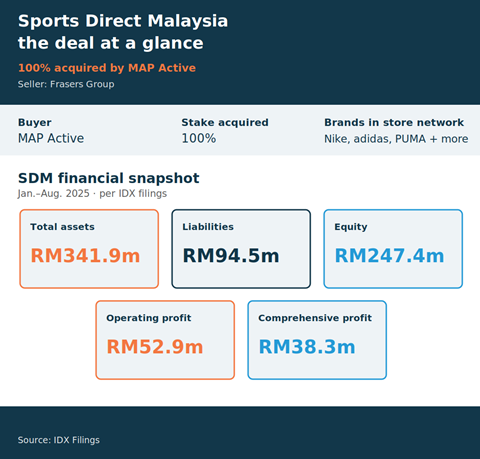
According to the IDX website, SDM brings solid financial footing to the table. The company holds total assets of RM341.9 million (€71.8 million), with liabilities at RM94.5 million (€19.8 million) and equity of RM247.4 million (€52.0 million). For the January to August 2025 period, SDM posted operating profit of RM52.9 million (€11.1 million) and comprehensive profit of RM38.3 million (€8.0 million).
So why did MAP Active (MAPA) pull the trigger now? Analysts see two likely forces at play.
The first driver centers on growth and diversification, and Harry Su (Managing Director of Research) of Samuel Sekuritas Indonesia said MAPA actively diversifies earnings from a strong base. The company logged Rp5 trillion in first-quarter net revenue (2026), while net profit jumped 39.6 percent year-on-year (YoY) to Rp473 billion, lifted by Eid al-Fitr spending. Hence, Indonesian players have a compelling reason to chase bigger returns just across the strait, where that momentum meets Malaysia’s surging athleisure market.
The second driver centers on currency timing. Citing multiple news agencies, the Malaysian ringgit logged Asia’s strongest performance throughout 2025, buoyed by solid economic fundamentals, robust exports and looser global monetary policy. Over the year, the ringgit climbed against most regional currencies. The currency gained 13.5 percent against the Indonesian rupiah, 10.5 percent against the Philippine peso, 8.5 percent against the Japanese yen, 3.8 percent against the Singapore dollar and 2.9 percent against the British pound. The ringgit lost ground only against the euro, falling 2.8 percent. Such currency strength likely made a Malaysian acquisition a strategically timed bet for MAP Active.
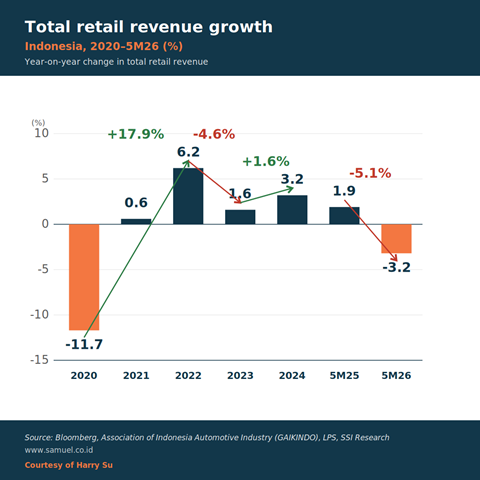
“It makes sense that MAPA bought SDM. Buying SDM is like buying foreign currency and earning income in that currency. A weakening rupiah only benefits MAPA. [With] retail sales overall are sluggish in Indonesia, MAPA needs growth elsewhere to offset the domestic slowdown,” Su said, pointing to the pressure on domestic purchasing power.
Bank Indonesia’s (BI) decision to raise the BI Rate to 5.75 percent may defend the rupiah, but the cost always lands somewhere. The burden increasingly falls on Indonesia’s middle class, whose spending power keeps shrinking.
“If Capital Expenditure [CapEx] heads abroad instead of staying home, the rupiah will weaken further down the road. That kind of outflow hurts growth and drags down retail sales in Indonesia. No expansion means no hiring. No hiring means weak employment. And weak employment means people stop spending,” Su added.
MAP Active’s acquisition of Fraser Group Trading Limited squarely targets the lifestyle shift that Gen-Z’s consumers embrace. Malaysia’s athleisure market expands on the back of that demand, as younger buyers increasingly prioritize health and seek more outdoor activities.
Global names including Nike and adidas give MAP Active a distinct advantage in brand recognition and consumer trust in Malaysia, but the rapid rise of the local athleisure market proves that having the biggest global portfolio alone does not guarantee market dominance in the Gen-Z retail race.
In Malaysia, homegrown brands including Āina Collective, MKLZ Collection, Camellia Activewear and Liberty Active gain ground. They cater to Gen-Z preferences, from personal stories and recycled materials to inclusive sizing and, with Muslims making up 63.5 percent of the population, hijab-friendly options.
Innersejuk founder Azrul Izzam said the Muslim-friendly athleisure segment performs just as strongly as the mainstream athleisure market, with hijabis spending as much as other consumers, though the amount varies by income bracket, ranging from conservative budgets to premium outlays.
Unable to match global giants on scale, Malaysian athleisure brands have won through segmentation, offering chic lower-priced designs, eco-friendly fabrics and modest inclusive activewear tailored to local needs. This niche focus turns their smaller footprint into a strategic advantage, positioning them as compelling investment plays within the broader global shift toward healthier living.
“My customers prioritize quality over price and consist of urban professional women,” Izzam shared.
“The problem for local brands arises when foreign players dump products at dirt-cheap prices to undercut and destroy the domestic market.”
Influencer marketing no longer resonates with the community. Ipsos found that 36 percent of Malaysians distrust social media influencers, and while that figure may seem low, Izzam said trust comes directly from the brand owner connecting with the community.
“Influencers no longer drive decisions and only generate buzz, but brands that align with consumer identity win,” Izzam added.
MAP Active’s SDM acquisition signals confidence in athleisure’s potential, fueled by economic growth and a health-conscious shift. Homegrown sector relevance for global brands entering Southeast Asia remains equally strong, as it thrives on inclusivity and local details that bigger players often miss.

Eastern views
Asia-Pacific insights for the sporting goods industry
Analysis, insights, and expert perspectives on the sporting goods industry across Asia-Pacific — covering market trends, manufacturing, retail, and brand strategy from China to Southeast Asia to Oceania. With Jakarta-based contributing editor Yohana Belinda.
Explore Eastern views →