The brand calls its running strategy “simplify to amplify”. What that means in practice: a smaller range of models, deeper development on each, what athlete feedback changed in the Velociti Elite 3, and why good product alone no longer reaches the runners a brand needs to win.
Under Armour’s Senior Product Line Manager for Performance Run Footwear talks about cutting the range to five or six shoes, what Sharon Lokedi asked for in the last 10 kilometers, and why a brand outside running’s leading group has to go looking for its consumers.
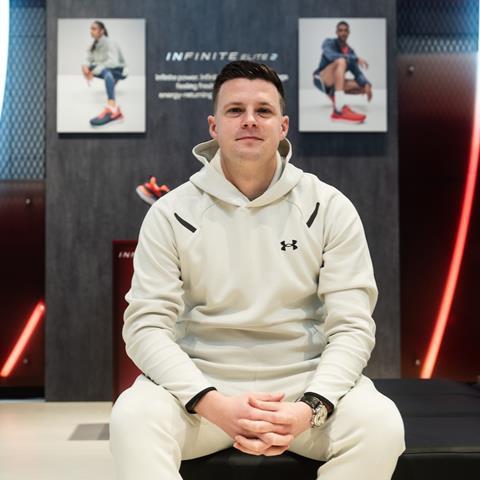
London on Friday, Sept. 4: some rain earlier had left gray skies by early afternoon, a stiff wind and the kind of damp, cool air. Perfect for runners, but the event opening that day was not a race, it was a festival. At the Boiler House in the Truman Brewery, doors were due to open at 4 pm for Run Culture: Live, the two-day gathering staged by the team behind the running magazine Like the Wind.
Jonathan Hutnyan had not been over yet. We were virtually sitting together, him in an office in central London, me in Berlin, the same gray sky and the same feeling of autumn approaching that can make some feel blue but that most runners welcome. He would head over to the festival later that afternoon, and speak on a panel there the following day.
Finding a distracted runner
Good product, he said, is no longer what separates brands. “It’s not just enough to make good product. There’s a lot of good product out there.”
What is scarce is the runner’s attention, and Hutnyan does not assume it arrives on its own. “We can’t rely so much on them finding us. We have to find them.”
Hutnyan is Senior Product Line Manager for Performance Run Footwear at Under Armour, which makes him responsible for what the brand puts on runners’ feet and for the argument that comes with it. He sets category direction for a team of designers, developers and material experts, and spends much of the year at marathons, Diamond League meets and local races, looking for what he calls white space.
“I get to wear kind of a lot of hats. I don’t see myself as an expert in one individual task,” he said. He can talk to a designer, he can work with a factory liaison, “but at the end of the day, it’s about driving a brand strategy forward of how we show up in run footwear.”
Simplify to amplify
A real business strategy is always about not only what to do, but also what not to do. So, in this case: Under Armour’s running brand strategy starts with subtraction. Over the past two years UA has cut its running range back to a handful of models, an exercise Hutnyan describes internally as ´simplify to amplify´.
“Our goal isn’t to make more things or more stuff, but to go deeper on the innovation in what we do offer,”
he said. The aim is a set of shoes a runner can reach into on any day of the week, covering easy recovery miles, a speed session and a race, without asking anyone to choose between dozens of models. Five or six, taken further.
Ask him where that depth goes and three priorities come back, none of them modest.
The first is race day shoe, a part of the market that has rarely been louder. Sabastian Sawe ran 1:59:30 at the London Marathon on April 26, the first legal marathon under two hours, and Yomif Kejelcha took the men’s half marathon record down to 1:56:51 in Buenos Aires on Aug. 23.
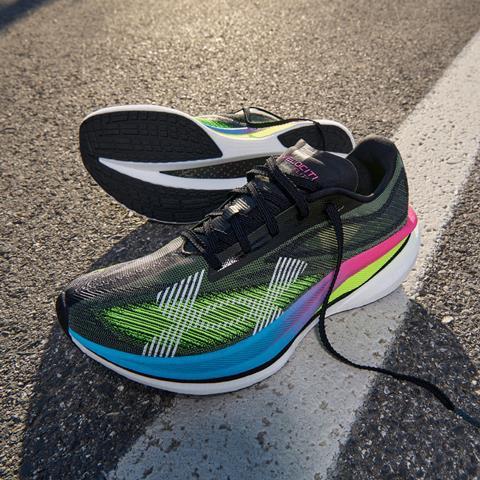
“There’s tons of focus and interest on that part of the category and market because it’s innovative and pinnacle leading, but then it also brings the everyday run consumer to have a piece of the pie,” Hutnyan said. “They can purchase and be part of what they see maybe their favorite athlete run and race in.”
The second is what he calls the super trainer: supercritical foams, first developed for racing, moved into everyday long-run shoes. He talks about it less as performance than as durability of a career.
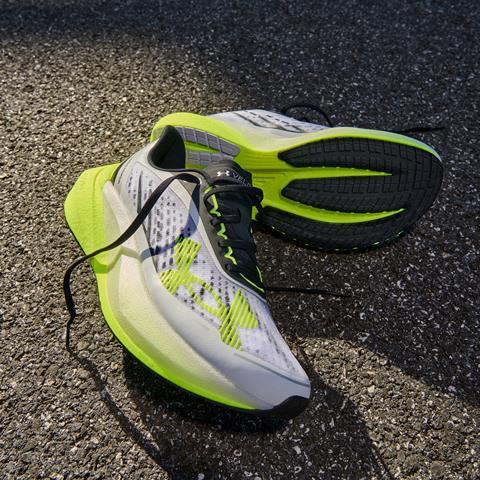
“Athletes are able to increase their workload, but you also recover faster. It’s extending the longevity of their careers, and that applies to an elite athlete, but also someone trying their first 5K,” he said. “It’s not just an elite solution. It’s an everybody solution.”
The third is the one that has changed most. Run clubs and crews have turned the everyday trainer into something people are seen in, which puts a demand on color and material that a lab cannot answer.
“Saturday morning coffee runs are becoming their own versions of fashion shows,” Hutnyan said, describing shoes that are performance models underneath but built for the moment they are photographed in. Internally, he said, the team has started talking about design innovation as its own discipline: “a visual cue that gives the nod of performance while being aesthetically beautiful.”
The last 10K
Where the two halves of the job meet is in the lab. Shortly after Sharon Lokedi won the New York City Marathon in 2022, her marathon debut and Under Armour’s first victory at a major, she spent several days at the company’s offices on a treadmill wired to an instrumented lab.
“You can have a data expert explain what it means on screen, but then she can tell us what it means in reality,” Hutnyan said. The work that followed fed the Velociti Elite 3: lower weight, more traction, a reworked geometry underfoot tied to the shape of the carbon plate. Lokedi won Boston in that shoe in 2025 in a course record 2:17:22, and defended the title in April.
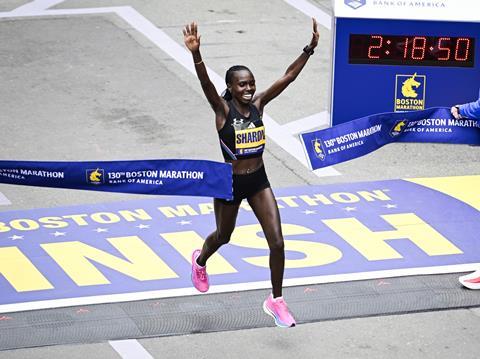
The messaging that follows those wins carries an implicit claim, that the athlete won because of the shoe. Hutnyan narrowed that question rather than dodging it. What Lokedi asked for, he said, was not speed but reliability at the point where a marathon stops being a tactical race.
“The big ask was the last six miles of the marathon, 20 and beyond. I need something I can rely on when the first 20 miles all the competitors are kind of feeling each other out,” he said. “Then the last 10K of it is the race, and that’s where things start to turn up.”
So the testing question changed too. “Not just how it performs fresh out of the box, but how does it perform with miles in the tank, and how does it give back to an athlete like Sharon when it’s already been used for two hours and now she really needs to use it more than ever.”
It is a coherent product story, and it belongs to a wider turnaround that Under Armour is still working through. Running is one part of that effort, and Hutnyan is candid about a structural limit on the part he does control.
“We’re a US-based brand, so we can’t be everywhere all the time,” he said. Product creation hands off to a global marketing team, which hands off again to regional leads who decide what actually lands in their market. “It can’t ever really just be like one person or one function, because there’s so many touch points.”
The regions want different things, and the same story cannot travel everywhere. In APAC, he said, consumer interest runs toward the technology itself, the midsole, the plate, what is in the shoe. In EMEA, performance is assumed and the conversation moves to versatility and to whether the shoe is worth wearing when the run is over. In his words:
“You’ve got to go speak the language they’re looking for, so to speak.”
Copenhagen, then Chicago
Which brings the calendar into view. At the World Athletics Road Running Championships later this month in Copenhagen (Sept. 19 – 20), Under Armour will have Vincent Ciattei in the men’s road mile, a Baltimore-born miler who trains in Flagstaff, Arizona, and who Hutnyan said will be representing the US at a global championship for the first time. His team was in Flagstaff a few weeks ago working on details with him.
Then Chicago on October 11, when Lokedi will switch from their usual fall marathon in New York. “She’s making a change in her fall marathon of choice,” Hutnyan said. “Heading to Chicago with really one clear goal, and it’s to run fast. Chicago is a great course for running fast, and the field is deep and competitive.”
Asked which record he expected next, Hutnyan smiled and would not go further than that. “I won’t share anything that isn’t public knowledge,” he said, which sounds less like caution than like someone unwilling to spend a result his partner athletes have not run yet.

Road, track and gravel: the business of running
We track the business story: brand strategies, product launches, financial performance, participation data, and the race formats reshaping the industry’s most competitive category.
Explore Running →