
The assumption once seemed settled: digital tools and virtual showrooms would inevitably replace the physical trade fair. For a time, the industry followed that path; travel budgets were tightened and material presentations moved almost entirely to the screen. However, as we move through 2026, that narrative has hit a wall. In an era defined by geopolitical shifts and volatile supply chains, the trade fair has been recast. For global manufacturing partners like LTP Group, which specializes in technically complex garments, this shift confirms a long-held belief: trade fairs are regaining their relevance as practical spaces for risk reduction rather than just marketing stages.
The Federation of the European Sporting Goods Industry (FESI) recently highlighted the industry’s shared anxiety, noting that when tariff and non-tariff barriers escalate due to political disputes, “companies lose the ability to plan, invest, and grow with confidence.”
This loss of certainty ripples across the entire value chain, but it is felt most acutely in material development. Early-stage decisions dictate the success of the entire product lifecycle. When the external environment is unstable, manufacturers and brands must at least be certain of their material foundations, which is a confidence that spreadsheets and digital renders cannot provide.

Digital renders cannot simulate performance reality
Unlike finished products, functional fabrics and technical components are difficult to represent fully in a digital format. Performance data and lab results are essential, but they rarely tell the whole story. The specific weight of a membrane, the recovery of a stretch fabric, or the way a surface feels against the skin only become clear through physical handling.
LTP Group, a Danish-owned global manufacturer specializing in technically complex garments, sees this challenge daily across its production sites in Europe and Asia. For a partner managing such high-stakes production, the “tactile truth” is often what separates a successful launch from a costly development delay.
Laura Didziokiene, Sourcing Manager Europe at LTP, argues that while digital progress is significant, it can never simulate the full human experience. As Didziokiene puts it, no digital tool can truly replicate the full spectrum of human perception. And while vision dominates presentations, the decisive judgments in material development are still made through touch, sound and the deeper sensory experience that defines how a garment is ultimately worn. ”The apparel industry is often satisfied with visual presentation alone, but seeing by itself does not allow for a 100% accurate evaluation,” she explains. “We miss the elements closest to the real wearing experience: the senses of touch and sound. Digitalization can help improve processes, but it will never replace the ‘soul’ of materiality.”
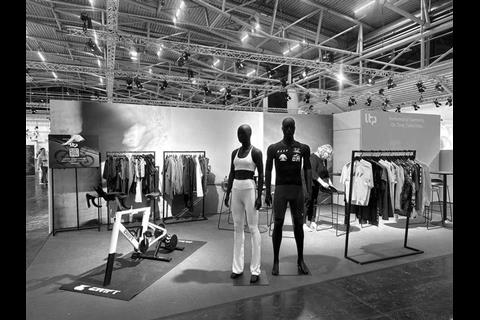
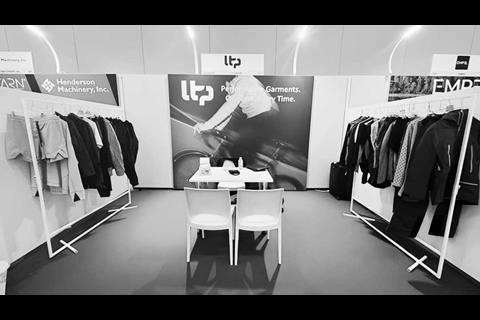

Fairs are operational tools for technical clarification
Trade fairs provide a unique setting where materials can be assessed side-by-side and technical questions can be answered immediately. This hands-on interaction helps eliminate ”the hidden cycle of sampling”, reducing the risk of a misunderstanding long before costly iterations or late-stage compromises set in. In this sense, fairs are becoming operational tools that allow for much faster technical clarification.
This immediacy compresses the development cycle. When tariff structures shift or production geographies change, long email chains become a liability. Physical meetings allow teams to solve in an afternoon what might take weeks digitally.
Didziokiene views the phrase “sitting down together” as a symbol of partnership. “Email is essentially an outdated method for complex problem-solving. It becomes delayed by multitasking and lacks the human factors—like a sense of humor—that help smooth out the tensions of a high-pressure production cycle.”
Kristina Tumpiene, Sales Manager Europe at LTP, agrees that face-to-face interaction is the ultimate logistical shortcut. “Direct conversation allows us to solve issues with a level of efficiency that writing simply cannot match. It establishes a real connection and a shared sense of urgency to reach a target.”
LTP’s global intelligence strategy
This is why LTP continues to prioritize these in-person touchpoints as a cornerstone of their global strategy and long-standing operational philosophy. While much of the sector moved toward a digital-only sourcing model, LTP maintained its specialized teams who remain deeply passionate about material science and the discovery of technical novelties.
This commitment is backed by decades of on-the-ground experience as their sourcing teams have been established in Europe for over 20 years and a decade in Asia. Through constant cross-regional knowledge shares, LTP ensures that a breakthrough in recycled membranes found by the European team is immediately cross-referenced with the manufacturing capabilities of the Asian productions centers.
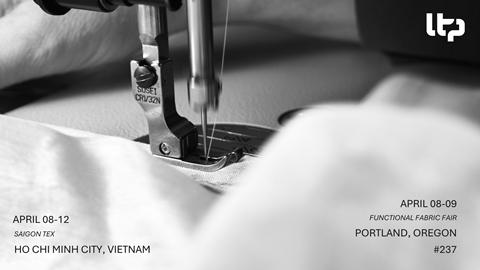
This spring, the LTP collective team was on-the-ground at PERFORMANCE DAYS in Munich (March 18–19) and will be at the Functional Fabric Fair in Portland (April 8–9) and the SAIGON TEX.
|
Trade Show |
Location |
Dates |
|
SAIGON TEX |
Ho Chi Minh City, Vietnam |
April 08–12 |
|
Functional Fabric Fair |
Portland, USA |
April 8–9 |
This strategy extends beyond the booth. By simultaneously maintaining a presence at machinery events in China and visiting fabric suppliers in Ho Chi Minh City, LTP bridges the gap between Western design hubs and Asian production centers. This on-the-ground presence ensures that when trade barriers are introduced, LTP has the local insight and material curiosity to help brands pivot production without sacrificing quality or innovation.
Physical alignment prevents “Development Debt”
The industry often focuses on the financial cost of shipping samples, but the “debt” incurred by technical misalignment is far higher. Without physical verification, brands risk committing to entire collections based on a digital approximation.
Kristina Tumpiene agrees that “hand-feel” remains the ultimate dealbreaker. “Even in 2026, values like softness and elasticity are incredibly difficult to describe through data alone because everyone’s perception differs,” she notes. “You can imagine the fabric in a 3D space, but you cannot verify its soul until it’s in your hands.”
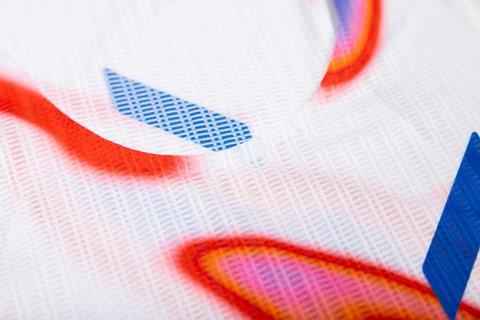
She likens the process to a high-stakes recipe. “A performance garment is like a complex ‘dish’ with many ingredients. Because fabric has natural deviations, the result can swing from excellent to disposable based on how those ingredients interact. Having physical samples from actual production is the only way to test how all components work together. Without that, you aren’t just risking a sample, but the entire collection.”
Infrastructure, not nostalgia
The renewed relevance of trade fairs in 2026 isn’t a return to old habits; it is a recognition of where physical interaction delivers irreplaceable value. As part of a globally connected strategy, they remain one of the few places where industry complexity can be addressed collectively.
Ultimately, as Didziokiene concludes, the goal is to foster “synergetic vibes” across human relationships. Because the most valuable asset a brand possesses is the human experience and the technical knowledge-share that happens between partners who truly know their craft.
Meet the LTP Team
You can reach out to LTP directly to secure a time to discuss your 2027 production roadmap. Get in touch:
For Performance Days meetings in the future
Laura Didziokiene
Sourcing Manager Europe
lad@ltpgroup.com
Ausra Paulauskiene
Business Development Manager
ap@ltpgroup.cm
For Functional Fabric Fair meetings
Vilma Kersiene
Innovation & R&D Manager
vike@ltpgroup.com
About LTP Group
LTP is a Danish-owned global manufacturing partner for over 40 premium brands in the running, cycling and outdoor sectors. Operating factories across Europe and Asia, the company specializes in technically complex garments, combining state-of-the-art technologies with a commitment to transparent, responsible production.