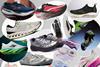
While two leading rivals are cutting back and rejigging their organization, the Adidas Group continued to charge ahead with sharp gains in sales and adjusted operating profit for the second quarter, spread across all markets other than Russia.
The group had already made it clear through an upgraded guidance last month that it has been in rude health. Its total sales surged by 20.0 percent in the quarter to €5,038 million, up 19 percent in constant currencies. It reported growth in both wholesale and retail sales, with the latter up by 21 percent for the quarter. This includes a spike of 66 percent for online sales, which jumped by 80 percent in North America and doubled in China.
The Adidas brand alone raised its sales by 21.4 percent to €4,497 million, up 20.5 percent in constant currencies. There was particularly avid demand for the Three Stripes in the running category, whipped up by the Boost technology. leading to a bottleneck in supplies for Boost footwear, which should continue until 2019.
| Adidas Consolidated Income Statement (Continuing Operations) | |||
| (Million Euros, Quarter ended June 30) | |||
| 2017 | 2016 | % | |
| Net Sales | 5,038 | 4,199 | 20.0 |
| Cost of Sales | 2,513 | 2,126 | 18.2 |
| Royalty/Comm. Income | 29 | 30 | -3.3 |
| Other Operating Income, (Expense) | (2,038) | (1,674) | 21.7 |
| Financial Income & Expense | (19) | (5) | 280.0 |
| Pre-Tax | 486 | 425 | 14.4 |
| Tax | 139 | 124 | 12.1 |
| Net income from continuing operations | 347 | 301 | 15.3 |
| Losses from discontinued operations | 189 | 10 | 1790.0 |
| Net Income | 159 | 291 | -45.4 |
| Earnings/Share, Diluted | 0.78 | 1.42 | -45.1 |
Aided by sales increases of 27 percent in running and 9 percent in training, the Adidas brand's turnover was up by 7 percent in the sports performance category. Football sales declined, as footwear and sales of replica shirts from leading clubs firmed up but apparel sales were reduced by the absence of international championships this year, and the termination of the partnership with Chelsea football club. Along the same lines, the decline in basketball was caused by the end of the Adidas brand's partnership with the NBA, while its basketball footwear business was up by 49 percent.
Adidas Originals' sales surged by 36 percent and the group emphasized that its latest franchises, such as NMD, Tubular and EQT, have increased by more than 60 percent – easily making up for declining growth rates for the Superstar and Stan Smith. The Neo business was up by another 45 percent for the quarter, driven by footwear.
In a conference call with analysts last week, Kasper Rorsted, the Adidas group's chief executive, was particularly enthusiastic about the Adidas brand's sales of women's products. They outperformed with a rise of 30 percent for the quarter, including increases of 77 percent in North America and 27 percent in Western Europe.
Unlike Nike and Under Armour, the Adidas brand has been unperturbed by the sluggishness of the U.S. market, as it continued to reap the benefits of its extra investments and to gain market share. The Adidas brand's sales were up by 36 percent to €915 million for the quarter in North America. This amounted to a rise of 33 percent in constant currencies – and that's after a jump of 32 percent in the year-ago quarter. The growth was spread across running, training and Originals, with 400 extra Dick's and Foot Locker stores on board so far this year.
| Adidas Group Net Sales | |||
| (Million Euros, Quarter ended June 30) | |||
| 2017 | 2016 | % | |
| Western Europe | 1,421 | 1,214 | 17.1 |
| North America | 1,014 | 788 | 28.7 |
| Greater China | 865 | 685 | 26.3 |
| Russia / CIS | 181 | 172 | 5.2 |
| Latin America | 441 | 379 | 16.4 |
| Japan | 261 | 236 | 10.6 |
| MEEA | 657 | 572 | 14.9 |
| Other Businesses | 198 | 155 | 27.7 |
| Adidas | 4,497 | 3,705 | 21.4 |
| Reebok | 431 | 399 | 8.0 |
| Total | 4,928 | 4,104 | 20.1 |
Last week Adidas announced that it has extended its partnership with Major League Soccer (MLS) for another six years until 2024. The exclusive deal started in 2004 was expanded to make Adidas the official supplier for the U.S. soccer league, its clubs, MLS youth academies and youth-affiliated clubs. The group declined to comment on estimates that the agreement was worth about $700 million, up from $200 million in 2010. Adidas will outfit MLS teams with game outfits, footwear, training gear and sideline apparel. The partners in the deal are committed to organizing more youth programs.
Just as remarkably, the Adidas brand continued to power ahead in Western Europe, with a sales rise of 18 percent in constant currencies – after a 30 percent jump in the year-ago quarter. The same applies for China, where the brand's sales surged by 28 percent in constant currencies in the three months.
The odd one out in regional terms for the quarter was Russia and the other CIS countries, where sales of the Adidas and Reebok brands together eased by 10.7 percent in constant currencies, although they were up by 5.2 percent in reported terms to €181 million.
Rorsted predicted that the Russian market would continue to contract, due to trade sanctions and other factors that are affecting the nation's purchasing power. The group has closed about 100 Adidas and Reebok stores in the country, reducing its store network in the region to about 800 units. Another 60 will shut down before the end of the year, although Adidas is continuing to invest in Moscow and St Petersburg.
Rorsted was eager to emphasize that the weight of the Russian market has greatly diminished for the Adidas Group. While Russia once made up more than 10 percent of the group's sales and was one of its juiciest markets, it made up less than 4 percent of the group turnover in the quarter.
Rorsted appeared underwhelmed by the company's performance in Latin America as well. Although regional sales increased by 13.9 percent in constant currencies for the Adidas and Reebok brands, he said that this was fueled by very strong demand in Mexico, while issues persist in Brazil, Argentina and other countries.
The Reebok brand alone managed a global sales rise of 7.9 percent to €431 million for the quarter, up 4.9 percent in constant currencies. That was below the increase of 13 percent recorded in the first quarter, and the group said that the growth appeared to have normalized in the second quarter.
The brand's sales tumbled by 16 percent in constant currencies in North America, as it continued to close outlet stores. It has shut down 35 of them since the last quarter of 2016, out of a program of 52 closures, which will leave Reebok with 62 stores in North America at the end of the clean-up in 2018. Apart from Russia, Reebok's sales were up in all other markets in constant currencies, including a leap of 33 percent in Western Europe.
But perhaps most importantly, Reebok also managed an increase of 4.1 percent in its gross margin to 41.0 percent for the quarter. The restructuring measures launched at Reebok last year are primarily intended to improve profit margins. Rorsted is set to provide a full update on progress at Reebok in March.
The gross margin of the whole group rose by 0.7 percentage points to 50.1 percent for the quarter, despite unfavorable exchange rate changes. Other operating income sank to €24 million, down from €159 million in the year-ago quarter, which included income of about €70 million from the early termination of the Chelsea contract and the divestiture of Mitchell & Ness.
The Adidas group's operating profit margin declined by 0.2 percentage points to 10.0 percent, but adjusted for the one-off gain related to Chelsea, the underlying operating margin increased by 1.4 percentage point for the quarter. The group ended the quarter with net income from continuing operations up by 15.5 percent to €347 million.
The company reported a loss from discontinued operations of €189 million, relating to TaylorMade and other brands in the golf business, CCM Hockey and a leftover from Rockport. So it ended up with net income attributable to shareholders of €158 million, down by 45.5 percent.
As previously reported, the quarterly performance encouraged the group to upgrade its guidance. It predicts a sales rise of 17 to 19 percent in the full year, up from the previous guidance of 12 to 14 percent, on adjusted net sales of €18,483 million for continuing operations in 2016. It projects an increased gross margin in the second half, with continued operating leverage. Net income from continuing operations should thus increase at a rate of 26 to 28 percent for the year, to reach between €1,360 million and €1,390 million – significantly up against the guidance provided in March, which called for an increase of 13 to 15 percent in net profit.