Columbia Sportswear is back with more willing victims and more extreme conditions — this time for its spring and summer range. Two new films from adam&eve\TBWA push “Engineered for Whatever” into warm-weather territory, where the competition wears SPF and the brand wields a flamethrower.
There is a standard formula for outdoor spring campaigns. Fresh morning light, a trail that looks like it was CGI’d, a model who has clearly never sweat in her life. Columbia Sportswear is familiar with this formula. Columbia has chosen not to use it.
Two new films from creative agency adam&eve\TBWA , released in late April 2026, extend the brand’s “Engineered for Whatever” platform into its warm-weather range. The brief, as best as one can reconstruct it from the results: identify the worst possible conditions in which to test a waterproof jacket and a cooling shirt, film what happens to the people wearing them, and ensure the camera crew blinks first.
“We could have sent happy-looking models on a hike through a steamy rainforest”
Strip away the entertainment value and there’s a real commercial issue underneath. Columbia’s head of marketing — more precisely, Senior Vice-President and Head of Marketing — Matt Sutton has been refreshingly straightforward about it: the brand is famous for cold weather, and it wants to be taken seriously in warm weather too. “We could have sent happy-looking models on a hike through a steamy rainforest,” he told Campaign, “but we’ll leave that to our competitors.”
Columbia competes in a category where Arc’teryx, Patagonia and Salomon have built credible, year-round technical identities. A consumer who thinks of Columbia only when the temperature drops is a consumer who is, statistically, not buying the Whistler Peak Shell Jacket in April. The extreme-test format bypasses the aspiration entirely and goes straight to the proof.
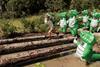
The first film, “Balloon Test,” is conceptually simple and visually satisfying. Two volunteers are seated beneath a crane-suspended water balloon containing, per the campaign’s framing, a full year’s worth of rain. The balloon pops. The deluge arrives. The camera crew, sensibly, had already left. The subjects, inside their Whistler Peak jackets with OutDry Extreme waterproofing, stayed dry. The spot opens with a disclaimer about water-filled lungs and public humiliation being “pretty much the best-case scenario,” which sets the tone efficiently.
The second film, “Sauna Test,” is more ambitious in its commitment to human discomfort. Twin brothers Craig and Simon are placed in a sauna located in the middle of a desert. Then, because a desert sauna alone apparently lacks ambition, a magnifying glass ceiling is added. Then a flamethrower operator. One twin wears the Diamond Peak Pro shirt, which carries Omni-Freeze Zero Ice cooling technology. The other does not. The gear, in both cases, stays humbly in the background doing its job while the humans look progressively more regretful.
Both spots were directed by Tim Bullock at Rogue Films. Ant Nelson, chief creative officer at adam&eve\TBWA, put the creative framework plainly: “Why test if a product is waterproof against an April shower when you can test it against a whole year’s worth of rain in one hit?” He framed this as a very valid question.
The question is gradually being answered.
The performance and outdoor category seems to be moving — not universally, but perceptibly — toward what might be called proof-over-promise creative: campaigns where the product is subjected to real, verifiable, occasionally alarming conditions rather than photographed in optimized ones.
The aspiration is still there — we see still too many staged images and vanilla videos — but it has shifted from the model’s expression to the technology’s performance. The risk, as with any format that depends on novelty, is diminishing returns. The first time you dump a year’s worth of rain on someone, it’s surprising. The fifth time, it needs to be a different kind of surprise.
How extreme can it go before it becomes weird?