Formula 1 has become a live test case for what happens when sport, fashion and music collide commercially. For sporting goods brands, the K-pop effect is no longer a curiosity — it is a strategy.
Formula 1 has become one of the sporting goods industry’s most commercially potent cultural platforms – and K-pop is accelerating the conversion. Brands including Adidas and PUMA are transforming team merchandise into premium lifestyle product as younger fans driven by identity and style collapse the boundaries between motorsport, pop music and fashion.
PUMA CEO Arne Freundt put it directly when the brand announced its official partnership with Formula 1: “Our new partnership with Formula 1 is an exciting opportunity to further explore this blend of motorsports and lifestyle. PUMA has always sat at the intersection of sports and fashion, and we feel we are in the perfect position to translate the culture of the sport into relevant streetwear collections and drive brand heat with a young, affluent, and diverse audience.”
The trend has a face – and it is currently wearing an unreleased jacket.
When K-pop arrives at the paddock, merchandise sells out
For the past couple of years, a single K-pop idol has generated higher media value than the biggest Hollywood stars. The case of Felix – the Australian-Korean singer, dancer and rapper, and a member of Stray Kids, one of K-pop’s best-selling acts globally – proves the point. Attending the 2026 Shanghai Grand Prix as a guest of Mercedes-AMG Petronas F1, he was already making headlines days before the race.
Visualizza questo post su Instagram
According to data published by influencer analytics platform Lefty in partnership with Karla Otto following the Louis Vuitton Women’s Fall-Winter 2026–2027 show on March 10, 2026, Felix generated an earned media value (EMV) of $14.1 million (approx. €13 million) – the highest of any K-pop artist at the brand – and also claimed the highest EMV among all male celebrities during Paris Fashion Week.
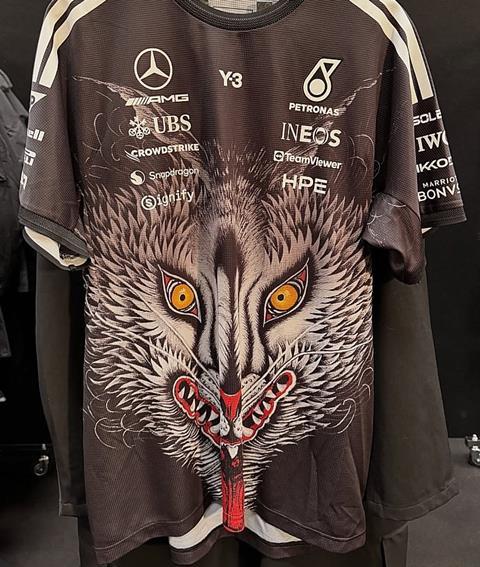
His influence did not stop there. When Felix was photographed in the Y-3 x Mercedes-AMG Petronas F1 collection – featuring a wolf motif designed as a callback to Yohji Yamamoto’s 2006 Adidas F50 design – demand surged immediately.
Within 24 hours of the official March 19 launch, the Team Jacket (retailing at approximately $900/€800) and the Wolf Graphic Jacket ($1,200/€1,100) had sold out across the Y-3 official site, Farfetch and Overkill, with resale prices more than doubling within days.
Esme Buxton, Founder of The Paddock Journal – a digital and print publication at the crossroads of fashion and motorsports – said that K-pop is now part of the mix, as this convergence signals a fundamental shift in how fandoms operate, with the boundaries between sports, music and style having completely fallen away.
“I think fandoms are no longer siloed to their one niche. The intersection of sports, music and fashion overlaps constantly. Enhypen are huge Red Bull fans, which means Enhypen fans are now interested in F1. The same with fashion – if you’re a Louis Vuitton fan, you are very likely to want to attend an F1 race, or at least see what the fuss is all about,” Buxton said, adding that F1 races have now become entire cultural ecosystems in themselves, much like sneaker culture or the world of K-pop, showcasing more entry points to the sport than ever before, and that’s the real thrill of it.
K-pop brings next-level fan engagement, high-gloss production and a fast-growing grip on music, fashion and digital media, with BTS and Blackpink smashing international records to prove it.
“You see this with creators online. An F1 creator will also post about their love of books or K-pop, and won’t have to look hard to find an audience who also loves both. It means that F1 can look for inspiration outside of the sport and work with ambassadors from other cultural sectors. It’s a win for everyone,” Buxton said.
According to the 2025 Global F1 Fan Survey published by Motorsport Network, 58 percent of Gen Z respondents and 58 percent of female respondents say fashion and lifestyle are part of their F1 fandom. As brand collaborations push F1 into new cultural spaces, it’s no surprise that the sport is tapping into the culture too.
Visualizza questo post su Instagram
When Enhypen’s Jay performed at the Singapore Indoor Stadium during his Walk The Line tour in October 2025 – wearing official Oracle Red Bull Racing gear and dedicating segments of the show to Max Verstappen – the moment spread immediately through both K-pop and F1 communities online. What had started as an organic TikTok of Jay in a Red Bull shirt at an Amsterdam soundcheck had evolved into a formal media partnership with the team by early 2026.
“When Enhypen’s Jay wore a Red Bull jacket on stage, it meant that Red Bull merch was now part of K-pop lore. We know that K-pop idols are some of the most influential ambassadors for brands, so it makes sense that F1 also wants to capitalize on this. When FROM FUTURE – a Parisian luxury house known for cashmere and silk – collaborated with Alpine, the aesthetic was purely fashion, which felt like a nod to K-pop culture rather than F1 culture,” Buxton said.
Buxton noted, however, that it is not K-pop alone fueling the momentum around F1 merchandise, but the broader intercultural crossover connecting people through the internet – and that is where the real impact lies.
The new fan formula – and what it means for sporting goods brands
Still, fandom alone won’t lock in a sport’s commercial future – it’s what fans actually buy that turns passion into lasting power. Buxton said that Gen Z now shapes F1’s future as its fastest-growing demographic, and their fixation on 1990s aesthetics is no accident – that was the era when F1 was at its absolute coolest.
The looks of Ayrton Senna and Michael Schumacher keep showing up on Pinterest boards, and the brands leaning hardest into that aesthetic are the ones winning the style game, explaining why PUMA and Adidas thrive in F1 by understanding that clothing has to reflect the culture.
Experts say merchandise is now keeping pace with Gen Z audiences through a range of collaborations with individuals and brands. This personal connection drives stronger purchasing behavior.
According to the 2025 Global F1 Fan Survey, 38 percent of Gen Z fans have purchased official team or driver merchandise – well above the 26 percent global average across all surveyed fans. Beyond the race itself, F1 has evolved into a fully fledged cultural movement where, for Gen Z and female fans alike, fashion, lifestyle and personal identity have become core components of their fandom.
| Gen Z fans |
38%
|
| Female fans |
39%
|
| Newer fans (≤5 yrs) |
36%
|
| Japan |
38%
|
| United States |
37%
|
Matthew Marsh of EDJ Motorsport Marketing observed a distinctly driver-centric and lifestyle-oriented shift among younger fans, marking a significant departure from the technical or team-based loyalty of previous decades. The 2025 Global F1 Fan Survey supports this: 41 percent of Gen Z respondents cite a specific driver as their primary reason for following the sport, compared with 25 percent who identify with a team.
| Follow F1 for a specific driver |
41%
|
| Follow F1 for a specific team |
25%
|
Marsh added that the driving force behind this success is the sport’s continued willingness to collaborate with other brands and to partner with figures likely to attract a Gen Z audience.
“It’s a fast-growing business. The Disney x F1 collaboration was a clear hit at the Grands Prix in China and Japan and also in-store with UNIQLO,” Marsh said. The Verdy x Yuki Tsunoda capsule – a limited-edition streetwear drop timed to the Japanese Grand Prix – sold out across the official F1 store and Verdy’s own webshop within 11 minutes of its April 3 launch. Engagement on Tsunoda’s social channels during the campaign ran 139 percent above his prior-season baseline, according to a marketing analysis attributed to Lefty and ListenFirst – achieved, as Marsh put it, “simply by mashing up F1 IP with proper streetwear.”
The momentum continues as F1 recently teamed up with Gentle Monster – a South Korean eyewear brand already favored by K-pop idols – with Charles Leclerc spotted wearing the collaboration for a Vogue China photoshoot.
“F1 is turning itself into a premium lifestyle brand, making the most of its wealthy audience and its growing intellectual property,” Marsh said.
“Since 2021, the enterprise value of the Formula One Group has grown by approximately 47 percent – from roughly $13 billion (€12 billion) to more than $19 billion (€17.5 billion) – a clear sign of a strategic shift towards high-end licensing and cultural branding. That momentum has pulled in the big names from luxury and lifestyle sectors. Adidas returned to F1 in January 2025 with a reported $30 million (€28 million) annual deal with Mercedes-AMG Petronas – its first major team partnership in the modern era and roughly five times the value of the previous Puma deal”
| Brand | Teams / scope | Notes |
|---|---|---|
| PUMA | Ferrari, Mercedes (to 2024), Red Bull (to 2022), Williams, Sauber, Aston Martin | Official F1 Supplier from 2024 — trackside staff and official merchandise |
| Adidas / Y-3 | Mercedes-AMG Petronas (from 2025) | First major team partnership in the modern era; reported $30m/€28m annually; replaced Puma and Tommy Hilfiger |
| Alpinestars | Red Bull, McLaren, Alpine, Haas, Racing Bulls | Technical performance focus — fireproof suits and boots |
| Castore | Red Bull (current), McLaren (current), Alpine (from 2025) | British sportswear brand; rapid F1 expansion from 2022 |
| Brand | Team(s) | Context |
|---|---|---|
| Under Armour | Red Bull Racing | Footwear and training gear, approx. 2017–2020 |
| Kappa | Alpine / Renault | Long-term apparel partner before Alpine transitioned to Castore |
| Asics | Red Bull Racing | Pit crew and staff footwear, approx. 2016 |
| Umbro | Williams | Kit and lifestyle apparel partner, 2020–2023 |
| Le Coq Sportif | Renault / Alpine | Official team apparel during Renault-to-Alpine transition |
| OMP Racing | Williams, Haas, Sauber | Technical fireproof suits and seating; competes with Alpinestars |
| Sparco | Alfa Romeo, Racing Bulls | Technical partner for racing gear and pit equipment |
| Reebok | Williams | Historical partnership; limited activity in recent seasons |
“What makes this so appealing is the fanbase itself. F1 followers are 1.6 times more likely than the general population to be high-net-worth individuals, according to Nielsen Fan Insights data – making them a very attractive target for premium merchandise. Looking ahead, the sport’s crossover appeal should drive growth beyond clothing too. F1 fans are far more interested in travel, music and food than non-fans, pointing to a future where merchandising moves into lifestyle and experiences,” Marsh said, adding that merchandise has become a key force, driving both the sport’s growing popularity and its revenue.
Once ruled by on-track performance, F1 is now just as shaped by what fans wear off it – and in a world where fandom, fashion and identity all blend together, winning the culture has become as important as winning the races.
We talked to
Esme Buxton is a British fashion photographer and the Founder and Creative Director of The Paddock Journal — a digital and print publication at the intersection of fashion, culture and motorsport, launched after she identified a gap in F1 media for culture-first editorial. thepaddockjournal.com
Matthew Marsh is the Founder and Managing Director of EDJ (Ecurie Drapeau Jaune), a Singapore-based motorsport marketing consultancy established in 2005, advising brands on commercial partnerships across Formula 1, Formula E, IndyCar, MotoGP and NASCAR. A former racing driver and F1 broadcaster across Asia, he previously served as Senior Vice President at Just Marketing International and Chime Sports Marketing, working alongside current McLaren Racing CEO Zak Brown. edj.hk

Eastern views
Asia-Pacific insights for the sporting goods industry
Analysis, insights, and expert perspectives on the sporting goods industry across Asia-Pacific — covering market trends, manufacturing, retail, and brand strategy from China to Southeast Asia to Oceania. With Jakarta-based contributing editor Yohana Belinda.
Explore Eastern views →