Saucony’s largest annual marketing investment to date spans a global brand platform, an invitation-only relay series and a China-specific campaign built around non-athlete ambassadors. A new CMO now inherits that direction, with no clear signal yet on what happens next.
Saucony enters the second half of 2026 with momentum on two fronts: accelerating commercial growth and what Wolverine Worldwide leadership has described as the brand’s largest annual marketing investment to date. The spending is visible across formats and markets: a global brand platform, film-led storytelling, experiential running events, fashion collaborations and China-specific social campaigns.
What connects them is a consistent focus on participation, community and running culture: Saucony sees growth opportunities beyond the narrow audience of competitive athletes.
One strategy, multiple expressions
The clearest example is Run as One, launched in March 2025 as Saucony’s first global brand platform. The campaign paired professional athlete Vanessa Fraser with creative collaborator Jae Tips and blurred the distinction between performance running and everyday movement. Instead of focusing on race results, the creative centered on the social and emotional connections that running creates.
That theme continued through subsequent campaigns. Run Home for the Holidays, which also featured Fraser and Jae Tips, translated the brand’s community-oriented messaging into seasonal storytelling, while The Runners, released in early 2026, moved further away from traditional product advertising.
The short film emphasized relationships, belonging and participation rather than footwear technology or competitive achievement.
Community as media
Saucony’s experiential marketing follows the same logic.
The invitation only Maze relay series, staged in cities including Paris, Seoul, New York, London, Jakarta and Madrid, replaces the predictability of conventional road races with team based challenges in unconventional urban locations. The events are designed to deepen engagement with local running communities and generate social content organically.
Visualizza questo post su Instagram
We have seen the same shift at other brands. As running participation expands, brands increasingly compete for cultural relevance and community loyalty, not just product performance. In that environment, local run crews and social running groups can be as influential as elite athletes.

A different approach in China
Saucony’s marketing in China shows how the brand is tailoring its playbook for local audiences while keeping the core message consistent.
A key platform is Hood to Coast China, the Chinese edition of the long running relay race that started in the United States. Unlike a traditional marathon, it is built around teams: runners split relay stages across a course of more than 140 kilometers. The format puts the emphasis on shared effort and community, which has made it a strong fit for Saucony’s recent push beyond elite performance. Saucony has backed the event for years and has used it as more than a sponsorship, connecting serious runners, run clubs and lifestyle consumers.
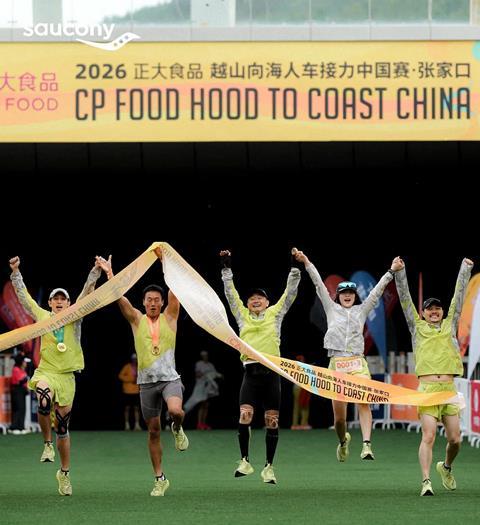
That approach took a new form in 2026 with the Victory Team campaign around Hood to Coast China’s Zhangjiakou race. Rather than signing professional athletes, Saucony built a five person roster from different fields: entrepreneur and scholar Mao Daqing, actor Zhai Yujia, journalist Gai Ke, lifestyle creator CC Yejiao 77, and medical science communicator Tu Baluo. The point was not race credentials, but showing how running fits alongside work, family and everyday life. The campaign ran mainly on Rednote (Xiaohongshu) and other Chinese platforms instead of Saucony’s global channels.
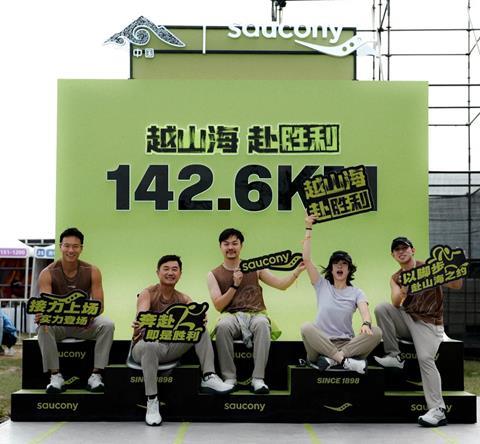
Even with local execution handled by Xtep, the campaign’s message stayed in line with Saucony’s broader direction. Like Run as One and The Runners, Victory Team put the spotlight on connection and shared experience, not podium results.
Marketing investment meets business momentum
Saucony is increasing brand investment while benefiting from strong commercial performance and growing global visibility. Wolverine Worldwide has highlighted major race partnerships, flagship store initiatives and expanded consumer focused events as part of the brand’s growth agenda. At the same time, several recent product launches have delivered some of the strongest commercial results in Saucony’s history.
Visualizza questo post su Instagram
The leadership transition
The most notable change during this period is at the top of Saucony’s marketing organization.
In May 2026, Saucony appointed Wendy Kula, previously Nike’s Vice President of Women’s Brand Marketing for North America, as Global Chief Marketing Officer. The role includes oversight of brand strategy, creative development and go to market execution. Because the campaigns discussed in this article were developed during Joy Allen-Altimare’s tenure, Kula’s appointment raises the question of whether Saucony’s community focused marketing direction will evolve or continue under new leadership.
Visualizza questo post su Instagram
So far, there is little evidence of a shift. The community-centered positioning introduced through Run as One still appears across markets, formats and consumer touchpoints, emphasizing community participation, local culture and everyday runners over elite-athlete performance.