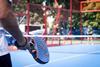
In Europe, growth appears to have been strongest in France, whose court total increased by 1,272 during 2024, the Global Padel Report for 2025 said.

Some 3,282 padel clubs opened over the course of 2024, according to Playtomic’s Global Padel Report for 2025. On average this amounts to nine per day, or 26 percent more than in 2023 (seven per day). Over the same period the world gained 7,000 padel courts, raising its total to 50,436, for a year-on-year increase of 17 percent (vs. 16% for 2023). This exceeds a forecast (presumably Playtomic’s own) of 50,416.

In Europe growth appears to have been strongest in France, whose court total increased by 1,272, an order of magnitude more than any other single country on the continent. The hotspot was the south, or “Padel Riviera,” with its Spanish and Italian influence, and the further influence of former pro sportsmen like Zinédine Zidane and Tony Parker. The Premier Padel Tour made its debut at Roland-Garros back in 2022.

Iberia (Spain, Portugal and Andorra) saw an increase (+1,077) comparable to France’s, while Italy (+365) seemed to cool, through competition from other sports. The Benelux (+548) and DACH (+431) regions saw considerable increases.

Padel

Source: Tomasz Krawczyk, Unsplash

In Europe, growth appears to have been strongest in France, whose court total increased by 1,272 during 2024, the Global Padel Report for 2025 said.

Meanwhile, in the UK (+329) padel “entered mainstream society” and demand for it was “high,” but that demand was not uniform. The sports’ top cities – London, Manchester, Bristol, Leeds and Dardy – make up a different list from that of the UK’s biggest cities by population (London, Birmingham, Liverpool, Nottingham and Sheffield).

Still, according to City AM, the UK is padel’s third-biggest market worldwide by revenue and fifth-biggest by games played.

The rest of Europe (+1,148) was comparable to Iberia and France and outstripped the entirety of Latin America (+873), whose major market was Mexico, with Brazil starting to stir.

Mexico’s top city for padel was not its massive capital, a place with potential, but Monterrey, a “highly developed market.” The sport reached cities of fewer than 200,000 people, too. Mexican clubs tended to be more expensive than Spain’s or Italy’s and were diversifying into Pilates, yoga and the like.

Brazil gained three courts per day for a sport Brazilians see as upscale, because of its association with Spain and clubs. But digitalization was high, and neighboring Argentina exerted an influence. Padel’s main Brazilian competitor, beach tennis, is cheaper, requires no court and is, well, beachy – Rio, of course, having one of the world’s most famous beaches.

Growth in the land of pickleball, the US (+352), was “steady” but restrained. But Playtomic is bullish on the country, expecting a “major expansion” in 2027 or so.

Last year padel’s growth there remained both scattered across the land and uneven where it had taken root. Clubs as close together as two miles “show alarming performance differences” – due, apparently, to things like digital infrastructure, management and neighborhood.

Padel was booming in Miami, the sport’s American capital, and catching on in nearby (and less-Hispanic) Fort Lauderdale. Houston was another hotspot, with Austin coming up among the other Texan cities. Next came southern California, with “limited” but “back to front” growth in Los Angeles. There were nascent padel scenes in New York City, Boston and Chicago.

To comment on America’s rival sport Playtomic quotes Santiago Gomez, CEO of Padel Haus: “Any racket sport, I think they all help each other out. I see the same with pickleball players trying padel for the first time. The conversion in most cases is one way, meaning people try padel and they just want to play padel; they don’t want to go back to tennis or pickleball. We have a 92% retention rate […].”

Asia (+270) remains a “long-term opportunity” for padel. Indonesia dominated growth in Asia-Pacific, but its players tend to be expatriates. Also growing fast were Thailand and Singapore, while Malaysia and the Philippines showed signs of activity and Hong Kong’s expensive real estate was driving padel clubs to the outskirts. Southeast Asia’s many payment systems were proving to be a hindrance.

Like France’s, India’s growth was in part the fruit of padel’s adoption by famous people – from Bollywood, cricket and tennis. And padel of the exclusive-club variety was turning out to be an alternative to golf and tennis for executives. The affluent make up a small share of India’s people, but the country’s population is so great that their absolute numbers are in the tens of millions.

Court numbers were up by a healthy bit in EMEA (+522), but a part of the region, the Middle East, has peculiarities – like “low digital value,” a preference for indoor clubs in the summer, and a preponderance at once of local investors and expatriate players. Qatar had almost no change in club numbers, because of government restrictions, and continued to separate courts by sex. The United Arab Emirates and Saudi Arabia were getting “very large clubs” and had little or decreasing separation by sex. Female players in the Middle East tend to be expatriates.

There was a different picture for padel in the context of gross monetary value, which Playtomic defines as revenue per court and month. The percentage rise by country was in the double digits throughout continental Europe, with Germany in the lead (48%). The rise was higher in the UK (74%) and lower in the US (40%), but the world’s standout was Indonesia (173%).

Playtomic’s forecast through 2027 is for growth (measured in new courts per year) at pre-Covid levels – or about 17 percent per annum. The lockdowns served as “bottleneck,” and the two subsequent years (2020-22) released the pressure with growth of 36 percent.

Playtomic has observed a transition in padel clubs from membership-only clubs to court conversion, regulatory adaptation, pay-to-play and, now, indoor clubs. Pay-to-play goes in tandem with digitalization, equipment rentals and, of course, open access. Itself running one of the top apps for padel booking and payment, Playtomic has a natural bias in favor of digitalization, and devotes a page of the report to its advantages.

The report concludes with the state of padel’s Olympic aspirations. The sport meets several of the International Olympic Committee’s criteria (many national federations, 60%-40% breakdown by sex among players, well-established rules, abidance by the World Anti-Doping Code, etc.) and has an avid lobbyist in the International Padel Federation (FIP), but, as Playtomic notes, is played at an elite level in only two countries: Spain and Argentina.

The list of sports for the 2032 Games in Brisbane will be set by the IOC in 2026.