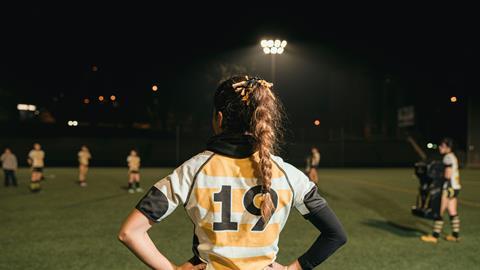
Women’s sports revenue is growing faster than at any point in history. Individual athletes are increasingly the engine of that growth – building audiences post by post, in a media landscape that still underserves them. The business case is overwhelming. The structural imbalance is, too.
Between 2022 and 2024, global women’s sports revenue grew 4.5 times faster than that of men’s sports, according to McKinsey. The sector crossed $1.88 billion (€1.78 billion) in 2024 – significantly ahead of Deloitte’s original forecast of $1.28 billion (€1.21 billion) – and is projected to reach $2.35 billion (€2.22 billion) in 2025. Commercial revenue, encompassing sponsorships, merchandise, and partnerships, already surpassed $1 billion (€946 million) for the first time in 2024, now accounting for 54 per cent of total industry income. These are not incremental gains; they represent a fundamental repricing of women’s sports as a commercial asset.
But the distribution of that momentum is uneven. A growing body of evidence shows an uncomfortable dynamic at the heart of it: much of the visibility work driving this boom falls not to broadcasters, federations, or leagues, but to individual athletes – on their own time, on their own accounts, often without compensation for the labour or protection from the consequences.
The engagement gap that changes the math
The broadcast picture has improved markedly. In the UK alone, a record 48 million viewers watched women’s sports in 2025, according to the Women’s Sport Trust (WST) Visibility Report published in February 2026 – up from 45.2 million in 2024 and the highest figure on record. Women’s sport now accounts for 8 percent of prime-time coverage on key UK channels, yet generates 13 percent of total prime-time viewer hours: audiences convert at a disproportionately high rate when the content is available.
On social media, the imbalance runs more starkly. At the 2024 Paris Olympics, female athletes received just 43 percent of competition news coverage, yet generated 53 percent of total social media engagement across TikTok and Instagram, according to research published by SportsPro and cited by Deloitte. The three top engagement drivers across all Olympic athletes were all women: Simone Biles (gymnastics), Ilona Maher (rugby sevens), and Suni Lee (gymnastics). Maher alone amassed 56.3 million followers across platforms during the Games, making her the most followed rugby player in history.
This matters commercially. Parity, the US-based sports marketing platform, tracks consumer behavior around women’s sports with unusual granularity. Its research shows that 20 percent of consumers follow individual women athletes on social media – ahead of the 18 percent who follow women’s teams and the 10 percent who follow women’s leagues.
Fans of women’s sports are 2.8 times more likely to buy a product recommended by a female athlete than one promoted by a traditional social media influencer.
Trust is the mechanism: 57 percent of consumers say they believe women athletes genuinely stand behind the products they promote, compared to 50 percent for male athletes. For brands measuring return on investment, that differential is significant. It also explains why athlete-led content consistently outperforms institutional content: WST data shows that during the 2025 Rugby World Cup, Maher’s Instagram content drove 41 percent engagement from females aged 13–34, well above the official tournament account’s 15 percent.
Revenue explosion – but concentrated at the top
The numbers at league level tell the same story. The WNBA (US Women’s National Basketball Association) began the 2025 season with a record 45 sponsors, 14 of them added in 2024 or 2025 alone, and accumulated 1 billion Instagram views over the course of 2025 – the highest of any women’s sports league or property globally, according to WST. The WNBA’s new broadcast deal, worth $2.2 billion (€2.08 billion) over 11 years, takes effect in 2026.
The NWSL (US National Women’s Soccer League) quadrupled sponsorship revenue over five years, reaching approximately $60 million (€56.76 million) in 2024. The NIL (Name, Image, and Likeness) rights market – through which college athletes in the US monetise their personal brands – is projected to exceed $2.5 billion (€2.37 billion) globally by end of 2026, evidence of how athlete-driven commercialisation has become the dominant value-creation mechanism in women’s sports.
Non-endemic brands have entered the space in force.
Luxury and lifestyle companies that historically avoided sports marketing are now signing women athletes: Tiffany & Co. created bespoke champions’ crowns at the Athlos athletics event in 2024; Dior signed Zheng Qinwen, the first Asian tennis player to win Olympic singles gold, as ambassador; Paula’s Choice named Maher as its first-ever brand ambassador. The Fortune 500 companies investing in women’s sports sponsorships across multiple leagues grew sixfold year-on-year, according to platform data tracked by Gather.
Yet this growth concentrates overwhelmingly in basketball and soccer, and predominantly in North America. Beyond marquee leagues, the picture remains uneven. Many female athletes – particularly in endurance sports, rugby outside the top tiers, athletics, and team sports outside the US – still combine elite competition with unstable income. The average gross salary for a professional women’s soccer player globally remains just $10,900 (€10,313), according to FIFA’s benchmarking data, a figure dragged down by lower-tier leagues where commercial infrastructure barely exists. Social media sponsorships bridge part of that gap. But they do so by shifting responsibility from institutions to individuals.
The infrastructure still missing
Laura Elbers, co-founder of German sponsorship platform Equal Champs – which connects brands with female athletes seeking partnerships – describes a structural transfer of labor that has happened quietly alongside the commercial boom. Where federations, broadcasters, and clubs once carried much of the visibility work, individual athletes now do it themselves. Not all of them are trained content creators, Elbers observes, yet all of them are expected to function like one: defining a personal brand, producing sponsor-ready content, managing audience relationships – all alongside elite training schedules. “All brands want authentic storytelling,” she says, “even though few can precisely define what they mean by it.”
On compensation, Elbers is explicit: many athletes accept underpriced partnerships out of gratitude or necessity rather than negotiation. The most durable collaborations, she argues, are structured around duration and flexibility, not fixed output schedules that collapse the moment an athlete is injured or deep in competition season. Follower counts still matter, but brands are increasingly targeting mid-tier profiles – roughly 10,000 to 30,000 followers – where audience credibility outweighs raw scale.
Simone van Slingerland, who runs communications agency Eyesprint, observes the same dynamic from the brand side. Metrics fluency has improved significantly: engagement rates, demographic data, and audience overlap are now standard in partnership conversations. But data does not replace fit. “It has to be a 100 percent match,” she says. On compensation: “You can’t buy a sandwich with product.” The industry’s fondness for product-only deals remains a structural problem for athletes who lack either the leverage or the experience to push back.
Maher’s own account of her commercial approach captures the contradiction precisely. She told Sky Sports in January 2025: “I am not going to sign a million-dollar or six-figure contract anywhere. We need to go about it in a different way. I saw how useful social media can be, and I think what sets the women’s game apart is we are comfortable showing our personalities.” Her Bristol Bears debut – relocated to Bristol’s Ashton Gate’s 27,000-seat stadium in response to unprecedented ticket demand – illustrated the commercial reality of athlete-driven visibility in practice. The club recorded a 9.3-times increase in Instagram engagement from the moment of her signing, according to WST data, and broadcast audiences rose 281 percent for matches in which she featured.
The hidden cost: labor, abuse, and inadequate protection
The commercial case for female athletes’ social media presence is now well-documented. The cost side receives significantly less institutional attention.
Content creation has become a professional obligation in its own right – one requiring time, equipment, and often a support team. Elite athletes managing active accounts increasingly rely on photographers, videographers, and social media consultants to maintain the consistency and polish that brand partnerships demand. For those without resources to outsource, the work sits on top of full-time training schedules. The result is a labor arrangement embedded within the commercial infrastructure of women’s sports that is rarely acknowledged and almost never compensated.
The psychological toll is more extensively studied than it once was – and the findings are troubling. A 2025 study by Sheffield Hallam University, published in the Journal of Communication & Sport, analyzed 52 policies across UK football, rugby, and cricket organizations and found that female athletes face 19 percent more online harassment than male athletes, with no clubs maintaining differentiated safeguarding policies for women’s sports. Discriminatory views toward female athletes increased 44 percent year-on-year between 2023 and 2024, per data from anti-discrimination organization Kick It Out. Female athletes were explicitly named in just one policy document across the 52 examined.
A study published in January 2026, led by researchers from Loughborough, Chester, Hull, Durham, and Manchester universities, examined misogynistic online rhetoric on X through the case of former UK footballer Joey Barton – convicted in November 2025 of six counts of grossly offensive communications targeting two female players and a pundit. The researchers found that high-profile influencers amplify abuse in ways current moderation systems cannot contain, and called for immediate reforms to platform-level responsibility. Their conclusion: “We are witnessing a pivotal shift where online impunity is finally meeting real-world retribution – financially and legally – for perpetrators. However, the cost for the victims remains unacceptably high.”
The NCAA’s 2024 pilot study of 1.3 million social media posts targeting student-athletes found that women’s basketball players received approximately three times more threats than men’s basketball players. World Athletics, which has monitored online abuse since Tokyo 2020, was tracking 1,917 athletes across four platforms by Paris 2024. Racism, sexism, and sexualized abuse were constants across all four years of data.
The WST’s own analysis adds a specific dimension rarely discussed in commercial coverage: that in the 2025 Rugby World Cup, Sarah Bern’s Instagram video addressing body image reached 8.7 million views in November 2025.
Athlete-led storytelling drives awareness, relevance, and engagement – and also, reliably, exposure to the worst of what online audiences deliver.
The structural question
The broader dynamic is one the industry still largely sidesteps. Women’s sports revenue is growing because audience engagement is growing – and audience engagement, increasingly, is individual-athlete-driven rather than institutionally generated. The gap between what is available and what audiences want has not closed; athletes are filling it themselves.
That is not a neutral arrangement. It concentrates commercial reward among those with the resources or media fluency to compete online. It exposes those individuals to harassment at rates that male athletes do not face and that governing bodies have not addressed. And it transfers responsibility for the visibility work that underpins an industry’s commercial growth from institutions to individuals who are, in most cases, not compensated for it.
McKinsey’s analysis projects that closing the monetization gap fully will require investment in dedicated facilities, innovative media distribution, and sponsorship structures that move beyond traditional models. Deloitte frames the same challenge: future growth depends on bold, collective action from sponsors, organizations, broadcasters, and platforms – not on individual athletes managing that alone.
Social media can accelerate equality in women’s sport. The engagement data is unambiguous. But the labor, the abuse, and the structural dependency on individual athletes to substitute for institutional infrastructure are a cost that is not yet priced into the commercial model – and until it is, the market’s headline growth figures will continue to obscure as much as they reveal.
Sources
- Deloitte, “Beyond the Billion-Dollar Barrier,” March 2025
- McKinsey, “Closing the Monetization Gap in Women’s Sports,” August 2025
- Women’s Sport Trust Visibility, February 2026
- Parity, “Beyond Viewership,” 2025
- Wasserman/The Collective, cited in SportsPro, November 2024;
- Sheffield Hallam University, Journal of Communication & Sport, 2025;
- European Sport Management Quarterly, January 2026;
- NCAA, Online Harassment Pilot Study, October 2024;
- World Athletics, Four-Year Online Abuse Analysis, 2024;
- FIFA Benchmarking Report, 2024
- Sponsor United Intelligence