In less than three years, Italy will be hosting the Milano Cortina Winter Olympics 2026, and some recent estimates are alarming. According to a new report by the Italian environmental group Legambiente, Italy’s ski industry heavily relies on artificial snow due to climate change. Nine out of ten Italian ski slopes are suffering from a lack of natural snow and depend on artificial snowmaking. Italy is actually the Alpine country most dependent on artificial snow, with 90 percent of slopes covered with it, followed by Austria (70%), Switzerland (50%), and France (39%). Germany boasts the lowest percentage in the lot (25%).
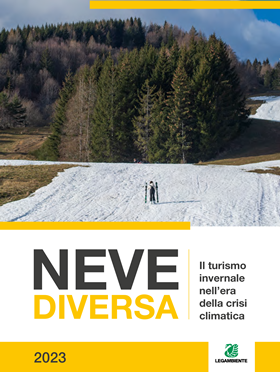
The report, titled “Nevediversa 2023:Winter tourism in the era of the climatecrisis,” explains that 2022 was the hottest and driest year in over two centuries in Italy and the second hottest in Europe. In the Italian Alps, it snowed half as much as usual during the winter season. When the flakes finally fall, the temperature is often higher than average, and the snow rapidly melts. Out of 224 mountain communities in Italy located in ski resorts or their close proximity, 22 municipalities witnessed an increase in the average temperature of 3 or more degrees Celsius from 1961 to 2018. In Aprica and Teglio, both in the province of Sondrio, the increase during that timeframe was even 3.9 degrees.
High temperatures also lead to water scarcity, and human-made snow requires massive amounts of energy and water to produce. Using satellite images, Legambiente mapped 142 artificial lakes near Italian ski resorts that are primarily used for artificial snow, according to the organization, for a total area of around 1,037,377 square meters. Incidentally, it is a default estimate that does not include the numerous reservoirs under construction or in the design phase and the ones that are not easily identifiable, adds the report. Trentino Alto Adige has 59 artificial lakes, followed in this particular Top 3 by Lombardy with 17 and Piedmont with 16.
This situation affects the country’s ski resorts, 249 of which have been closed, while another 84 open and close depending on snowfall.
The report’s conclusions advocate a shift to year-round, diversified and environmentally friendly mountain tourism, calling it “the turning point for the future.” This approach requires not only money, says Legambiente, but also “a comprehensive project with new cultural foundations.”
The full 191-page report “Nevediversa 2023” is available for download on the Legambiente website.
Winter Games 2026
Podiums and Products
How sporting goods companies partner with athletes and compete for Olympic success—products, activations, messaging, and strategies.
EXPLORE THE SERIES