Patagonia sued US drag activist and environmentalist Pattie Gonia because of “consumer confusion” in a claim which stressed the threat to the reputation of the brand caused by the alledged infringement. The question is whether the lawsuit does more damage than the alleged violation.
It was an incident in Jan. 2026 seemingly so inconsequential that it warranted only a small sentence on our sister publication Outdoor Industry Compass: “Patagonia has filed a trademark infringement lawsuit against drag activist Wyn Wiley, known as Pattie Gonia, seeking to stop merchandise sales that it says … infringe on its brand name.” But a statement released by Pattie Gonia on 27 May, 2026 has brought the matter into focus and to a huge global audience.
It’s important to start by saying that the writer of this article is not an expert in the complex labyrinth of US trademark laws. But neither is the vast majority of the general public and consumer base. And that is exactly what matters in this case. The real issue here isn’t about the ins and outs of trademark law; it’s about the optics of a now high profile case and the damage it could potentially do to Patagonia’s reputation.
What’s Patagonia’s issue with the drag queen Pattie Gonia
First, the key points of the complaint:
● On Jan. 21, 2026 Patagonia filed a lawsuit against drag queen and activist Pattie Gonia;
● The complaint was filed in response to Pattie Gonia’s own trademark application for her name, apparel, online marketing, and activist events;
● Patagonia claims Pattie Gonia’s application “compete[s] directlywith the products and advocacy upon which Patagonia built its Patagonia brand over the last fifty-three years;”
● If Pattie Gonia becomes a commercial enterpriseit will “confuse consumers,” the complaint adds.
The key points of Patagonia’s argument:
● They are not against “art, creative expression, or commentary about our brand”;
● It’s not about the money. They are requesting only a symbolic one dollar settlement;
● There have been years of discussions with Pattie Gonia to try and resolve this issue, according to Patagonia (and the claim provides email evidence to back this up);
● Pattie Gonia had agreed to refrain from using the term “Pattie Gonia” and the iconic P6 mountain silhouette as a brand or in commercial activities;
● Pattie Gonia violated this previous agreement, leaving Patagonia no choice but to sue according to both the complaint and astatement released by Patagonia in January, 2026;
Patagonia’s complaint essentially boils down to three strands: preventing the commercialization of “Pattie Gonia”, protecting the Patagonia brand, and avoiding potential customer confusion.
The key points of Pattie Gonia’s counter argument:
● Pattie Gonia is named after the region, not the outdoor brand;
● They do not sell the “fan art” parody of the P6 mountain logo (examples of which are included in the lawsuit) as merchandise;
● Pattie Gonia merchandise features only new, original designs.
When it comes to the commercialization of her brand and her own trademark application, Pattie Gonia says she took such action to protect her name, citing the example of fellow drag artist and RuPaul’s Drag Race contestant Lexi Love, currently engaged in atrademark dispute over her name, resulting in lost social media presence and the withdrawal of her music from streaming platforms.
A one dollar settlement does give Patagonia the right to assert that “It’s not about the money.” Unfortunately, that doesn’t take into account legal fees, which Pattie Gonia says could be as high as 1 million USD.
Visualizza questo post su Instagram
The question of harm and customer confusion is at stake
A quick google of US trademark law reveals that there are several ways to defend against an accusation of trademark violations. One is fair use. For example, calling your deli “New York Bagels” when it’s based in New York.
This is one defence Pattie Gonia is clearly opting for, claiming that her stage name comes from the region, not after the brand. It’s an interesting tactic too, because Patagonia has a strong record of protecting ancestral lands and indigenous stewardship.
To claim ownership of a name which comes from a region doesn’t chime well with a brand that, as its own lawsuit asserts, is built on “responsible business practices and corporate citizenship.” It may open up Patagonia to accusations of co-opting and colonial-like corporate behavior from observers of the lawsuit. Comments on Pattie Gonia’s social media posts are already taking this stance with one user saying, for example, “you’re bringing a real colonizer energy by insisting you own the name of 400,000 square miles of South American land. Boo hiss.”
A second defence is lack of customer confusion. In the claim, this is an angle pushed by Patagonia. It says: “Consumers are already confused about whether Pattie Gonia is affiliated with Patagonia.” Patagonia include a screenshot from social media with comments highlighted, showing users confusing Pattie’s content for Patagonia’s.
But crucially, when it comes to the optics of this lawsuit for Patagonia, it does not seem as if this confusion is causing Patagonia harm. In fact, it seems the opposite. Above the highlighted social media comment in the claim, is another (not highlighted) which states: “It looks like Patagonia has it together. I’ll happily spend my money there.”
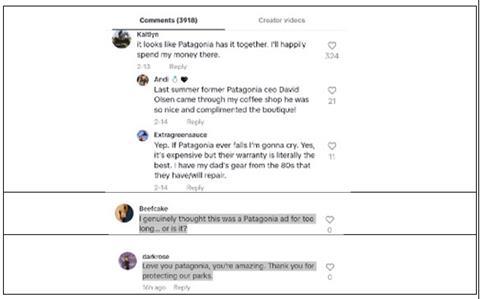
Pattie Gonia’s 1.7 million followers love any perceived crossover or implied endorsement by Patagonia.
Additionally, parody and satire are protected speech in the US and are also defences against trademark violation. With one caveat however: They must not mislead consumers. If Pattie Gonia’s merchandise could be mistaken as Patagonia, whether deliberately or not, it is harder to rebuff the claim of violation.
Editor´s note: In the EU, courts see this much the same way. EU laws protect parody, but a performer still cannot use a famous name to take unfair advantage of a brand or confuse the public.
Patagonia has “no choice” but to protect its trademark
There is a statute of limitations in US trademark law which compels brands to be active in protecting their trademarks. Brands cannot wait too long to file a claim or they may forfeit their right to enforce. And a trademark has to be actively defended (enforced) in order to continue to be valid. Any abandonment of a trademark makes it vulnerable to being revived by somebody else.
This appears to be Patagonia’s main sticking point: That in order to protect its brand from other misuses – which may not align with Patagonia’s core values so clearly as Pattie’s environmental and social advocacy does – it has to defend its trademark. If not, it opens itself up to anyone taking the Patagonia brand and using it for their cause; in particular hate groups and other bad actors. Examples from fracking and the oil industry are included in the claim.
A shorter statement released by Patagonia on May 27, 2026 – likely in response to renewed interest in the case – doubles down on this. It states the lawsuit is not about financial gain nor challenging anyone’s right to advocacy but protecting the brand of Patagonia. “Protecting the Patagonia trademark is part of protecting the ability of this company to continue doing that work in the future … The last thing we wanted was a legal fight with someone who shares our values, but we must protect our business and employees.”
But if this is Patagonia’s fear, it has not been clearly communicated to the consumer, the outdoor community, and Pattie’s supporters. And to the layman, Patagonia doesn’t seem to meet the criteria of going dormant or displaying a lack of public visibility which would necessitate such action.
Again, the optics do not seem to be in Patagonia’s favor.
Issue of anti-LBGTQ sentiment cannot be overlooked
What is not in question in this case is the current highly-charged atmosphere surrounding LGBTQ+ rights in North America and beyond. The issue is crossing over into retail, with the actions (or not) of businesses and their declared stances (or lack thereof) on issues affecting the LBGTQ+ community being closely scrutinised by certain sections of the public and dictating where consumers spend their dollar (or not).
Some observers have questioned whether the lawsuit would have arisen had there not been such hostility towards the queer community – which includes drag artists – in the US. They once again see Patagonia’s filing of the lawsuit at this time as a mis-step, which plays into the hands of those seeking to erase drag and queer culture. Surely not exactly the activism Patagonia would like to be known for.
When it comes to the suggested confusion surrounding Patagonia, Pattie Gonia and the outdoor brand’s endorsement of Pattie, some have asked: Why would it be a problem for Patagonia to endorse Pattie Gonia when her platform is one of environmental advocacy, and climate protection?
Clearly, Patagonia cannot trademark activism, but there is a paragraph in the claim which points to the “overlap” between the social activities of Patagonia and Pattie Gonia: “Pattie Gonia filed a trademark application seeking the exclusive rights to use the brand “Pattie Gonia” to sell clothing and apparel, promote environmental activism, engage in online marketing and endorsements, and more. These rights would directly overlap with the work we do and the products we provide.”
Once again, to the layman, it almost sounds like Patagonia is trying to trademark environmental activism. Does this open up Patagonia to the criticism that it’s OK with activism, but it has to be a particular type of activism from a particular type of person?
Verdict from Court of the Public may be just as pivotal
Each of the three Instagram posts from Pattie Gonia on the subject have already received thousands of comments and hundreds of thousands of likes. The video alone has 329k likes and 17k comments to date, the majority of which express dissatisfaction with Patagonia and an intention not to buy from the brand until it drops the lawsuit.
On May 28, 2026, Google Trends had Pattie Gonia with the highest possible interest it’s possible to have. The lawsuit has now reached international mainstream news outlets worldwide. Patagonia’s latest social media posts are flooded with comments about the lawsuit, most against continuing with the claim.
One thing is for sure: This is not a one-line news story for Patagonia anymore.
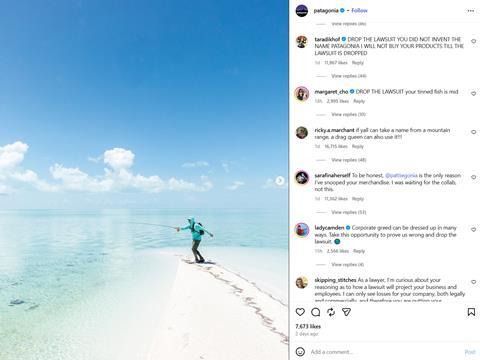
At the heart of the claim is the threat to Patagonia’s reputation as a responsible company and its commitment to environmental and social activism caused by Pattie Gonia’s alleged trademark violation. And the goodwill this generates amongst consumers.
“While Patagonia seeks only nominal monetary damages, the harm Pattie Gonia has caused and will cause to the Patagonia brand is irreparable and cannot be remedied by money damages or other remedies short of an injunction.”
But when it comes to reputation, it may be that filing the claim and the somewhat bland statements released by Patagonia which do not properly address the potential poor optics being pointed out by Pattie’s supporters could do more damage.
As one Instagram user puts it, “The act of suing you causes far more damage to their brand in an instant than [Pattie Gonia] ever could in a lifetime.”