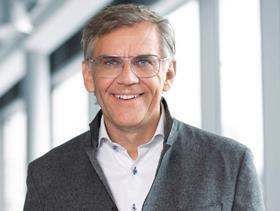
New Balance recently predicted that its sales would grow by about 30 percent to $4.5 billion in 2021, which would likely keep it as the sixth largest sports brand in the world. Reaching a new record level, a similar increase was booked last year in Europe, said Mathias Boenke, a 56-year-old German executive who became senior vice president for the EMEA region last June, returning to the brand from Intersport.
In an interview, Boenke also said that the the brand’s European turnover is likely to go up this year to more than €1 billion, in line with continued strong global growth of around 25 percent, with a potential for doubling within the next five years.
As with other brands, the recent and projected growth in revenues would have been higher without the current Covid-related and supply chain challenges. The factory lockdowns in Vietnam last summer cut the overall footwear supply by about 10 percent, although, the company continued to do prototyping and to assemble shoes in the U.K. as well as in the U.S.
Underlining this strategy, New Balance recently opened a new $33 million plant in the U.S., located in Methuen, Massachusetts, that was described as the “factory of the future” by Jim Davis, the company’s owner and chairman. It was the first investment of the kind in more than two decades.
The company already has five other plants employing 1,300 workers in New England. Its English plant in Flimby still makes about 5 percent of the premium shoes distributed by the brand in Europe. In contrast with other athletic footwear brands, in-house manufacturing is intended to keep craftmanship levels high and to ensure the production of the brand’s premium ranges, explained Boenke.
Deliveries to the brand’s European retail partners are likely to run more smoothly in January and February, Boenke said, although the Covid epidemic recently hit some of the 250 workers at the company’s production facility in the U.K. Furthermore, port congestions in China continue to be a problem that is likely to see ongoing disruption through the first half of this year and into the early part of the second half.
One positive factor has been the start-up in October of New Balance’s new, fully automated distribution center at Venlo in the Netherlands, which cost some €50 million, adding to its logistics facilities in the U.K. Poland and Italy.
Stressing the wholesale channel
Boenke believes that New Balance can maintain and build up on its strong market position by capitalizing on its strong heritage and its values in closer cooperation with selected retail partners, instead of running in competition with them through an all-out development of its direct-to-consumer (DTC) operations - like some other sports brands.
As previously reported, New Balance has taken over the distribution in the last six years from its former wholesale partners in Italy, Spain, the Nordics, Poland, France, the Benelux countries, and most recently, the Czech Republic, Slovakia and Hungary. It now has about 85 percent of its European business under control.
The process has paved the way for New Balance to work more directly and more selectively with its retail partners in the region. It also has allowed them to have access to a wider range of products and to obtain better service on reorders and never-out-of-stock programs for certain items. Presumably, this has also allowed New Balance to improve conditions with key accounts in exchange for the purchase of bigger packages of products and cooperation in marketing and merchandising.
As a private company New Balance is not under pressure from outside shareholders. As Boenke pointed out, it directly manages a policy of re-investing profits into domestic manufacturing, green-led initiatives, and research and development programs. A strong team culture has strengthened New Balance’s ability to meet the problems associated with Covid and supply chain snarl-ups, according to the executive.
While company officials decline to discuss the extent to which the takeover of the distribution has contributed to the company’s European sales growth in the last years, Boenke said that New Balance is now dealing with fewer retail clients than five years ago in Europe, but it is working more deeply with them.
As running shoes are its main product category, New Balance generally insists that running specialists should place at least 15 to 25 percent of their orders with its brand.
In its relations with generalist retailers, many of which are attracted by its highly popular lifestyle items, New Balance wants them to collaborate in the brand’s diversification process by placing orders from its wider range of products including its apparel and its offerings in the football and basketball categories.
While the emphasis of the diversification process has been more in the areas of basketball and baseball in the U.S., the emphasis is more on football in Europe, where the brand sponsors leading football clubs like Lille in France and Roma in Italy.
Classical heritage lifestyle sneakers like the 574, which remains strong and is the brand’s No.1 franchise, as well as the 550 and the 530, are currently enjoying “outstanding brand heat,” especially among younger consumers, Boenke noted.
They have come to represent a significant percentage of its turnover on the continent, but New Balance wants multi-sport retailers to ensure a better balance between these “must-have” lifestyle products and its performance-oriented items in their stores, to convey the full story of the brand. The 1080, the 800 series and the Herro trail running shoe are leading the charge for New Balance’s performance portfolio.
On the other hand, in contrast with some other brands, to help the dealers, New Balance wants the share of its DTC operations to stay in a range of 25 to 30 percent of overall revenues for the foreseeable future. Online sales represent around 25 percent of the DTC business globally, but they vary in Europe from one country to the other.
As previously reported, all the 22 mono-branded stores in Spain are closing down, following the termination of a temporary franchising agreement. It plans to set up a new, directly managed retail structure across Spain and Portugal, starting with the opening of five to ten stores this year at key locations.
As of March 1, the company’s Iberian subsidiary is going to be led by Angela Scheidgen Alvarez. She is the daughter of Anna Scheidgen, who is planning to retire after 45 years of association with the New Balance brand and its former Spanish distributor, Alfico.
As of now, New Balance has 98 directly owned mono-brand stores in Europe, including 44 outlets, as well as 145 partner stores, in addition to its European e-commerce platform.
Boenke believes that existing wholesale partners can play a key role in highlighting New Balance’s values and the brand’s unique identity to the consumer through the establishment of effective and close working relationships for the long term. At the same time, the brand is seeking to position DTC and wholesale as an essential and powerful combination to reinforce the brand’s distinctive strengths.
Boenke has already demonstrated at Intersport that he is a consumer-focused believer in omni-channel operations that can provide a seamless transition for the customer from the online to the offline channel, where the best multi-brand retailers will continue to have a strong position, in his opinion.
Based at New Balance’s European office in Amsterdam, which takes care mainly of finance and DTC operations, Boenke returned to the company last June after an absence of 15 years. He had already run New Balance’s German operations from 2001 to 2006. After spending seven years as sales and marketing officer for a German clothing group, Boenke developed useful insights for his relations with wholesale partners on the other side of the fence, working for Intersport in Austria, Poland and Germany.
After giving a remarkable impulse to the Austrian Intersport organization, which had suffered from the pull-out of its biggest retail member, Boenke moved to Germany to be in charge of category management, strategic purchasing, marketing, communications and digital expansion. He also sat on the board of Intersport International Corp. for a couple of years, until his departure from Intersport Germany in October 2020.