The deal positions a Hong Kong sports science startup at the intersection of two accelerating trends: the consumer shift toward biological self-monitoring and growing Asian capital flows into global fitness tech.
Wearable patch PointFit raises funds to displace heart-rate tech
Seveno Capital has invested in PointFit, a Hong Kong-based startup developing a skin-worn patch that monitors the body’s chemistry through sweat, in a deal that values the company at $10 million (€9.2 million). The transaction, announced March 9, marks the first investment from Seveno Capital’s newly opened Hong Kong office and the inaugural deal led by incoming Partner Jean-Baptiste Roy.
From wristband to skin patch: what the category shift actually means
Wearable fitness technology has evolved in distinct generations. The first was the heart-rate chest strap, a sensor worn during training that transmitted a single metric to a watch or cycle computer. The second was the smartwatch and fitness band — a wrist-worn device that added step counting, GPS tracking, sleep monitoring, and, eventually, estimated stress and recovery scores. Both generations share the same underlying logic: they observe external signals such as movement, electrical activity, or light absorption through the skin, and calculate what is probably happening inside the body.
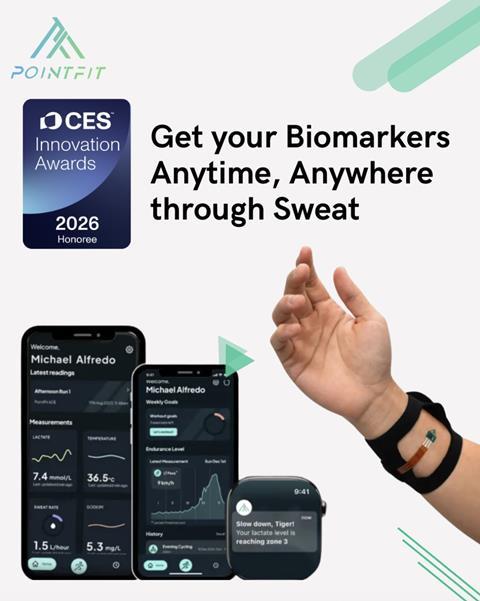
PointFit’s patch represents a different approach. Worn directly against the skin like a plaster, it reads the body’s chemistry through sweat rather than inferring it from physical signals. That is not a refinement of what came before — it is a different category of measurement entirely.
The simplest analogy is the continuous glucose monitor now widely used by people managing diabetes: a small patch that replaces periodic finger-prick blood tests with a constant stream of data. PointFit is applying the same principle to endurance sport, starting with lactate.

Why lactate — and why it has been so hard to measure
Lactate is produced by muscles during intense physical effort. The rate at which it accumulates in the bloodstream is one of the most useful indicators in endurance training: it reveals when fatigue is genuinely setting in, where an athlete’s true aerobic and anaerobic thresholds lie, and how effectively the body is recovering between hard efforts. Coaches and sports scientists have long relied on lactate data to design training programs and manage athlete load.
The problem is access. Measuring lactate accurately has historically required stopping mid-workout for a small blood sample — typically taken from a fingertip — analyzed either in a laboratory or with a dedicated portable device. The process is invasive, disruptive, and largely confined to professional sport and elite research environments. PointFit’s patch performs what the company calls Continuous Lactate Monitoring (CLM): reading lactate levels in real time, through sweat, without needles, blood, or interruption to training. The platform is designed to expand over time to track additional biomarkers including electrolytes and sweat rate.
The company, incubated at the Hong Kong University of Science and Technology (HKUST) and supported by the Creative Destruction Lab accelerator, received a CES Innovation Award in Digital Health at CES 2026 in Las Vegas, signaling growing recognition in the North American sports and venture communities. It has conducted product demonstrations with sports federations, fitness equipment manufacturers, and retailers.
What this means for sporting goods brands and retailers
For brands and retailers operating in endurance sports — running, cycling, triathlon, and multisport — the emergence of consumer-grade biomarker monitoring raises a practical question about where wearable technology goes next. The first generation of fitness wearables created a large and durable accessories market. A second generation anchored to direct biological measurement could reshape how performance products are designed, sold, and differentiated.
The competitive implications extend beyond dedicated sports tech companies. Established players in the wearables space — including Garmin, Polar, and Whoop, as well as the broader smartwatch ecosystem led by Apple and Samsung — have built dominant positions on activity tracking and heart-rate-based metrics. A validated patch format capable of delivering richer physiological data at comparable price points would introduce a new competitive tier above the current category ceiling.
Seveno Capital cites analyst projections that the global wearable market will double to reach $200 billion (€184 billion) in total addressable market by 2030, driven by consumers shifting from basic activity tracking toward clinical-grade biological data. Those figures are company-cited rather than independently verified, and wearable market sizing varies considerably across research sources; they should be read as directional context rather than established benchmarks. More specific is PointFit’s own estimate of a $15 billion (€13.8 billion) serviceable market among dedicated endurance athletes.
The longevity economy as demand driver
The broader commercial context for PointFit’s pitch is the convergence of athletic performance with longevity and metabolic health — one of the most significant shifts reshaping the fitness sector in 2026. Consumers who once bought sports products primarily for competitive or recreational reasons are increasingly motivated by long-term health optimization. That shift is driving investment across gym chains, connected fitness platforms, supplement brands, and health technology startups.
Real-time biomarker data delivered reliably at consumer price points would accelerate that convergence, extending access to physiological insight previously available only to professional athletes or clinical research subjects. For endurance-focused sporting goods brands and their retail partners, that development could eventually inform product recommendation, training program integration, and loyalty mechanics — extending the commercial relationship well beyond the initial transaction.
The investment also fits into a pattern Seveno Capital explicitly references: the growing role of Asian capital and innovation in global sporting goods and fitness technology. The firm draws a parallel with Anta Sports’ acquisition of a 29 percent stake in Puma in January 2026, framing both as evidence of cross-border consolidation originating from Asia.
About
PointFit is a sports technology startup founded in Hong Kong and incubated at the Hong Kong University of Science and Technology. Its first product focuses on continuous lactate monitoring through a non-invasive sweat patch. The company is additionally backed by Creative Destruction Lab, a global science-based accelerator network. Kenny Oktavius is co-founder and chief executive.
Seveno Capital is a Singapore-based venture firm focused on human healthspan technologies, with investment activity across Asia, Europe, the Gulf region, and North America. The firm opened its Hong Kong office with the PointFit transaction. Allen Law serves as Principal; Jean-Baptiste Roy joined recently as Partner with a background in sports technology and human performance investing.