Extreme sports as a platform: The German extreme athlete approaches projects strategically. Adventures become stories – and from there, reach and business. How this system works and where its limits lie.
This man’s job is adventure. Thousands of kilometers through deserts and mountains, a triathlon around the world, 120 Ironman races in 120 days – Jonas Deichmann’s projects are extreme. But they are more than just athletic feats. They are the foundation of his business model. The Adventurer is less of a record-breaker than a storyteller – and his projects are one thing above all else: adventures that can be translated into content, reach, and partnerships. His motivation is not only athletic ambition but also the desire to maintain maximum independence – as an athlete and as a brand.
The turning point: triathlon around the world
The Stuttgart native embarked on his career as an adventurer in 2018. As early as 2017, he had set two records: the fastest cross-country bike ride through Europe and Eurasia – on his own and without external support. However, attention for these records was largely limited to the outdoor community. Deichmann came more into the spotlight with his 2019 Cape-to-Cape tour. But it was with his round-the-world triathlon (2020/2021) that he achieved his breakthrough – a project that allowed him to “break out of the bubble” and that shows what drives him: not just performance, but stories.
A mass phenomenon in Mexico: the German Forrest Gump
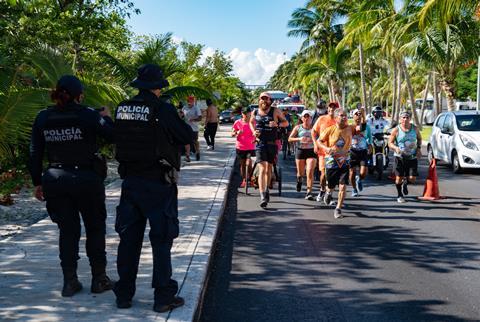
In Mexico, the media turned him into a mass phenomenon – the name “Forrest Gump alemán” was by no means a coincidence. Deichmann had deliberately purchased a “Bubba Gump” cap beforehand and embraced the comparison when he appeared in the media. This gave rise to a narrative that resonated far beyond the realm of sports. It gained additional momentum thanks to a stray dog that accompanied him, whom Deichmann named “La Coqueta.”
Content as a growth driver
What appears to be a coincidence follows a clear logic for the extreme athlete. “I created the conditions for luck to find me,” he says in retrospect. As the story unfolded in Mexico, he “realized very quickly” the potential it held – and did everything he could “to keep this wave rolling.” By the numbers: Even during his Cape-to-Cape tour, Deichmann was operating in a niche with around 13,500 followers. With the around-the-world triathlon and the media buzz surrounding Mexico, his reach grew to 129,000 – today it stands at over 300,000.
Business model: projects as a platform
The key question is: How can Deichmann’s adventures be turned into a business model? Each project serves as the starting point for everything that runs in parallel or follows: content for social media, books, films, and lectures. This builds reach – and with it, the foundation for partnerships. The around-the-world triathlon was the decisive turning point: it was there that the story emerged that made him famous beyond the sports scene. With formats like “Trans America Twice,” he further developed this approach and applied it to new projects. “120 Ironman” in Roth, Germany’s triathlon mecca, in turn demonstrates how this can foster a connection with the community and generate concrete revenue – through daily visibility and the direct involvement of local people.
New adventures, new target audiences
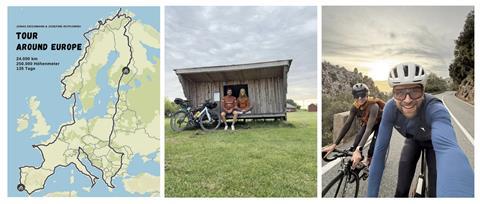
The next stage is already in the works: On April 25, 2026, Deichmann and Josefine Rutkowski will set off from Munich on their joint “Around Europe” tour. Deichmann, previously known primarily as a solo adventurer, is shifting his focus more toward long-term brand development. In addition, this project is likely to appeal to new target groups – beyond the previously predominantly male sports community. At the same time, he is returning to his roots. “For me, it’s a bit of a return to adventure,” says Deichmann. “Adventure is in my DNA.”
Forrest Gump project on German soil
And the momentum continues right after that: With a “Forrest Gump” project on German soil – 30 marathons in 30 days across Baden-Württemberg – Deichmann is (once again) shifting his focus. Instead of the next big solo adventure, he’s consciously prioritizing connection with the community. He’s inviting people to join him, wants to get people moving – and is adding another building block to his model: from the hero project to a community format.
Our graphic shows the key focuses of Deichmann’s projects:
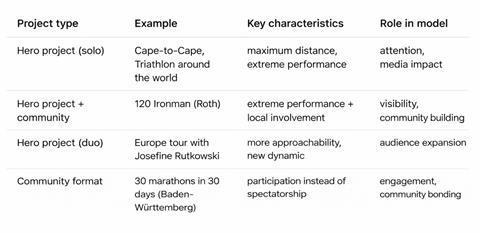
The logic behind it: Adventures become stories. Stories generate attention. And that leads to a business model.
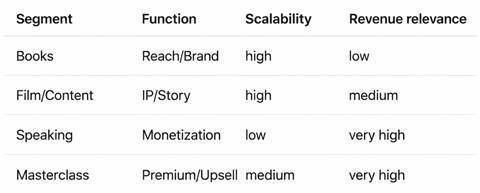
How exactly does Deichmann make money? His approach is based on several building blocks that play different roles – from building reach to monetization. It turns out that reach is generated primarily through content and books, while actual monetization comes from formats such as lectures and premium offerings.
When athletes and brands grow together
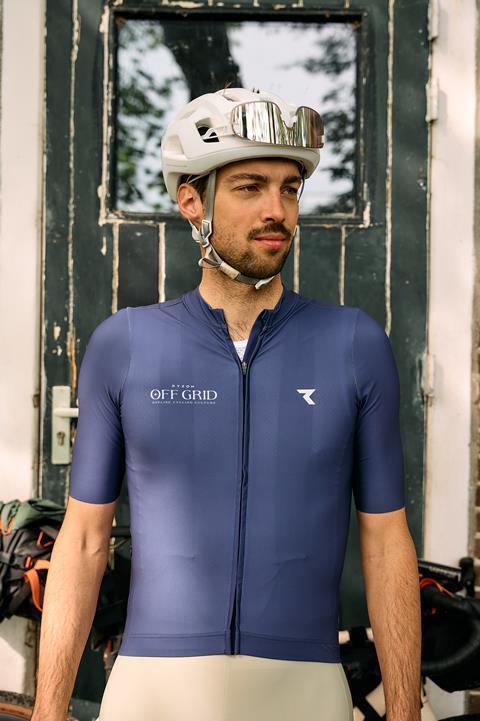
In this system, partnerships are not a standalone product, but rather the result. They emerge where reach, story, and brand converge – and become the connecting element between content and business. Ryzon plays a special role in this system – though less as a driver and more as an early companion. The brand approached him even before Deichmann’s global breakthrough. “We’ve grown together,” recalls the extreme athlete. A strong foundation was the content fit – and the shared idea of telling stories directly from the world of sports. “For us, it’s never just about reach, but about telling real stories,” says Sven Schröllkamp, Global Pro Sport & Partnership Manager at Ryzon. He elaborates: “We don’t buy reach – we develop it together with the athletes.”
Long-term partnerships instead of quick deals
In this context, the German performance brand is less of a traditional sponsor and more of a long-term partner. And: The collaboration goes beyond contractual structures. “There are definitely things where there’s no contract at all – it’s just: Let’s do it. And a handshake,” Deichmann describes the relationship. In fact, their rise ran parallel: While his reach and recognition exploded, Ryzon also grew significantly. “For us, Jonas is a stroke of luck,” Schröllkamp said over four years ago in an interview with ISPO.com. “He embodies the values we stand for as a brand.” These include not only a drive to perform and perseverance, but also a conscious relationship with the environment and a clear commitment to sustainability.
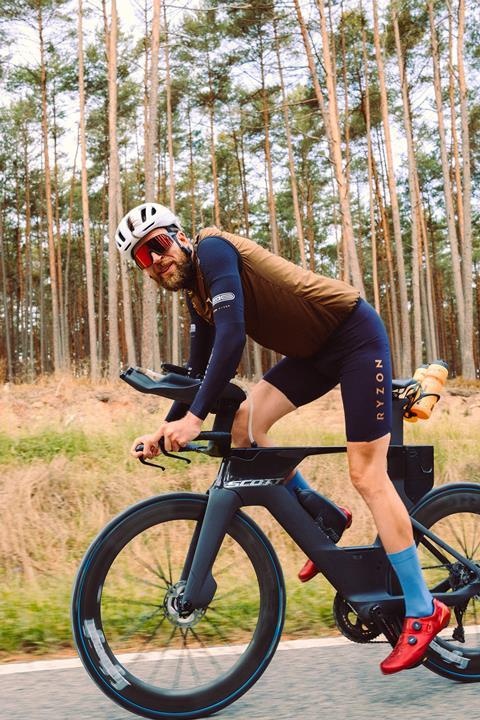
The key factor was and remains the mutual influence: “The image definitely rubs off in both directions.” For Deichmann, the choice of his partners is thus also part of his own brand strategy – they must fit the story he’s telling. He selects them accordingly: For him, sponsorships aren’t short-term deals, but long-term relationships. “I’ve generally had most of my sponsors for many years,” he says. And he adds: “If I’m sponsored by the best company in a given field, that’s a statement in itself. I would never sign with some cheap company, because that would also damage my image.” Moreover, it’s not just about financial support, but also about a network and the specific equipment that makes his projects possible in the first place under extreme conditions.
Adventurer Deichmann: Not an influencer, but a brand
This approach clearly differs from traditional influencer marketing. “I don’t get involved in all that influencer stuff.” Instead of monetizing reach, Deichmann builds his partnerships around content, fit, and long-term development. He deliberately works with a small number of select partners – from equipment and technology providers like Canyon, Garmin, or DT Swiss, to his apparel partner Ryzon, and even brands like Mestemacher. The fact that even a traditional bakery is part of this system shows just how far his model has strayed from traditional sports sponsorship. What matters isn’t the category, but the role within the project and how well it fits into the narrative. The partners make his projects possible – and at the same time become part of them.
Age is no limit
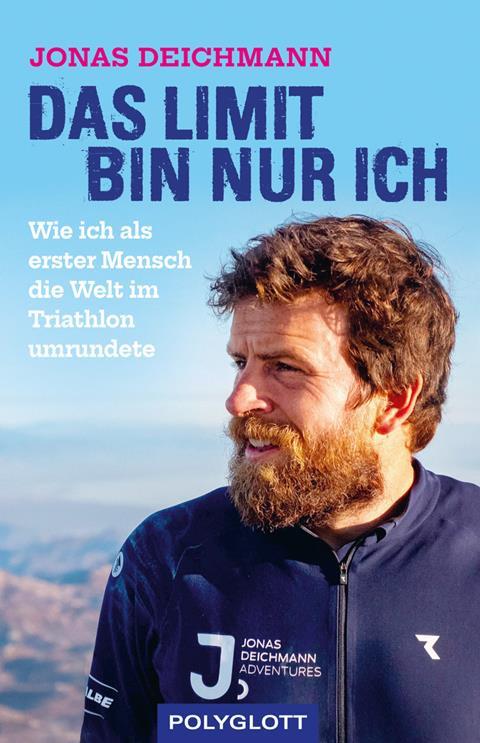
The intriguing question is: How long can this be sustained? Deichmann is approaching 40. Yet he sees his age less as a limit: “I’ll simply adapt my adventures,” he says. Ultimately, it is precisely this strategic thinking of a man who sees only himself as a limit: For him, growth isn’t determined by the next athletic milestone – but by the ability to turn every adventure into a story that can be shared. That is where the real scaling lies. But there is something else that simply isn’t scalable, and that is likely Deichmann’s greatest asset: He is a genuine, credible inspiration – for everyone who wants to get moving.