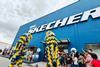
Three Skechers openings across Southeast Asia, Europe and Latin America in five months expose a consistent logic: company-owned doors shift revenue toward DTC, and DTC carries structurally higher margins than wholesale.
At a moment when much of the footwear industry is rebalancing its retail footprint, prioritizing digital channels, tightening wholesale distribution and focusing on cost efficiency, Skechers has continued to expand its physical store network at scale.
Three new locations in five months — a 16,592-square-foot megastore in Melaka, Malaysia, a 700-square-meter flagship on one of Copenhagen’s most trafficked pedestrian streets, and a second company-owned store in Brazil within six weeks of the first — are the visible surface of a financial strategy that the brand has been constructing quietly for several years, and that its most recent annual report makes legible.
Visualizza questo post su Instagram
The thesis: company-owned stores generate structurally higher margins than wholesale distribution. Indicative company figures put DTC gross margins in the range of 67 percent versus approximately 44 percent for wholesale. Every store Skechers opens itself, rather than through a partner, shifts the revenue mix in a direction the income statement rewards.

From distributor to operator
Brazil shows the strategy most clearly. Skechers had been present in the country through third-party partners for years before January 2026, when it opened its first company-owned location at Só Marcas Outlet in São Paulo. Six weeks later came BarraShopping in Rio de Janeiro, one of Latin America’s most visited retail complexes. Nine branded stores in the market now, two of them operated directly by Skechers do Brasil Calçados LTDA (all according to company press releases). The pace signals intent more clearly than any investor presentation.
President Michael Greenberg laid out the roadmap explicitly in comments around the launch: more company-owned stores in key cities, an e-commerce platform, a wider product assortment. That’s a market-maturation sequence the brand has already run in other international markets, and it reflects a recognition that distributor relationships, however efficient in the early stages of market entry, eventually cap both margin and brand control.
The same logic, applied differently, produced the Copenhagen flagship. Denmark already had 32 Skechers stores when Amagertorv opened in April. A 33rd store on a premium pedestrian thoroughfare, at 700 square meters, isn’t filling a coverage gap: it’s anchoring the brand in the kind of high-visibility, high-footfall location that changes how wholesale partners and consumers alike perceive it.
Greenberg called it arriving “at the right place and time.” A less diplomatic reading is that Nike’s pullback from wholesale partnerships and adidas’s ongoing reset have likely eased competition for premium retail space, allowing Skechers to move into locations that were harder to access just a few years ago.
The megastore argument
Malaysia represents a different argument. The Tarcor Park opening in Melaka, at 16,592 square feet, is the brand’s largest store in the country. Malaysia is a secondary market for Skechers, and that is the point.
Standard mall concept stores cannot carry the product depth or experiential range Skechers needs to serve the full breadth of its offer: lifestyle, performance, kids, apparel, accessories and, in Melaka, a KOI Thé café inside a “transparent shoebox” concept inspired by the brand’s packaging. Longer dwell time in a footwear store converts.
Skechers’ Managing Director for Southeast Asia, Zann Lee, described the ambition as reaching “a wider audience” through accessibility and scale. It is a format that requires conviction to commit to in a secondary market. It also requires confidence that the demand is there.
What the numbers actually say
Skechers ended 2024 with $8.97 billion in net sales and approximately 5,296 stores worldwide. International revenue accounted for around 62 percent of the total, per SEC filings — which makes the Denmark, Brazil and Malaysia moves less surprising once you understand that most of the brand’s growth story now lives outside North America.
Of those 5,296 stores, roughly 1,787 are company-owned. The rest operate through franchise partners, joint ventures and distributors. The expansion program — Skechers has indicated plans for 180 to 200 new company-owned openings in 2025 — is therefore as much about changing the ownership mix as it is about adding absolute footprint. Each conversion from third-party to direct shifts margin capture upward.
One complication worth naming: in fiscal 2024, wholesale sales grew 13.2 percent, compared to 10.7 percent for DTC. Wholesale is still growing faster in absolute terms. Skechers isn’t abandoning its partners — it’s layering a higher-margin owned-retail operation on top of a wholesale business that remains large and healthy. The risk, common to hybrid models like this, is that the two channels can eventually work against each other in markets where the brand is trying to hold pricing integrity while simultaneously operating outlet-format stores.
The Skechers´ DTC bet will keep unfolding.
What connects Melaka, Copenhagen and Rio de Janeiro isn’t geography. It’s a shared conviction that the consumer relationship forged inside a well-designed, well-stocked physical store — where someone tries the Hands Free Slip-ins, sits down with a drink or watches their child pick out a first pair of trainers — is harder to disrupt than one built through paid social and YouTube Shorts. How many Skechers stores and megastores will launch worldwide in the coming months? Probably more than expected.