Seven events across five European countries this autumn show marathons evolving beyond race day: creator-led festivals, brand activations and a dedicated B2B trade show now sit alongside the finish line, redrawing how sporting goods brands reach runners.
For years, the running industry’s calendar revolved around its largest race weekends, from London and Berlin to Amsterdam and Athens. Brands showed up, elite athletes competed and runners collected their medals, while most of the commercial activity remained closely tied to race weekend itself.
That model has not disappeared. But it is no longer the whole story.
Worldwide, and across Europe too, a new layer of events is emerging around participation running. Some are attached to major marathons. Others stand entirely on their own. What they share is a focus on community, experiences, education and connection alongside competition. Brands want ways to meet consumers outside traditional retail. Creators and media companies want physical spaces that bring online audiences together.
The result is a growing event economy in which running has become part sport, part culture, and part lifestyle business. This autumn’s calendar offers one of the clearest snapshots yet of that shift, from a magazine-led storytelling festival in London to a 200-plus-brand industry gathering in Amsterdam. Here our European picks:
Run Culture: Live
London, Sept. 4-5
If one event captures where running culture is heading, it is Run Culture: Live. Created by the team behind Like the Wind magazine, the two-day gathering at the Boiler House in London’s Truman Brewery doubles as the publication’s 50th-edition celebration. Experiential agency Robotproof designed the visitor journey, structuring Friday around long-form storytelling, film, and conversation, and Saturday around athletic insight, creativity, and community.
Confirmed speakers include sprinter Linford Christie, distance runners Molly Seidel and Lucy Bartholomew, ultrarunner Stephanie Case, author Adharanand Finn, and run-crew founder Charlie Dark. Organizers describe the format as an immersive, festival-style gathering that blends talks and panels, creative workshops, brand experiences, and community spaces, with a curated marketplace for independent running brands and makers. Like the Wind says its publishing platform reaches readers in more than 40 countries, giving the event an international audience beyond the UK market, and the festival doubles as preparation for the magazine’s own expansion into the American market.
What makes this different from a typical race expo is the brand mix. Participating brands include Under Armour, Salomon, PUMA, Wahoo, Kailas Fuga, Precision Fuel & Hydration, and United Repair Centre, spanning performance footwear and apparel, endurance technology, trail and mountain running gear, sports nutrition, and product repair and circularity, rather than the footwear-and-bib-collection mix typical of a marathon expo.
For sporting goods brands, that is a different proposition from a traditional race expo. Instead of catching runners as they collect their numbers, the event brings together highly engaged consumers around media, storytelling, and community. The result is a form of brand access built less on race participation and more on cultural relevance.
Event site: https://runculture.co/

Richmond RUN-FEST
London, Sept. 12-13
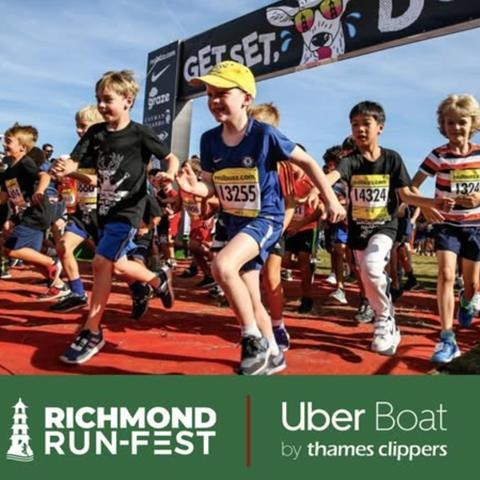
A week later, a more traditional format shows the same audience-broadening logic at work. RUN-FEST combines a marathon, half marathon, 10K, and Kids’ & Family Mile around the Royal Botanic Gardens, Kew. The adult races start inside the UNESCO World Heritage Site before finishing at a festival village in Old Deer Park, Richmond, featuring live entertainment and a fitness expo. The weekend attracts around 7,000 runners and is sold out for 2026.
Unlike creator-led gatherings such as Run Culture: Live, RUN-FEST demonstrates how established mass-participation events are evolving into broader consumer experiences. The event’s sponsor roster includes Nike, Lucozade Sport, and HIGH5 Sports Nutrition, reflecting the mix of performance, hydration, and endurance brands that increasingly use race weekends as direct-to-consumer marketing platforms.
The commercial significance lies in the audience. Events like RUN-FEST are no longer built solely for committed runners chasing personal bests. They are destinations for families, beginners, and local communities, with more than 1,000 children participating in the Kids’ & Family Mile program.
For brands, the opportunity extends well beyond race day. The finish festival, fitness expo, and family-oriented programming create multiple touchpoints with consumers, turning what was once a race into a weekend-long engagement platform.
Event site: https://run-fest.com/events/about-richmond-runfest/
BMW Berlin Marathon Weekend
Berlin, Sept. 27
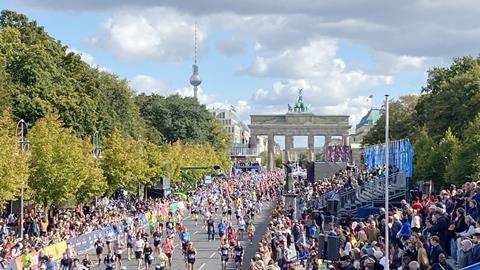
The traditional marathon majors remain central to the calendar, but they have also evolved into commercial platforms in their own right. Around 60,000 athletes from approximately 160 countries are expected to take part in the 2026 BMW Berlin Marathon, one of the six Abbott World Marathon Majors.
Its accompanying Marathon Expo by BRITA, staged at Berlin’s historic Tempelhof Airport, has grown into one of Europe’s largest running industry gatherings, attracting up to 100,000 visitors and featuring more than 100 exhibitors across running, fitness, health and lifestyle categories.
The Expo enters a new phase in 2026 through a multi-year partnership with BRITA, which becomes both co-sponsor of the race and presenting partner of the Expo. The activation includes refill stations along the course and free filtered water at the event. Technology brand UGREEN is also expanding its presence as Official Charging Partner, while adidas maintains a dedicated merchandise area featuring the official BMW Berlin Marathon collection.
For sporting goods brands, Berlin functions simultaneously as a competitive stage and a marketing platform. The flat, record-friendly course continues to attract elite performances, while the Expo provides direct access to one of the largest concentrations of committed runners anywhere in Europe. Product launches, athlete appearances, community runs and brand activations increasingly sit alongside race performance itself.
Event site: https://www.bmw-berlin-marathon.com/en/
Munich Runners Festival
Munich, Oct. 9-11
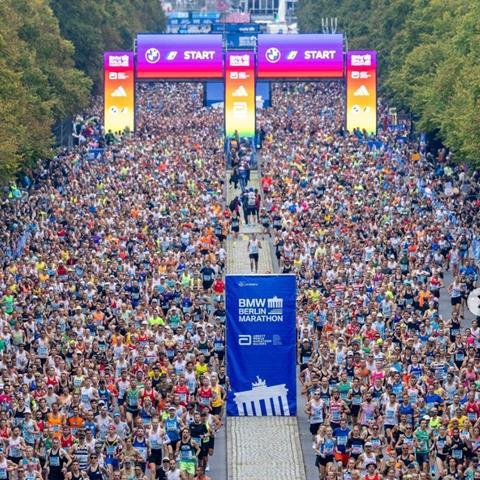
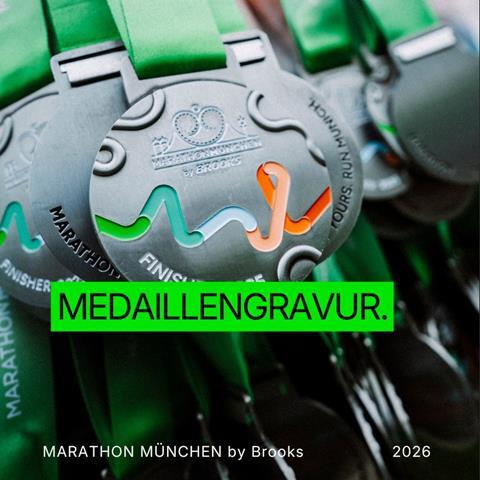
Munich’s Runners Festival by Brooks may be the clearest example of running’s evolution into a festival business. Built around the Marathon München by Brooks, it transforms Hans-Jochen-Vogel-Platz, the central square between the Olympic Stadium and Olympic Hall in the Olympic Park, into a three-day meeting place for runners, brands, and lifestyle exhibitors, with organizers citing up to 80,000 visitors. Exhibitors from sport, health, and lifestyle are joined by community runs, DJs, food, and recovery activations, turning marathon weekend into a broader consumer event.
The event’s commercial footprint already extends beyond the race itself. Brooks serves as title sponsor and technical partner.
The participant base is also growing. Following a record 28,500 participants in 2025, the first edition under the event’s new ownership structure, organizers are aiming for further growth in 2026, while approximately 150,000 spectators lined the course that year.
Those figures help explain why brands increasingly view running festivals as an alternative to traditional advertising. Visitors spend time with products, take part in activations, and interact directly with companies in an environment built around community and participation.
Event site: https://marathonmuenchen.org/en/runners-festival/
Amsterdam Marathon Expo
Amsterdam, Oct. 15-17
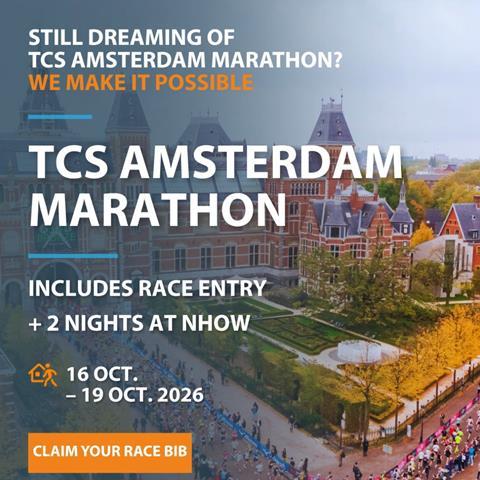
If Munich represents the festival model, Amsterdam demonstrates the retail opportunity. The Marathon Expo Amsterdam, tied to the 50th edition of the TCS Amsterdam Marathon, moves to RAI Amsterdam for 2026, giving it considerably more space than its previous venue. Over three days, brands across running footwear, apparel, performance products, health, and nutrition present their newest launches to what organizers describe as a highly purchase-driven audience; the race itself has grown to around 32,000 participants across its distances in 2026.
What makes marathon expos valuable is intent: visitors arrive already committed to the category, evaluating products and often buying on the spot. For brands launching shoes, apparel, or nutrition products, few audiences are more relevant.
Event site: https://www.rai.nl/en/calendar/marathon-expo-amsterdam-2026
Athens Marathon Week
Athens, Nov. 4-8
Athens combines heritage with commercial scale. The week surrounding Athens Marathon. The Authentic includes the Allwyn Marathon Expo, running November 4 to 7 at the Indoor Stadium of Palaio Faliro (the former Tae Kwon Do venue), with the marathon itself taking place on November 8. Organized for SEGAS and produced by Be Best, the event is promoted as the largest sports exhibition in Greece and one of the leading sports business gatherings in southeastern Europe.
The commercial footprint is significant. Organizers say the Expo hosts more than 180 brands spanning running, sports equipment, nutrition, health, and wellness, while attracting tens of thousands of visitors from Greece and abroad.
Unlike many marathon expos that focus primarily on bib collection, the Athens event wants to be a broader marketplace for the international running community. Visitors can discover new footwear, apparel, nutrition, and training products, meet representatives from races around the world, and engage with sports tourism and wellness exhibitors.
The event proves how running festivals can bring together sport, tourism, and retail. Participants come for the historic Marathon-to-Athens route, while brands gain access to a concentrated audience of runners already immersed in the category. At a time when many sporting goods companies are seeking direct engagement with consumers, the Allwyn Marathon Expo has become one of the largest such platforms in the eastern Mediterranean.
Event site: https://www.athensauthenticmarathon.gr/en/pages/allwyn-marathon-expo
International Running Expo (IRX)
Amsterdam, Nov. 4-5
Not all of running’s new festivals are aimed at consumers. Hosted at RAI Amsterdam and co-located with ISPO, the International Running Expo (IRX) positions itself as Europe’s only dedicated business-to-business event for the running industry. For its second edition, organizers expect more than 200 international brands, while visitors will have access to more than 1,500 products available to test on-site.
The exhibitor mix underscores the event’s ambition to become a central meeting point for the running business. Confirmed participants include SCOTT Sports, Shokz, Superfeet, Suunto, BUFF, adidas Eyewear, Tailwind Nutrition, and Mount to Coast, while new exhibitors for 2026 include Triumph, MAAREE, BAHE, Veloci, and several emerging performance and retail-technology brands.
The conference program is equally industry-focused. Speakers include Intersport chief executive Tom Foley, alongside executives, retailers, race organizers, and brand leaders discussing product innovation, sustainability, community building, and the future of sports retail.
For SGIE readers, this may be the most commercially significant event on the autumn calendar. While marathon expos focus primarily on runners, IRX focuses on the business behind the sport: product innovation, retail strategy, sustainability, distribution, and market development. Its audience consists largely of retailers, wholesalers, distributors, brands, and industry executives rather than consumers, making it one of the clearest indicators of where the running market itself is heading.
Event site: https://www.internationalrunningexpo.com/

Road, track and gravel: the business of running
We track the business story: brand strategies, product launches, financial performance, participation data, and the race formats reshaping the industry’s most competitive category.
Explore Running →