Goldman Sachs said the World Cup wouldn’t move GDP. It doesn’t need to. Harry Kane’s two-goal opener in Skechers boots arrived inside a tournament producing triple-digit US apparel sales, record FIFA sponsorship revenue and the performances needed to make both matter commercially.
Before the first ball was kicked, two competing readings of this World Cup were already circulating. The official one, advanced by FIFA and underwritten by pre-tournament retail forecasts and nine-figure sponsorship commitments, held that the 2026 edition would be the most lucrative sporting event ever staged. The skeptical one also had substance. In a research note published June 3, Goldman Sachs drew on GDP data from every World Cup since 1982 to argue that hosting a mega-event has a marginally positive but statistically insignificant effect on real output, with long-run macroeconomic impact that is effectively zero.
On ticketing, the pre-tournament picture was no cleaner. Attorneys general in New York, New Jersey and Texas initiated inquiries into FIFA’s variable pricing practices and allegations that fans had been misled about seat locations before a single group-stage match had been played.
Week 1 is delivering a more granular answer to what was always the right question for this industry: not whether the World Cup moves GDP, but whether it generates the concentrated commercial returns that sporting goods brands, retailers and sponsors are positioned to capture.
So far, the answer is arriving daily. On Wednesday, it wore Skechers boots.
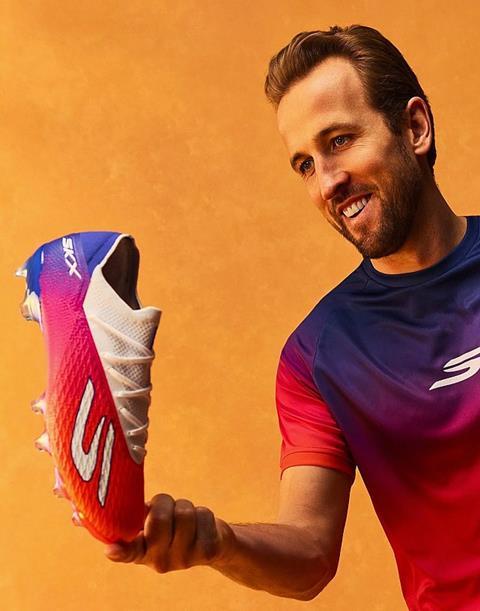
On June 17 at Arlington’s AT&T Stadium, England opened their Group L campaign with a 4–2 win over Croatia. Harry Kane scored twice — a retaken penalty in the 12th minute and a header from a Declan Rice corner in the 42nd — equaling Gary Lineker’s England record of 10 World Cup goals. He also did it in Skechers football boots.
Visualizza questo post su Instagram
Kane, Skechers and a reawakening market
Kane’s partnership with Skechers has been one of the more closely watched unconventional athlete-brand pairings in the sport. For his opening World Cup match he wore the Skechers SKX_2 Elite FG, a gradient orange-pink-and-blue boot priced at around £195 in the UK market, featuring Hyper Burst Pro cushioning and a multi-direction traction outsole.
Two goals and a record-equaling night later, the boots are drawing exactly the kind of attention that athlete sponsorship partnerships are designed to generate.
Moments like this one — a record-equaling brace, broadcast to a global audience, in a boot most football fans had never seen before — are exactly what Circana analysts had in mind when they forecast a short-term performance footwear boost driven by World Cup visibility. The research firm said the US soccer performance footwear segment declined through 2025 before the World Cup cycle reversed the trajectory.
Circana footwear advisor Beth Goldstein noted ahead of the tournament that the back-to-school season immediately follows the World Cup window, creating a short but concentrated opportunity for performance boot sales.
Kane’s two-goal opener compresses that window into a single news cycle.
The lifestyle angle has its own backstory. Circana’s data shows soccer lifestyle footwear grew faster than performance in 2025, with the Samba’s resurgence over the past two years serving as a proxy for consumer interest in the broader football-adjacent category. Skechers, with its comfort-first positioning, is playing across both territories simultaneously: Kane’s on-pitch boots carry the performance credentials, while the brand’s lifestyle range benefits from any association with tournament success.
The commercial tournament takes shape
Kane’s record-equaling performance is part of a broader World Cup story that is already delivering the sporting moments needed to support its commercial ambitions. Argentina’s Lionel Messi scored a hat trick in the opener against Algeria, tying Miroslav Klose for the all-time World Cup goals record at 16. France’s Kylian Mbappé scored twice in France’s first match.
The first week has produced the goals and star power that broadcast partners, sponsors and retailers need to sell the tournament to audiences that, according to Circana’s Omnibus Survey from March 2026, include only 19 percent of Americans reporting active interest in the World Cup.
That gap between the tournament’s commercial scale and the depth of American soccer fandom is one the industry has managed for years. Circana’s analysis points to structural progress — MLS expanding from 20 to 30 teams, the NWSL growing, Messi’s 2023 arrival at Inter Miami accelerating mainstream attention, and the US Women’s National Team’s gold medal at the 2024 Olympics sustaining visibility.
The demographic foundations are also shifting: the growing US Latino population, for whom football is an embedded cultural practice rather than an acquired sport, is the most durable driver of long-term fandom growth.
Turning World Cup fandom into sales: the US perspective
Circana’s point-of-sale data shows how that fandom translates into purchasing behavior. International soccer apparel sales in the US grew triple digits in Q1 2026 versus the same period in 2025, according to Circana, with men’s apparel accounting for roughly 80 percent of the total.
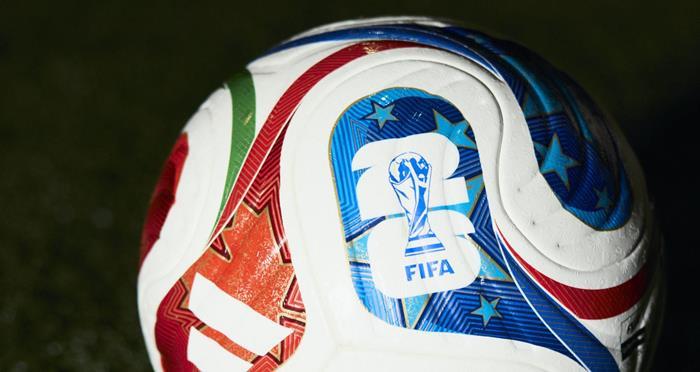
FIFA-licensed soccer equipment posted comparable growth, building on a similar spike in the 2022 World Cup year. The soccer equipment market in the US generated over $720 million in sales in 2025, according to Circana, with soccer balls accounting for close to two-thirds of that figure.
Consumer purchase intent, surveyed in March 2026, showed that more than a third of those planning to buy fashion or athletic items around the tournament would opt for team logo apparel, while roughly equal shares expressed interest in player jerseys and accessories, and team headwear.
The proportions suggest broad rather than deep engagement, driven more by participation in the cultural moment than by deep team loyalty, which is exactly the kind of spending pattern retailers can capture with relatively light activation.
The sponsorship layer
Behind the retail performance, the sponsorship architecture that FIFA put in place over the past four years is now running at full activation. According to FIFA, the 2026 tournament is on track to generate $2.7 billion in commercial partner revenue – a figure up by at least $1 billion from Qatar 2022 – with eight global partners, including adidas, Coca-Cola and Visa, and a second tier of eight tournament-specific sponsors.
The revenue upside is real. FIFA’s most recent financial report projects $9 billion in income from the 2026 tournament year, with media rights alone accounting for approximately $3.9 billion, growth driven by the expanded 48-team, 104-match schedule and the North American broadcast market’s more favorable time zones relative to Qatar.
After exceeding its revenue target for the 2022–2026 cycle, FIFA has already raised its budget for the next four-year period to $14 billion.
The ticketing picture carries more friction. Projected at approximately $3 billion, ticket sales have generated both record revenue and reputational scrutiny, with pricing inquiries opened in three US states before the tournament began. The most expensive ticket to the July 19 final at MetLife Stadium was listed at $10,990.
The controversy does not appear to have materially affected attendance or revenue, but it sits alongside Goldman Sachs’ macro skepticism as part of the pre-tournament headwinds the commercial case is now being measured against.
The back-to-school window opens
For sporting goods brands and retailers, the remaining five weeks of the tournament represent a concentrated commercial opportunity with a clear endpoint. The World Cup precedes peak soccer footwear season, creating a short-term boost window for brands willing to activate around special releases.
Kane’s boots are now part of that narrative whether Skechers planned for that specific moment or not.
Global soccer-related toy sales were up 160 percent in dollar value through April, according to Circana, with soccer toys now accounting for nine percent of all sports-related toy sales — double the share from the same period last year.
The category expansion beyond trading cards (44 percent of sports toy sales) into building sets, collectible figures and plush confirms that soccer’s cultural footprint in the US is broadening beyond its traditional performance and fandom channels.
The question that remains open is whether the tournament’s commercial momentum can be sustained across five weeks and 104 matches without the sustained marquee-team performance that concentrates audience and retail attention. Which is also, without making any speculation of course, why the most commercially significant outcome for the host nation would involve the US team advancing deep into the knockout rounds.
Goldman Sachs, for its part, gives them a 39 percent chance of reaching the Round of 16.
FIFA World Cup 2026: The Business of the Beautiful Game
How brands, retailers, and the sports economy compete on football’s biggest stage.
Explore Our Coverage →