arena’s Chief Brand Officer, Mark Pinger, speaks to us on brand leadership, European value creation and the role of premium products in a market that increasingly must learn how to explain performance, not only price.
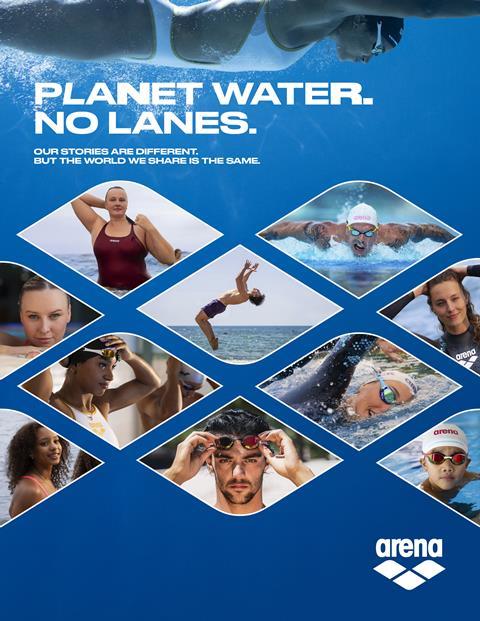
In a sporting goods landscape shaped by price pressure, fragmented retail structures and rising sustainability expectations, arena is deliberately taking a different route. Instead of chasing short-term sales spikes, the company is shifting towards premiumization, European manufacturing resilience and a long-term brand platform.The “Planet water – No lanes” campaign pivots away from a performance-exclusive positioning toward a broader, lifestyle-relevant brand universe. It is designed not for transactional conversion but for long-term brand equity, challenging traditional marketing ROI logic.
In this exclusive SGI Europe interview, Pinger outlines why premium products succeed only when both brands and retailers are able to articulate their value. It becomes clear that online channels accelerate innovation, specialist retailers convert premium customers and global athletes like Summer McIntosh amplify brand stature far beyond competitive swimming.
arena is positioning itself as a premium brand for everyone who chooses to “swim their own way” in the spirit of ”No Lanes.”
SGI Europe: The ”Planet Water – No Lanes” campaign reflects a value-driven brand ambition. What measurable shifts have you observed since the launch?
Mark Pinger: We have been running the Planet Water campaign since 2023. The new phase expands the idea, and the early results are strong. We run PR, paid media and social. One encouraging indicator is that many viewers watch the entire video. Even when people scroll without sound, they stay with it.
A key goal is not to alienate any segment. If we focus too much on competitive swimming, we risk excluding others. If we show only fitness swimmers, younger competitive athletes may not relate. This campaign widens the lens and signals that we include everyone, however they choose to swim.
The “No lanes” concept communicates independence. It is about not letting others define you. Many of our athletes reflect this. David Popovici from Romania may have been told that swimmers from his country do not win gold medals, yet he proved the opposite. Kate Douglass is another example, as well as Summer McIntosh, with three individual Olympic gold medals. Competing at that level in different strokes is extremely rare.
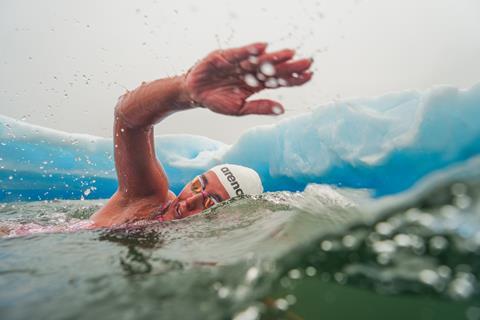
We also feature swimmers who train in freezing open water, such as Barbara Hernandez, who has the nickname Ice Mermaid.
The message is simple. However you want to swim, arena is your brand.
This campaign sits at brand level. It is not designed to measure sales impact directly. Of course, we want consumers to think of arena when they buy products. But the main purpose is long-term brand building.
arena: Engagement first, Monetization second
So, community engagement first, monetization second?
Exactly. If you try to sell equipment directly after delivering an emotional brand message, it is not authentic. We build long-term brand equity.
Before we move into product and market dynamics, let’s briefly clarify the strategic setup behind this. How much brand management discipline is built into this approach?
A lot. We want longevity in our concepts. When we define a message, we avoid reinventing it every year. We need to be certain, before launch, because we will not change it a year later. We will stick with this message. It can evolve, but it will remain under “Planet water.” Water is also a resource. The campaign is not primarily about sustainability, but it matters to us.
arena wants to embrace competitive swimming and everyday swimmers
“Planet water” touches on sustainability and resource issues. The “No lanes” idea also reflects many global situations. arena is clearly engaging a broader community, not only competitive swimmers, right?
The high-end competition level can be intimidating. It is like Usain Bolt running in Puma spikes. Nobody saw that and thought they needed Puma shoes for a weekend run. Our €600 race suits are incredible for competitive swimmers, but they do not resonate with casual swimmers. We must stay rooted in competitive swimming, because that is our origin. But we must also include everyone who wants to swim.
Still, competitive swimming remains essential for arena. One of your strongest strategic levers is your athlete roster. With that in mind, we must talk about Summer McIntosh. How does she influence your brand communication?
I often say she is just another athlete on the team, because we have many world-class swimmers, like Gretchen Walsh, Thomas Ceccon and Nicolò Martinenghi.
But, to be honest, Summer is at a different level. She has three individual Olympic gold medals and a silver. She is the full package. Standout athletes like Summer transcend markets.
Even before the contract was signed, she committed to a photo shoot and showed up. Working with athletes is different for us than for brands outside sports. We are part of their performance. Our first question is always: Do you like our suits? They must feel comfortable. At the elite level a few hundredths of a second decide outcomes.
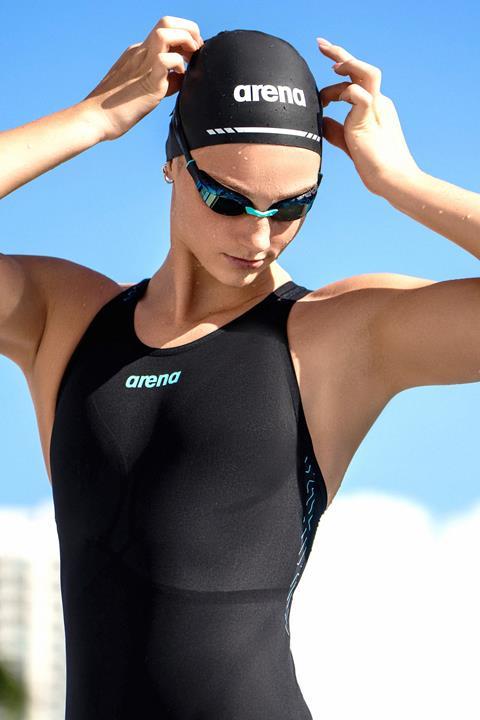
We launched the Powerskin Veloce race suit, which combines many desired features. She tested it and said it provides the best balance between compression and comfort. At her level she has access to excellent equipment. She also posted a childhood photo in arena and wrote that she has always been on Team arena. That was great.
arena with a dual manufacturing approach
Sounds like a perfect match. The Canadian 19-year-old swim star also works with Red Bull, as I saw on her Instagram channel.
It is a strong match for all sides: Summer, Red Bull and arena. Her profile will only grow.
Beyond visibility, what opportunities does she open for arena?
She resonates internationally and inspires young swimmers. When other brands feature her, even without our logo, her visibility increases and this indirectly supports us. The core target group in competitive swimming is very young. Summer is a major driver in that segment.
Let’s turn from athlete influence to product creation. arena takes a dual manufacturing approach. What advantages does the European innovation cluster offer?
Partners like Carvico and Eurojersey produce world-class materials. Even when products are made elsewhere, the fabrics often originate in Italy. The Italian textile industry is highly innovative, and we benefit from being part of that ecosystem. We also produce in Europe. Our The One Plus goggle is made in Italy, and our race suits are produced in Italy and Slovakia.
Proximity gives us a clear advantage. We can visit factories frequently, prototype faster, and refine fit and quality with greater precision. Fit is the most important factor in a race suit. Materials matter, but the perfect fit is what truly makes the difference.
Shorter supply chains reduce complexity and transport, and they increase resilience in today’s geopolitical environment. Innovation is collaborative for us. We develop products alongside our partners, not separately.
Production and collaboration lead us directly to another topic: sustainability. arena is introducing models made with renewable Lycra EcoMade fiber. What role does this play in your sustainability strategy?
Sustainability gained importance when [arena CEO] Peter Graschi joined. Consumers say it matters. It may not always be the primary purchase driver, but it is expected. All our polyester is recycled, and 100 percent of our pool and beach collection contains recycled components. Lycra EcoMade, which is made from corn, is an impressive innovation.
We also developed a product launching in summer 2026 that combines stretch and chlorine resistance. Traditionally, fabrics that provide stretch break down in chlorinated water. Our new material offers both performance and longevity. Durability itself is sustainability.
Consumers are more selective
A topic we can talk about for a whole day or maybe longer, but let’s have a look beyond. How do you assess the European market in 2025 regarding premium and specialist retail and e-commerce?
We are satisfied. But of course: Consumers are more selective, and swimwear is seasonal for many retailers. Trying on at home is convenient, but the best product advice still happens in specialist stores. This is where premium wins if it is explained. Many of our top sellers are premium products. It is challenging to communicate premium differences. Better products enhance the swimming experience.
You mention the importance of explanation. Where do consumers ultimately buy premium products: at retail or online?
Both. Many retailers hesitate to list or sell premiums actively, but online retailers embrace higher price points. That helped innovations like the Cobra Ultra succeed early. Specialists, however, convert premium customers because they can explain the value. For families buying race suits, expertise is essential.
Let’s take a broader view again. What country developed the strongest in 2025?
The US became our largest market after years of being small. Growth potential remains high. Europe performs solidly across most countries.
Equipment and goggles are growing strongly
And which categories show the most dynamic development?
Equipment, especially goggles and backpacks, is growing strongly. Non-racing swimwear is growing above average. Racing is more challenging in a non-Olympic year. We focus on racing, fitness and beach, and we aim to reenergize the beach category.
To bring this back to retail execution, which initiative is strengthening the brand in brick-and-mortar environments?
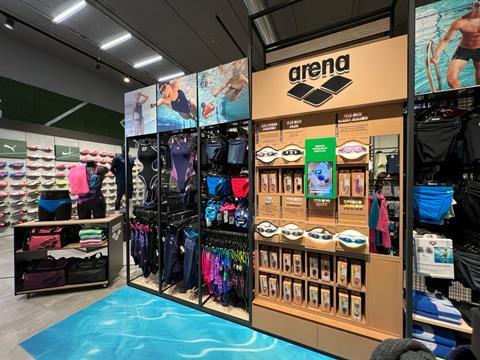
Training. If consumers understand product differences, they make better choices. We provide training and POS fixtures. Without explanation, prices dominate. With explanation, premium wins.
Finally, looking ahead to 2026, what will shape your brand leadership?
We will continue our strategy. Competitive swimming is our foundation. We see growth in beach and fitness. The European Championships in Paris will be significant. Globally, the next major peaks are 2027 and the 2028 Olympics. We’re planning early – athletes, products, events. We think in multi-year cycles.
arena Chief Brand Officer Mark Pinger
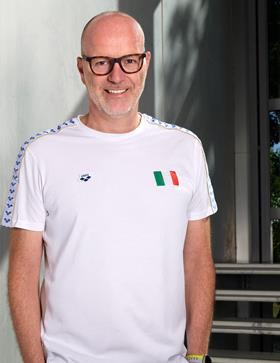
Mark Pinger has served as Chief Brand Officer of arena International since autumn 2025. The former world-class swimmer and Olympic athlete has German roots but prefers to speak English, which is not surprising in light of his international career. Born in Freiburg in southwestern Germany, he has lived and worked in the US, China and Hong Kong. Before joining arena, he worked in management consulting at McKinsey and later served as General Manager at Nike.
In 2016 he returned to his sporting roots and joined arena as General Manager North America. Today, as CBO, he oversees global brand strategy, product development and licensing. He is considered one of the most influential leaders in the global swimming industry.