The gain belongs to the sport where newcomers start and younger riders gather, while skiing’s base ages and first-timers dwindle. The U.S. snowsports trade body SIA wants skiing to build a similar entry route.
A poor snow year in parts of the U.S. did not thin the crowds. Snowsports drew 31.96 million participants last winter, a six-season high. Snowboarding led the gains, rising about 9 percent to 10.6 million. Snowsports Industries America (SIA), the U.S. snowsports trade association, released these and other data.
That total represents a 3 percent increase from the previous year. Among U.S. residents ages 6 and up, the participation rate climbed to 10.3 percent, from 10.0 percent the year before. SIA says winter sports are outpacing population growth.
Snowboarding is winning over the young
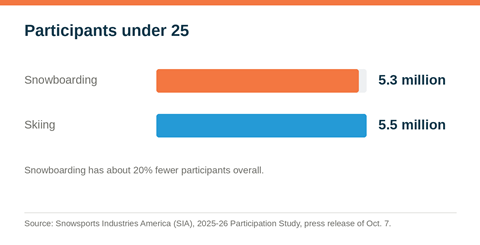
The sport has about 20 percent fewer participants than alpine skiing, but it has almost caught up with skiing among young people: 5.3 million of its riders are under 25, against 5.5 million skiers. The base is also changing, the report highlights. Hispanic participation has grown three seasons running, reaching 2.2 million from 1.8 million two seasons earlier, and Hispanic riders now account for a quarter of female snowboarders.
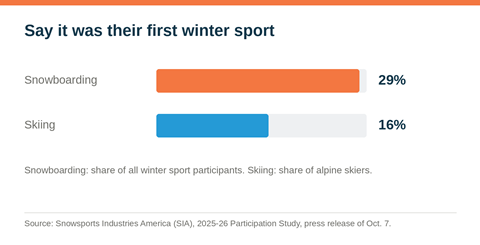
Snowboarding is also where many people start. It was the first winter activity for 29 percent of all participants, while only 16 percent of skiers began on skis. Among people who sat out this season, 1.8 percent say they “definitely” plan to snowboard next winter, versus 1.1 percent for skiing. Those who joined or returned totaled 4.2 million, comfortably ahead of the 3.3 million who drifted away.
Skiing holds still while the country grows
Alpine skiing has stayed near 13.2 million for roughly four seasons and remains short of the 14.9 million recorded in 2018-19. This year, skiers who joined or came back (6.0 million) only made up for those who left (also 6.0 million). SIA says first-timers have been falling for four or five seasons, and that a flat count still means lost ground in a growing country.
Age sharpens the problem. Skiers aged 55 and over number 1.9 million; for snowboarding the figure is 0.3 million. Nick Sargent, President and Chief Executive Officer of SIA, wants the industry to develop “a similar pipeline for skiing” by applying what snowboarding has learned.
Weather cost days on snow, not participants
Skiers reported nearly 6 percent fewer days on snow, snowboarders nearly 3 percent fewer. The Mountain region took the heaviest hit after poor snowfall: 38 percent of its skiers made at least seven outings, down from 45 percent. Elsewhere, including regions with better conditions, frequency barely moved.
Plenty of people simply played differently. Touring on skis or snowboards, cross-country skiing and snowshoeing all logged more outings. Snowshoeing, sledding and Nordic skiing, all pursued off-resort, have grown substantially since the pandemic, and SIA flags lower cost and easier access as a possible reason.
About the SIA report
The findings rest on 15,000 surveys, run with research partner Physical Activities Council, an alliance of nine U.S. industry associations, between late 2025 and early 2026. The sample is built to mirror the U.S. population age 6 and up. Visit: snowsports.org for more information and to access the report.
More from SGIE
Later in October, SGIE publishes its Winter Sports State of Play report on sports participation. In the meantime, please visit our Sports Participation hub page with news, numbers and our premium reports.