Despite decades of progress in sports science and inclusivity, women’s running shoes remain designed from male templates. A new Canadian study explores what women actually need — and how brands can finally close the comfort gap.
For more than half a century, running shoe design has revolved around one assumption: that a smaller version of a man’s shoe would fit a woman’s foot. In the footwear industry, this practice became known — and often criticized — as “shrink it and pink it.”
Yet today, women runners are not only a major consumer group but also the driving force behind innovation in apparel and footwear. Despite this, many continue to experience discomfort, poor fit, or even injuries caused by shoes that don’t reflect their anatomy.
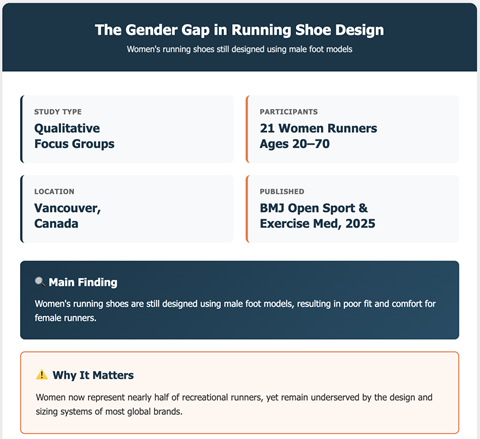
A new Canadian study led by Dr Christopher Napier, a sports scientist and clinician at Simon Fraser University, challenges this long-standing bias with qualitative evidence from women themselves.
“Despite known differences in anatomy and biomechanics, most running shoes are still designed for men,” says Napier. “That affects comfort, performance, and ultimately participation.”
Inside the study
Napier’s team conducted two focus groups with 21 women runners aged between 20 and 70, including both recreational and competitive athletes. They were asked to discuss how they choose their shoes, what determines comfort, and how their needs evolve through life events like pregnancy, injury, or aging.
The researchers recorded and thematically analyzed their discussions to identify patterns in women’s perceptions, expectations, and frustrations about running footwear. Among participants, most ran two to four times per week, across varied terrains — from roads and trails to treadmills. Experience ranged from casual joggers to marathoners.
Key findings
a. Comfort comes first.
Across age groups and ability levels, comfort emerged as the single most important factor when selecting running shoes. Women described discomfort not as a matter of preference but as a functional limitation — tight toe boxes, hard midsoles, and unstable heels were common complaints.
“Comfort trumps all when I’m selecting my shoes,” (…) “If they don’t feel right, I won’t even try to run in them.”
Comfort isn’t cosmetic: it reflects differences in female foot shape, tissue elasticity, and pressure distribution. Brands treating it as “subjective” risk ignoring biomechanical realities.
b. Injury prevention drives choice.
Many women linked their shoe choice to injury prevention, believing the wrong fit could contribute to joint pain or recurring injuries. Several mentioned hip and knee discomfort after pregnancy, or issues with balance and stability as they aged. However, most were unsure how specific shoe technologies — from pronation control to carbon plates — actually influence injury risk.
The study reveals a communication gap: while brands market innovation, women remain unconvinced by unclear performance claims and rely on intuition and peer advice instead.
c. Needs evolve with life stage.
Participants emphasized how their shoe needs change with pregnancy, hormonal shifts, and aging. Feet widen, arches drop, and cushioning preferences change — yet product lines rarely reflect this evolution.
“After having kids, my feet changed shape,” said a 38-year-old marathoner. “I had to go up a full size, but none of the women’s models fit right anymore.”
Your opportunity. Women’s anatomy isn’t static — neither should footwear be.
Industry impact
The implications of Napier’s study reach far beyond women’s running shoes. It exposes how entrenched design conventions — and gender assumptions — still shape the global sporting goods industry.
Despite research showing that women’s feet are narrower at the heel and wider at the forefoot, with greater arch flexibility and softer connective tissue, most brands still use men’s shoe lasts as the foundation for both sexes.
For product developers, this means:
● Re-examining fit algorithms and 3D foot scanning data
● Designing gender-specific lasts from the ground up
● Adjusting materials and cushioning to accommodate different weight distributions and pronation patterns
● Testing shoes across life stages, not just size ranges
“This isn’t about pink shoes,” Napier notes. “It’s about ergonomics, health, and performance equity.”
What’s next
The researchers acknowledge their study’s limitations — small sample size, regional focus, and qualitative nature — but argue it’s a necessary step toward evidence-based inclusivity. Next steps could include:
● 3D scanning and pressure-mapping studies of female feet
● Collaboration between biomechanics labs and footwear companies
● Integrating women’s data into AI-driven shoe design models
● Such partnerships could move the industry from gender-neutral rhetoric to genuinely gender-specific engineering.
“We’ve done enough resizing,” says Napier. “Now we need redesigning.”
SGI Europe takeaways
Design insight Women’s shoes should start from women’s data — not men’s templates. Market gap No major brand yet designs for pregnancy, post-partum, or aging feet. Next step Invest in data-driven, gender-specific shoe lasts and cushioning systems. Business impact Comfort-driven design could strengthen loyalty in the fastest-growing segment of the running market.
The study
Napier C, Dhillon G, Wilhelm A, Ezzat AM. “If a shoe had been designed from a woman’s foot, would I be running without getting the injuries?”: running footwear needs and preferences of recreational and competitive women runners across the lifespan. BMJ Open Sport & Exercise Medicine. 2025;11:e002597. https://doi.org/10.1136/bmjsem-2025-002597
- Abstract here
- Download the full study (open access)
SGI Europe Running Report
In our Running Report we studied the German Running Market. What brands do consumers prefer? What are sensitive price points or does the frequency of running affects buying habits? These are just a few questions our survey-base reports answers. Click below to lear more.

|
Performance Running Market Germany 2025Decoding how Germany’s runners think, shop, and spend. Get exclusive insights on price points, key features, and consumer behavior. Download the report |