

LaMunt asks owners to remove zips and trims; Arc’teryx assigns disassembly to ReBIRD. The two approaches show how choices made for performance shape the work required after use, and why that work belongs in product approval.
Keeping garments in use for longer and recovering their materials afterwards are connected ambitions in a circular economy. In sportswear, they can pull a design in different directions: a component that improves durability may also have to be removed before the fabric can be recycled.
The recycling instructions on selected LaMunt fleeces give their owners that task: remove zips and trims once the garment can no longer be used or repaired. The label, reproduced in Oberalp’s Contribute 2025 report, puts a consequence of product development into the wearer’s hands.
Comparing that instruction with Arc’teryx’s approach to its Sperro SV hardshell reveals a decision that belongs alongside the material specification: who will prepare the garment for recovery? The answer changes what a brand asks of its customers and what it needs from its services. It also needs to remain workable when suppliers change and the approach spreads to more products.
LaMunt simplifies the fabric, then asks the wearer to act
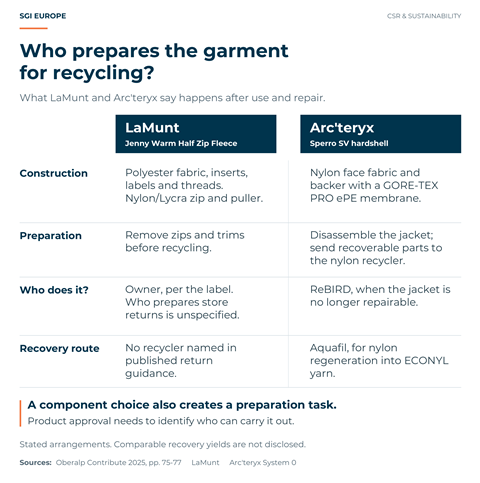
The Jenny Warm Half Zip Fleece illustrates the construction behind LaMunt’s instruction. One polyester fabric supplies both plush and smooth surfaces, creating visual variety without adding another fabric. Inserts, labels and threads are also polyester. The zip and puller contain nylon and Lycra, which Oberalp says it retained for durability. Removing them leaves a simpler fabric stream for recycling.
This gives the performance exception a practical consequence. The design reduces the number of materials in the fabric, while leaving the owner with a separation task. Whether that task is carried out becomes part of the route from a worn garment to material a recycler can use.
LaMunt’s return guidance adds another step: owners can bring products carrying its circular-design icon to the Munich store or Mountain Shops stocking the brand, which promise proper disposal. LaMunt also states that it has no take-back and recycling system of its own and cannot guarantee suitable infrastructure in every market. The published guidance does not identify a recycler or say who prepares store returns.
Store collection settles where an owner can leave a garment. Preparing it for a recycler requires a further commitment about what happens to that return. This connects LaMunt’s product decision to the wider need for collection, sorting and preparation to develop alongside fibre-recovery capacity.
Arc’teryx assigns the task to ReBIRD
Arc’teryx makes that next step part of its product offer. The Sperro SV hardshell, available from September 2026 under the System 0 platform, combines nylon face fabric and backer with a GORE-TEX PRO ePE membrane. The company describes a recovery process that grinds the fabric and separates nylon from the membrane. Once the jacket is no longer repairable, ReBIRD is to take it back and disassemble it, sending recoverable parts to Aquafil for regeneration into ECONYL yarn.
The construction is more complex than LaMunt’s fleece, and the preparation is assigned differently. LaMunt’s label depends on the wearer acting on its instructions. Arc’teryx’s offer depends on a brand service preparing the returned garment for the named nylon recycler. Bringing disassembly into that service creates a workload that has to be planned as returns arrive.
The two disclosures provide no comparable cost or finished-garment recovery figures with which to judge their commercial results. What they do make visible is the relationship between a performance choice and the resources needed after use.
That relationship gives substance to the call for consistent design standards for sportswear. A brief that retains a non-polyester zip should also identify how it will be removed and who is expected to do it. Where separation sits within a brand service, approving the construction should include agreement on the preparation that service can handle. Those decisions connect the product specification to the recovery arrangement.
Keeping the arrangement valid when the product changes
That connection has to survive purchasing decisions made after launch. Sperro SV was the first product certified under the private TESTEX Circularity scheme, which Arc’teryx helped pilot. The scheme’s current rules show how the assessed basis for a product can become an ongoing sourcing responsibility.
The September 2026 standard combines laboratory durability tests with reviewed company questionnaires on repairability and recyclability, supported by evidence as required. Its recycling assessment considers material compatibility and disassembly, including take-back arrangements and recycler partnerships. It also requires advance notification of changes that may affect conformity, including relevant changes to composition, processes or suppliers. The certifier decides what documentation, testing or reassessment is needed before the changed product can continue to bear the certificate.
A substitution accepted for price or availability can therefore have consequences beyond purchasing. If it changes the basis on which the product was assessed, another review may be necessary. Keeping that basis visible alongside the bill of materials would help buying teams recognise when a proposed change needs to go back through approval. The recovery arrangement has to stay connected to the garment being ordered.
Turning component choices into category rules
LaMunt’s zip and Arc’teryx’s membrane each serve a function during use, while creating a need for separation afterwards. That connection brings the discussion back to the design brief: which components are essential to performance, and which can be reduced or omitted? Primark’s experience in the wider apparel industry shows how those judgements can become guidance across a product range.
Its April 2026 Circular Product Standard update describes reducing the depth of elasticated waistbands and removing metal elements with no functional role, such as rivets. Omitting an unnecessary component removes the need to handle it later. The waistband example adds a question about how much of a functional construction is needed.
For sportswear, such guidance would have to be developed around the demands of each product category. A team deciding on a functional zip or membrane needs to consider its role during use together with the process that can handle it afterwards.
Primark says its revised approach draws on trials with buyers, designers, quality teams and suppliers. Its training workshops produce guidelines for individual categories, now covering nine product areas. That gives the component decisions a place in recurring development work.
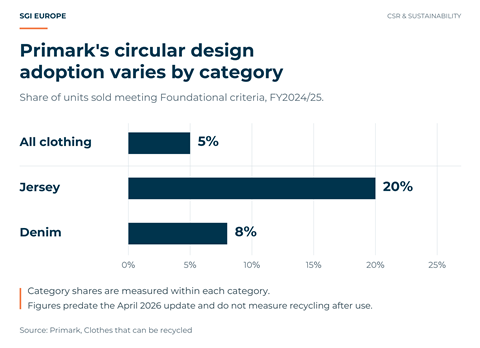
The company reports that 5 percent of clothing units sold in FY2024/25 met its Foundational criteria. The category shares were 20 percent for jersey and 8 percent for denim. Those figures predate the update and measure adoption of design requirements. They indicate how far the rules had reached the range; the preparation and recovery of returned products still require separate evidence.
This brings the issue back to the zip on LaMunt’s fleece. Keeping it for durability also creates a removal task. Assigning that task to an owner or a brand service changes the participation and resources on which recovery depends. As circular designs move into successive collections, brands need to preserve the connection between the garment they approve and the work required after use. Deciding who can carry out that work is part of approving the product.

Circular economy
Keeping products in use and recovering their materials calls for changes across the business. Reporting and analysis on circular design, repair, resale, rental and the infrastructure needed to make textile recycling work at scale.
Explore Circular Economy →