During the month-long World Cup 2022, the first to take place in a Muslim country, the Middle East and in a Northern Hemisphere winter, FIFA wants the focus of players and fans to be strictly on the game. The eight sponsors of the kits that the 32 teams will don, led by Nike and Adidas, undoubtedly want the same thing since the global spectacle provides an opportunity to reach new markets, players, fans and soccer consumers alike. But these athletic brands, like other sponsors of the event, could find themselves having to address the human rights record of the host nation that has been questioned for more than two years.
FIFA will reap record revenues from the 2022 World Cup
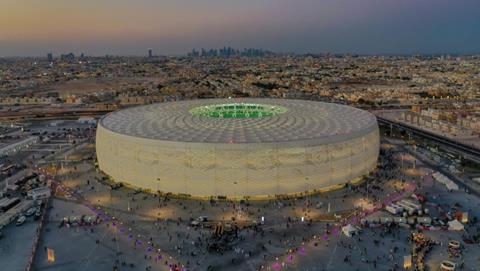
Qatar – awarded the tournament’s rights nearly a dozen years ago – is the smallest nation ever to host the World Cup and is expected to attract more than 1.2 million visitors and yield a projected economic impact of €16.4 billion. And FIFA will reportedly reap record revenues, exceeding its internal target of $6.4 billion and topping the $5.4 billion that was generated in Russia four years ago.
Human rights issues have engulfed the event for nearly two years
According to a February 2021 report by The Guardian in the U.K., more than 6,500 migrant workers from Bangladesh, India, Nepal, Pakistan and Sri Lanka died in Qatar over the last 12 years, ostensibly while working on infrastructure and stadium projects related to World Cup 2022. Legal complaints filed in 2019 by two French human rights groups, Sherpa and the Committee Against Modern Slavery (CCEM), allege numerous human rights violations by the Qatari subsidiary of the French construction company Vinci Construction Grands Projets. The charges include “labor conditions incompatible with human dignity” and “holding people in servitude.”
In recent weeks, players, artists and teams have been outspoken about Qatar’s alleged human rights record, including its stance on the LGBTQ+ community and women’s rights. Musician Dua Lipa has told Complex that “she looked forward to visiting Qatar when it has fulfilled all of the human rights pledges it made when the right to host the World Cup,” and Shakira has stepped down from performing during the event.
Denmark, which will don a Hummel kit during the tournament, recently had a request to wear “Human Rights for All” jerseys during training sessions rejected by FIFA.
App security is also a concern
Beyond human rights, Qatar has also faced criticism for the mandatory apps it will require all World Cup attendees to download. Security experts allege the two, Ehteraz for tracking Covid-19 and Hayya for entering match venues, each endangers data security and personal privacy, according to a report in the Jerusalem Post last week. Ehteraz, according to security experts, allows remote access to users’ pictures and videos and can read and write to the file system. Hayya, meanwhile, will provide free access to Qatar’s public transportation for World Cup attendees.
Some FIFA decisions may jeopardize the event’s success
And FIFA has more problems to solve – one of which is to appease Budweiser, the $75 million beer sponsor, and fans who want to drink the beverage at any of the tournament’s eight venues. Qatar banned the sale of beer in all World Cup stadiums just a couple days before the tournament began, despite previously agreeing not to do so.
Another risk for the World Cup and its commercial and public success is FIFA’s treatment of the athletes and their freedom of expression. On Nov. 21, FIFA made it clear that they would impose disciplinary sanctions if national team captains wore their own armbands with messages – especially the “One Love” armband launched by the Dutch federation KVNB and joined by seven federations playing in the World Cup, including the German Football Association (DFB) with team captain Manuel Neuer. Following FIFA’s announcement, these federations now signaled that they would refrain from wearing the armbands. FIFA explained the ban with the World Cup regulations recognized by all participants. Explicitly, the federation highlighted Article 13.8.1 of the Equipment Regulations in a statement: “For FIFA Final Competitions, the captain of each Team must wear the captain’s armband provided by FIFA.” FIFA said it supports campaigns such as “One Love,” but this must be done within the framework of the rules known to all.
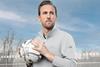
The first captain to openly violate FIFA regulations would have been England’s Harry Kane in the match against Iran. “We had been prepared to pay fines, which would normally be the case for breaches of kit regulations. However, we could not put our players in a situation where they could receive a yellow card or even be forced to leave the field,“ a joint statement said. According to experts, however, there is no regulatory basis for handing out yellow cards for a violation of the kit rules. Penalties are actually only allowed to be imposed in the form of monetary fines. FIFA’s order, therefore, remains questionable.
The Football Supporters’ Association responded with sharp words: “To paraphrase FIFA president Gianni Infantino – today LGBT+ football supporters and their allies will feel angry. Today we feel betrayed,” it read. “Today, we feel contempt for an organization that has shown its true values by giving the yellow card to players and the red card to tolerance. Never again should a World Cup be handed out solely on the basis of money and infrastructure. No country which falls short on LGBT+ rights, women’s rights, workers’ rights or any other universal human right should be given the honor of hosting a World Cup.”
Nike and Adidas will market the sport, event to consumers worldwide
Both Nike, which will outfit 13 national teams, and Adidas, which will provide seven kits (including those of Germany, Spain, Wales and Belgium), have released global commercials for the World Cup, which kicked off yesterday with the host nation’s match against Ecuador.
The Adidas spot, narrated by British rapper Stormzy, features cartoon monkey Indigo Hertz and the stars of the game, Lionel Messi and Karim Benzema. The investment in its marketing is deliberate: Adidas’ CFO Harm Ohlmeyer told investors last week that he expects a “tailwind” of up to €400 million from the World Cup.
Nike is banking on video game special effects in the Footballverse, where goofy scientists in a Swiss lab are working to determine the greatest of all time by pitting past and present players against each other.
For more interesting facts from the entire sports business, please visit our database of data visuals with downloadable infographics and charts at www.sgieurope.com/data-visuals.