The US sporting goods manufacturer has once again posted declining sales in the third quarter but made operational progress. While margin pressure and weak US business continue to weigh on the ongoing turnaround, management will be focusing on stabilization as of the coming fiscal year – analysts remain much more cautious over the timeline.
In the third quarter of fiscal year 2026, Under Armour recorded a 5 percent decline in sales to $1.33 billion compared with the previous year. North America had a particularly negative impact, while international business grew, driven by EMEA. The gross margin deteriorated significantly, falling by 310 basis points to 44.4 percent, which the company attributed primarily to higher tariffs and an unfavorable channel and regional mix. On a GAAP basis, the group remained in the red, with a loss of $150 million, but achieved a positive adjusted operating result of $26 million. The net loss widened to $431 million, mainly because of special items such as a high litigation reserve and a non-cash tax valuation adjustment. On the balance-sheet side, inventories declined slightly to $1.1 billion, while the liquidity position remained stable at $465 million in cash.
| Under Armour - Income (unaudited) | |||
|---|---|---|---|
| 2025 | 2024 | Change | |
| Q3, ended Dec. 31 ($ thousand) | |||
| Net revenues | 1,327,761 | 1,401,039 | -5.2% |
| Cost of goods sold | 738,021 | 735,884 | 0.3% |
| Gross profit | 589,740 | 665,155 | -11.3% |
| SG&A expenses | 664,540 | 637,701 | 4.2% |
| Restructuring charges | 74,980 | 13,945 | 437.7% |
| Income from operations | -149,780 | 13,509 | -1208.7% |
| Interest income, net | -8,892 | -3,391 | 162.2% |
| Other income, net | -1,584 | -2,563 | -38.2% |
| Pre-tax | -160,256 | 7,555 | -2221.2% |
| Tax | 270,604 | 6,295 | 4198.7% |
| Income from equity method investments | 33 | -26 | -226.9% |
| Net income | -430,827 | 1,234 | -35013.0% |
| Diluted EPS of Class A, B and C | -1.01 | 0.00 | – |
| 9M, ended Dec. 31 ($ thousand) | |||
| Net revenues | 3,795,209 | 3,983,727 | -4.7% |
| Cost of goods sold | 2,028,389 | 2,059,765 | -1.5% |
| Gross profit | 1,766,820 | 1,923,962 | -8.2% |
| SG&A expenses | 1,776,517 | 1,994,858 | -10.9% |
| Restructuring charges | 119,714 | 42,243 | 183.4% |
| Income from operations | -129,411 | -113,139 | 14.4% |
| Interest income, net | -21,548 | -2,794 | 671.2% |
| Other income, net | -7,221 | -8,713 | -17.1% |
| Pre-tax | -158,180 | -124,646 | 26.9% |
| Tax | 293,886 | 9,308 | 3057.3% |
| Income from equity method investments | -187 | 144 | -229.9% |
| Net income | -452,253 | -133,810 | 238.0% |
| Diluted EPS of Class A, B and C | -1.06 | -0.31 | 241.9% |
| Source: Under Armour | |||
Regional development slows turnaround
A look at regional developments underscores the continuing uneven recovery. In North America, the group’s most important market, sales declined by double digits in the third quarter. In Q2, there had been a sequential recovery. This shows that the US business remains highly volatile. Internationally, the picture was mixed: EMEA confirmed its role as a stable growth driver, while in Asia-Pacific the downward momentum slowed but business continued to decline. Latin America grew at double-digit rates, but its relatively small base limits its impact. Overall, international growth is still not sufficient to compensate for the weakness in the core market.
Revenue by region Q3 FY26
- North America: $757 million (-10% yoy)
- EMEA: $316 million (+6% yoy)
- Asia-Pacific: $191 million (-5% yoy)
- Latin America: $71 million (+20% yoy)
| Under Armour - Revenues (unaudited) | ||||
|---|---|---|---|---|
| 2025 | 2024 | Change | ||
| Q3, ended Dec. 31 ($ thousand) | ||||
| Segments | ||||
| North America | 756,726 | 843,620 | -10.3% | |
| EMEA | 315,751 | 297,890 | 6.0% | |
| Asia-Pacific | 190,885 | 201,112 | -5.1% | |
| Latin America | 70,603 | 58,990 | 19.7% | |
| Corporate Other (1) | -6,204 | -573 | -982.7% | |
| Total net revenues | 1,327,761 | 1,401,039 | -5.2% | |
| Channels | ||||
| Wholesale | 659,965 | 704,760 | -6.4% | |
| Direct-to-consumer | 646,845 | 672,948 | -3.9% | |
| Net Sales | 1,306,810 | 1,377,708 | -5.1% | |
| License revenues | 27,155 | 23,904 | 13.6% | |
| Corporate Other (1) | -6,204 | -573 | -982.7% | |
| Total net revenues | 1,327,761 | 1,401,039 | -5.2% | |
| Categories | ||||
| Apparel | 934,015 | 966,068 | -3.3% | |
| Footwear | 265,135 | 301,208 | -12.0% | |
| Accessories | 107,660 | 110,432 | -2.5% | |
| Net Sales | 1,306,810 | 1,377,708 | -5.1% | |
| Licensing revenues | 27,155 | 23,904 | 13.6% | |
| Corporate Other (1) | -6,204 | -573 | -982.7% | |
| Total net revenues | 1,327,761 | 1,401,039 | -5.2% | |
| 9M, ended Dec. 31 ($ thousand) | ||||
| Segments | ||||
| North America | 2,218,547 | 2,416,225 | -8.2% | |
| EMEA | 882,037 | 807,960 | 9.2% | |
| Asia-Pacific | 533,446 | 590,609 | -9.7% | |
| Latin America | 178,992 | 170,340 | 5.1% | |
| Corporate Other (1) | -17,813 | -1,407 | -1166.0% | |
| Total net revenues | 3,795,209 | 3,983,727 | -4.7% | |
| Channels | ||||
| Wholesale | 2,084,065 | 2,211,266 | -5.8% | |
| Direct-to-consumer | 1,648,456 | 1,703,497 | -3.2% | |
| Net Sales | 3,732,521 | 3,914,763 | -4.7% | |
| License revenues | 80,501 | 70,371 | 14.4% | |
| Corporate Other (1) | -17,813 | -1,407 | -1166.0% | |
| Total net revenues | 3,795,209 | 3,983,727 | -4.7% | |
| Categories | ||||
| Apparel | 2,617,090 | 2,671,048 | -2.0% | |
| Footwear | 794,616 | 924,357 | -14.0% | |
| Accessories | 320,815 | 319,358 | 0.5% | |
| Net Sales | 3,732,521 | 3,914,763 | -4.7% | |
| Licensing revenues | 80,501 | 70,371 | 14.4% | |
| Corporate Other (1) | -17,813 | -1,407 | -1166.0% | |
| Total net revenues | 3,795,209 | 3,983,727 | -4.7% | |
| (1) Corporate Other primarily includes net revenues from foreign currency hedge gains and losses generated by entities within the company’s operating segments but managed through its central foreign exchange risk management program. | ||||
| Source: Under Armour | ||||
What is holding up the ongoing turnaround?
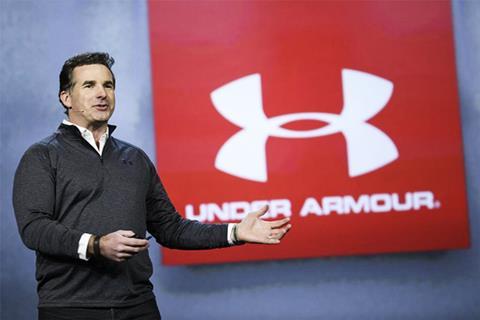
Since May 2024, with the start of the turnaround announced by CEO Kevin Plank, Under Armour has been working on a fundamental realignment of its brand, cost structure and go-to-market model. However, the third-quarter figures show that this restructuring continues to be associated with considerable friction losses. North America, the heart of the business, remains particularly volatile despite a temporary recovery and is not yet showing any signs of sustained stabilization.
At the same time, gross margin remains under sustained pressure. Footwear represents a structural weakness, while apparel is comparatively stable. Added to this are the burdens from the ongoing restructuring program, which promises efficiency gains in the long term but distorts the reported results in the short term. The turnaround is thus clearly defined and underway – but not yet far enough advanced operationally to overcome the structural weaknesses of the business.
Guidance with reservations: Management sees bottom reached
With its Q3 figures, the US sporting goods manufacturer also clarified its outlook for the current fiscal year – albeit with a clear distinction between operational performance and reported results. While the Group continues to expect a decline in sales of around 4 percent for the year as a whole, the adjusted earnings target has been raised: Adjusted operating income is now expected to be around $110 million, a range of $95 million to $110 million having been forecast in Q2. At the same time, GAAP guidance deteriorated significantly, mainly because of additional restructuring expenses, a high litigation reserve as mentioned above, and a non-cash tax valuation adjustment.
Plank explicitly classified the third quarter as the low point of the current reset and spoke of the “most challenging phase” of the restructuring in North America but emphasized that “greater stability ahead” is expected. From an analytical perspective, this choice of words underscores the central message of the guidance: the turnaround is expected to gain operational substance but will remain overshadowed by volatility and special effects in the short term. For investors, the focus is thus shifting away from the reported losses and toward the question of whether Under Armour can actually deliver on its announced stabilization in the final quarter and beyond.
Short-term price rally meets with continued skepticism
Nevertheless, the Q3 figures were initially received positively on the stock market. The share price rose by double digits in after-hours trading, supported primarily by better-than-expected adjusted earnings and the confirmed annual forecast on an adjusted basis. However, analysts remain cautious. Adrienne Yih of Barclays confirms her neutral rating but has raised the price target from $5 to $8, thereby acknowledging the operational progress. Matthew R. Boss of JP Morgan remains much more skeptical, reiterating his sell recommendation and leaving the price target unchanged at $5. Overall, the market reaction reflects the current picture: short-term relief about the operational development, but continued doubts about the pace and sustainability of the turnaround.
Positive signals: Management expects FY27, analysts expect FY28
The time horizon remains crucial. Management has indicated that the turnaround that has been underway since May 2024 should deliver its first tangible effects from the coming fiscal year onwards. CEO Plank speaks of increasing stability after the low point that has now been reached. Analysts, on the other hand, are much more conservative in their calculations and do not expect a sustained recovery until FY27 at the earliest, and in some cases not until FY28. The difference therefore lies less in the assessment of the direction than in the pace at which the restructuring can actually be translated into margin stability and growth.