The EU has made “very little progress” in its transition to a circular economy, according to a report published by the European Court of Auditors (ECA). More than 10 billion euros of investment has had little impact, with a lack of circular design and circular manufacturing processes being blamed. The report concludes that achieving the EU’s ambition of using twice as many recycled materials during the current decade as during the previous one will be “like trying to square the circle.”
What has the EU done to help move to a circular economy?
Resource efficiency has been on the EU’s political agenda for over a decade. The Circular Economy Action Plans form part of the EU Commission’s strategies on the circular economy.
In 2015, the Commission issued its first Circular Economy Action Plan (CEAP 1), comprising measures to establish the supporting regulatory framework and policy orientation, allocate EU funding and monitor the EU’s transition to a circular economy. It contained 54 specific actions.
In 2020, in response to the European Green Deal, the Commission issued a new action plan (CEAP 2). This added 35 new actions and set an aspirational target of doubling the EU’s share of material recycled and fed back into the economy (“circularity rate”) by 2030.
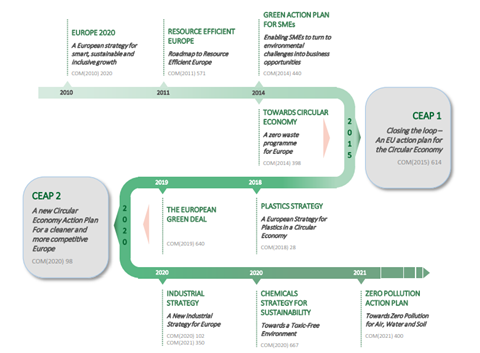
As the ECA explains, neither of these plans are binding, but they were designed to support member states in increasing circular-economy activities in recent years.
By June 2022, nearly all EU countries had a national circular-economy strategy or were in the process of developing one.
The EU also made significant funding available, earmarking more than €10 billion between 2016 and 2020 to invest in green innovation and help businesses get ahead of the curve in the transition to a circular economy.
Misdirected focus has yielded low progress in circularity
In its special report, the ECA assessed whether European Commission action had effectively influenced circular economy activities in the member states, focusing on the first action plan of 2015 onwards. The assessment revealed the Commission had not been successful.
“EU action has been so far powerless, meaning the circular transition is unfortunately almost at a standstill in European countries,” said ECA member Annemie Turtelboom.
The vast majority of the more than €10 billion funding was spent on managing waste rather than on preventing it through circular design, which probably would have had more impact.

According to the 2019 CEAP 1 Commission implementation report, 75 percent of the planned €7.1 billion in cohesion policy fund spending on the circular economy is related to implementing EU waste legislation.
There was only “limited evidence” that a range of measures to enable innovation and investment contributed effectively to a circular economy. They had only a “modest impact at best in helping businesses to produce safer products or to access innovative technologies to make their production processes more sustainable,” according to the report.
Between 2015 and 2021, the average circularity rate for all 27 EU countries increased by only 0.4 percentage points. Seven of them – Lithuania, Sweden, Romania, Denmark, Luxembourg, Finland and Poland – even regressed during that time. Therefore, the auditors conclude that the EU’s ambition of doubling its share of recycled material and feeding it back into the economy by 2030 looks very challenging.
Monitoring and incentivization could increase uptake of circular economy measures in the EU
Ending its report, the ECA made recommendations to the EU on how it could improve its circularity measure:
- Improving monitoring of Member States’ transition to circular economy
- Analyze reasons for low take-up of EU funding for circular design
- Consider scope for greater incentivization
READ MORE ON DESIGNING FOR CIRCULARITY
What is the European Court of Auditors?
The ECA is the EU’s independent external auditor and looks after the interests of EU taxpayers. It does not have legal powers but works to improve the European Commission’s management of the EU budget and reports on EU finances.
The ECA:
- Gives its expert opinion to EU policymakers on how EU finances could be better managed and made more accountable to citizens
- Audits EU revenue and expenditure to check EU funds are correctly raised, spent, achieve value for money and are accounted for.