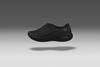
Justin Bieber’s Skylrk label has made its first move into footwear with the launch of Earth Bender, a 3D-printed sneaker created in collaboration with Hamburg-based technology firm Zellerfeld
The debut took place at a four-day Skylrk pop-up in Tokyo’s Shibuya/Harajuku district, where fans previewed the shoe in a vivid lilac colorway and inspected a neutral oat variant.
Football-inspired design meets single-piece construction
The Earth Bender’s design borrows heavily from football cleats, featuring an overturned tongue, sculptural lines and mesh-like textures printed directly into the upper to create a single-piece construction. That monolithic build is both aesthetic and functional, replacing traditional stitching and adhesive with a continuous printed form. The shoe was presented as wearable and boldly sculptural rather than purely conceptual.
Zellerfeld bridges experimental design and mainstream access
Zellerfeld’s role in Justin Bieber’s project places the Earth Bender within a broader movement to industrialize 3D-printed footwear. The Hamburg-based company has already worked with major players such as Nike and luxury brands and is developing performance styles with athlete-led ventures. Industry reporting describes Zellerfeld as positioning itself as a bridge between experimental design and mainstream accessibility – making it an ideal partner for Skylrk’s tech-forward vision.
Additive manufacturing reduces waste, enables circularity
Sustainability and production efficiency are central to both the shoe’s narrative and Skylrk’s broader brand philosophy. Zellerfeld’s additive process reduces material waste by printing only what is required and supports recyclable constructions, aligning the launch with rising consumer demand for environmentally conscious fashion. This commitment to innovation over mass production reflects Skylrk’s founding principles. Zellerfeld has publicly signaled ambitions for decentralized production and a circular approach to footwear, aiming to localize printing capacity and recycling streams.
Tokyo pop-up showcases personality-driven lifestyle vision
The Tokyo pop-up exemplified Skylrk’s personality-driven approach, doubling as a lifestyle showcase. Alongside the Earth Bender, Skylrk displayed slides, hoodies, sunglasses and novelty accessories. Hailey Bieber contributed a design to the event, a Rest Slipper in a shade dubbed “Hailey Grey”, and the space included a tongue-in-cheek phone case adaptation inspired by her Rhode Lip Case. The family collaboration underscored Skylrk’s positioning as a personality-driven lifestyle label that prioritizes immersive retail experiences over conventional product drops.
For Skylrk, the Earth Bender marks a significant expansion beyond the apparel and accessory lines established when Bieber and Neima Khaila launched the brand earlier this year. The move into footwear was framed by Skylrk as an embrace of innovation rather than an attempt to replicate legacy manufacturing models. Industry coverage notes Skylrk has additional 3D-printed styles in development with Zellerfeld, though wider release plans remain unconfirmed.
Celebrity backing gives 3D printing mainstream visibility
Celebrity involvement in 3D-printed footwear is no longer novel, but Bieber’s entry gives the technology heightened mainstream visibility while staying true to Skylrk’s founding mission. Earlier celebrity projects with Zellerfeld and other makers have shown the format’s appeal across generations and genres – commentators suggest the Earth Bender may push conversation about what celebrity-driven sneaker launches can look like when rooted in technological experimentation rather than simple co-branding.
Historical context places Bieber’s initiative within a lineage of artist-led sneaker ventures that reshaped culture and commerce. From early licensing deals that blended music and athletic fashion to later collaborations that fused scarcity-driven hype with design innovation, the Earth Bender represents a tech-forward iteration of that trajectory, one that emphasizes modular design, reduced waste and rapid iteration – values that sit at the heart of Skylrk’s identity.
Launch signals shift from experimental to consumer-facing
Whether the Earth Bender becomes a mass-market product or remains a limited, collectible release, its debut signals a turning point for sneaker culture in 2025 – additive manufacturing is shifting from experimental showcases to consumer-facing drops backed by established creative names. For Skylrk and Zellerfeld alike, the launch functions as both a product moment and a statement of intent about the future of footwear, one that aligns perfectly with Skylrk’s vision of building cultural relevance through innovationrather than mass-market saturation.
Visualizza questo post su Instagram
About Zellerfeld
Zellerfeld is a footwear technology company founded in 2015, named after the German town of Clausthal-Zellerfeld where co-founder Cornelius Schmitt studied engineering. The company operates across the United States and Germany, with headquarters in New York/Brooklyn and a large-scale 3D printed footwear production facility in Austin, Texas, serving the American market.
In Germany, Zellerfeld maintains significant R&D and manufacturing operations in Hamburg. The company’s mission is to achieve “printed shoes on every foot” by using proprietary 3D printing systems to produce fully customized, single-material footwear from recyclable zellerFOAM, eliminating stitching, glue and traditional sizing. This on-demand, additive manufacturing approach reduces production waste and supply chain complexity.
Zellerfeld also operates an open platform – often called the “YouTube of shoes” – allowing designers and brands to upload and sell unique 3D footwear designs globally, democratizing the design and production process in the footwear industry.