In an era where the socio-economic impact of major sporting events (MSEs) like the UEFA Euros and the Paris Olympics is scrutinized, 4GLOBAL offers vital insights into how these events can transform host cities and communities. This analysis delves into both the tangible and intangible benefits these spectacles bring, providing a data-driven perspective on their legacy.
Major sporting events are more than just global entertainment; they are in the best case catalysts for job creation, infrastructure improvement, and cultural activities. When done right these events drive substantial economic activity and enhance the social fabric of host cities, creating lasting impacts on local communities.
Participation data analysis by 4GLOBAL provides a window into the influence of major events and the growth of grassroots sports participation.
Spotlight on UEFA Women’s EURO 2022: Driving change beyond the field
The UEFA Women’s EURO 2022 was not just a tournament; it was a strategic opportunity to elevate women’s football. From grassroots participation to professional levels, the event set high benchmarks in a pre-tournament impact report:
- Aiming for attendance targets between 480,000 to 525,000.
- Enhancing the perception of women’s football in the UK, with a planned viewership of 51% among football fans.
- Generating £54 million in economic activity and supporting 96,000 international visitors.
These ambitious goals underscore the potential of MSEs to foster significant economic and social benefits.
Data-Driven insights: Participation and legacy
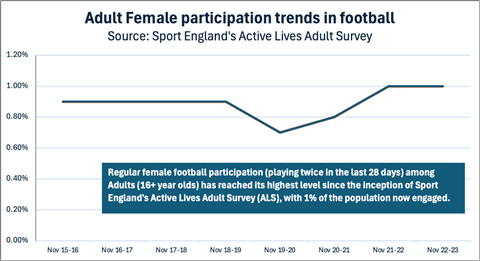
Mid-term participation data analysis from Sport England and 4GLOBAL’s DataHub show the influence of the UEFA Women’s EURO 202 on grassroots sports growth. For instance, the Active Lives Survey highlights a nuanced recovery in football participation levels post-pandemic, with adult female participation reaching unprecedented heights since the survey’s inception. While overall participation has realigned with 2018/19 levels, it has not yet returned to the peaks observed in 2015/16.
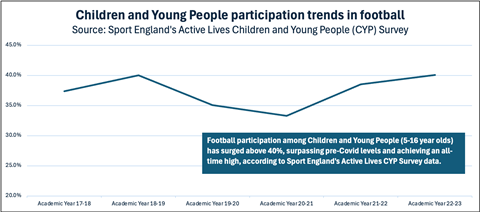
Among children and young people, participation is at an all-time high, with notable advances in girls’ participation outside school settings, marking a 19% engagement rate—a record increase. The UEFA Women’s EURO 2022 has particularly spurred this uplift, showing a 15.5% rise in girls’ participation in football, suggesting the profound influence of major sporting events on youth engagement in sports.
Analyzing the socio-economic value of football participation
The 4GLOBAL DataHub, through its collaboration with Sheffield Hallam University, provides comprehensive insights into the social benefits of football participation. This partnership has led to the Social Value Calculator’s development, which quantifies football’s positive impacts. According to the Social Value Calculator, football participation between 2021 and 2024 generated an average social value of £101 per person. This valuation reflects the extensive benefits football provides, encompassing physical and mental health improvements, enhanced subjective well-being, and contributions to individual and community development.
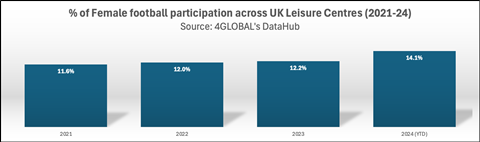
The general trend of participation levels reflects growth year on year, notably with female visits to leisure centres increasing from 11.6% to 14.1% in 2024. This increase resulted in a YOY growth in social value creation of 13.1% within female participants. Neil Tandy of 4GLOBAL: ”This data underscores a shift towards broader demographic engagement in football, emphasizing an increased participation rate among females, which enhances the social value and broadens the impact of the sport within community settings.“
Future orientations: Sustaining momentum and building legacies
Looking ahead, the planning and execution of MSEs are pivotal. 4GLOBAL’s strategic insights suggest that:
- Early integration of MSE planning with city and government initiatives enhances the success of these events.
- Visionary legacy planning with clear KPIs and objectives is crucial for sustained benefits.
By employing a community-level, place-based approach, MSEs can serve as a powerful catalyst for sports development and societal enrichment.
Commitment to community and innovation
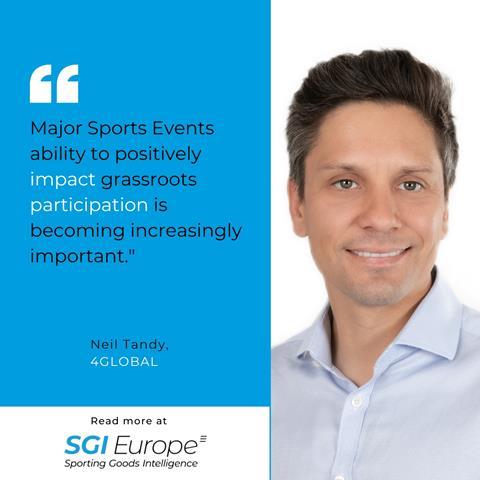
Tandy emphasizes the evolving role of MSEs, noting, “Major Sports Events have long been attractive for brands due to their coverage and prestige. However, their ability to positively impact grassroots participation is becoming increasingly important.” This shift reflects a broader trend toward leveraging sports for comprehensive community development.
4GLOBAL’s continued analysis and collaboration, including with the World Health Organization, highlight its commitment to leveraging data for social good, ensuring that sports serve as a bridge to greater health and community cohesion.
By integrating data insights with proactive community engagement, MSEs can indeed be transformative, promoting not just athletic excellence but also enhancing the quality of life for communities worldwide.
4GLOBAL is a UK-based data services and technology company, empowering clients with actionable insights to maximize health and social benefits derived from physical activity.
4GLOBAL acknowledges the power of sport to transform lives – even save lives – and see our purpose as finding new and exciting ways to get people active through the intelligent use of data from across the sector.
4GLOBAL’s DataHub is the largest repository for sport and physical activity participation data in the UK and Europe, integrated and enhanced through a suite of business intelligence solutions. The DataHub provides actionable insights across the entire sports ecosystem, including government, cities, federations, and private and public activity providers. Currently, it is tracking the activity patterns of millions of people through billions of datapoints and is still growing. All data collection, storage, and usage are fully GDPR compliant. For more information, visit our website - https://4GLOBAL.com or get in touch with Neil Tandy – neil.tandy@4global.com.