With 104 games spanning multiple kick-off windows, the biggest football tournament in history is also the most fragmented, and the marketing model built on shared prime time moments no longer holds.
Around six billion people are expected to engage with the FIFA World Cup 2026 across broadcast, streaming and social platforms, making it the most widely consumed sporting event in history, according to FIFA projections reported by Forbes. Yet the defining commercial challenge of the tournament is not reach. It is simultaneity. Or rather, the absence of it.
For the first time in the tournament’s history, the World Cup is distributed across three host nations: the United States, Canada and Mexico. Forty-eight teams, 104 matches, 16 cities and multiple kick-off windows across three time zones mean that the shared prime-time broadcast moment, the bonfire around which brands have built their sports marketing strategies for decades, no longer exists in any reliable form.
Scale dilutes the moment and raises execution risk
FIFA expects to generate $2.8 billion in sponsorship income from the 2026 edition, up from $1.8 billion in Qatar in 2022. The expansion of the field by 50 percent created more commercial inventory: more games, more airtime, more hospitality, more content windows. Total projected tournament revenue sits at $13 billion, according to Barron’s.
But the tournament’s geographic expansion adds a layer of complexity no prior edition has faced. Ricardo Fort, who previously oversaw global sponsorships at World Cup partners Coca-Cola and Visa, argued in comments reported by SportsPro that a sponsor in 2026 is no longer planning one event. It is effectively managing dozens of interconnected ones. In his view, the brands most likely to succeed will resist the instinct to activate everywhere equally.
Scale is only an advantage when paired with strategic discipline, particularly given the tournament’s operational footprint.
From broadcast window to content ecosystem
What changes most fundamentally in 2026 is the relationship between the match and the moment. For European audiences, many games kick off at 10 pm, 1 am or 3 am local time. Across Asia and the Middle East, the timing is no easier. The match is live. The conversation is not.
Holger Hansen, Executive Director Sport and Entertainment at Publicis Groupe, sets out the structural shift in market commentary ahead of the tournament: the event still happens, but its social processing is distributed. One viewer watches live. Another catches the highlights in the morning. A third encounters only the 18-second clip that circulated overnight. All three talk about the same scene, from different points of entry.
According to research by Publicis More in Germany, reported by the German B2B media outlet Meedia, 67 percent of 18- to 75-year-olds in Germany plan to follow the tournament in some form. But interest no longer converges into a single shared moment.
The pattern extends well beyond Germany. Across Europe and in major markets globally, fans increasingly access football through fragmented channels that suit their schedules rather than those of broadcasters. Among Gen Z audiences, the same research puts social media as the primary World Cup coverage source for 39 percent, against 26 percent of the general population.
For this group, Instagram, YouTube and TikTok are not supplementary channels. They are the tournament.
The implication for brands is significant. The most commercially valuable moment may not be the live broadcast. It may be the debate that follows a controversial call at 2 am, the creator commentary uploaded by mid-morning, or the cultural reference that turns a goal celebration into a meme. Brands that continue to operate on a prime-time logic – big spend, single window, broad message – will be present on the pitch-side boards while missing the actual conversation.
What the sports brands are doing
adidas offers one of the clearest illustrations of how brand presence is shifting beyond the broadcast.
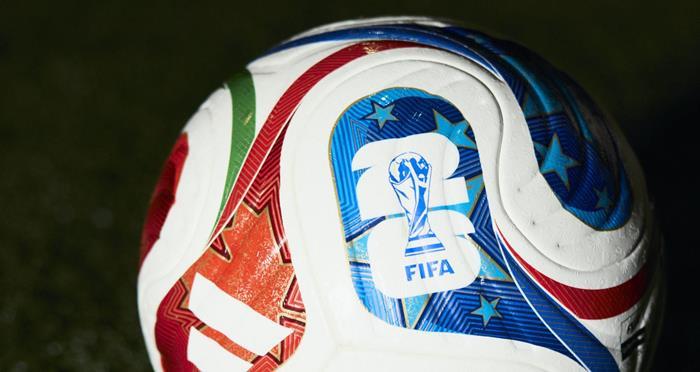
As the official match ball supplier, the company already occupies the most product-visible position in the game. Every match moment features the Trionda, the official ball designed to reference the three host nations through a new four-panel construction and a color system tied to Canada, Mexico and the United States.
But it is adidas’s collaboration with WhatsApp that reframes where that visibility now matters.
In a partnership announced on June 4, the platform’s football emoji was transformed into a digital version of the Trionda ball. Each time users send the emoji, it appears as the official match ball, embedding the product directly into conversations, predictions and reactions across billions of messages.
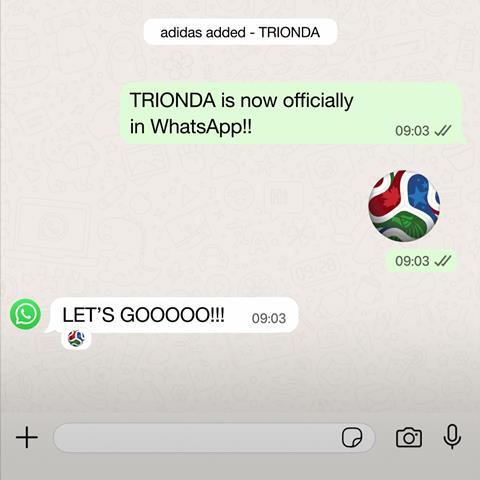
According to WhatsApp’s own data cited in the adidas announcement, the platform recorded more than 25 million messages per second during the 2022 World Cup final, a volume expected to be exceeded in 2026.
Rather than relying solely on broadcast exposure, adidas is placing its most visible asset inside the flow of private communication, where much of the tournament’s real-time cultural exchange now takes place.

The broader product deployment reflects the same logic. adidas is supplying kits for 14 national teams alongside the “Road to Glory” boot pack, originals apparel, several collaborations and a campaign, “Backyard Legends,” anchored in 1990s streetwear nostalgia and free play rather than elite performance.
Nike has designed a structurally different strategy to match it. Its campaign arrived in two movements: the first, on May 21, was anti-spectacular: a series of lo-fi Polaroid photographs featuring athletes, artists and cultural figures, designed to generate speculation rather than immediate satisfaction.
The second, on June 4, was “Rip the Script”: a six-minute film set inside a Hollywood mega-studio, with a cast running to more than 30 names including Cristiano Ronaldo, Kylian Mbappé, Erling Haaland, Vini Jr., LeBron James and Kim Kardashian. But the film is explicitly not Nike’s campaign. It is the entry point to what the brand calls its “Universe of Nike Football”: a 12-week distributed rollout of product launches, cultural collaborations, community activations and serialized content designed to sustain presence through the full tournament cycle rather than peak and fade after a single broadcast moment.
All, rigorously, social-first.
What broadcasters are doing, and why it matters to brands
Traditional broadcasters have not stepped back. But those paying attention recognize that the audience they are addressing no longer fits a single description.
The BBC’s World Cup campaign “Let’s Make It Iconic” is a useful case study in how a national broadcaster tries to hold that fragmented reality together. The film combines live action, 2D animation, hand-crafted elements and stop-motion to transform supporters’ scarves, enamel badges and flags into layered “fanvases” where past and present football collide. The aesthetic choice is deliberate: craft over synthetic polish, texture over algorithmic smoothness, human fingerprints over generated imagery.
But the deeper ambition is sociological, not stylistic.
Across Europe and beyond, millions of people will watch this tournament while supporting different teams depending on where they were born, where they live now and who they are watching with: a Moroccan-British family in Birmingham, a Brazilian community in Paris, a Mexican diaspora spread across Los Angeles and Chicago.
For many, the World Cup is not one conversation but several: some happening over WhatsApp with relatives in another country, some in a bar, some on a beach, some on a phone screen at 1 am while the rest of the house sleeps.
The BBC campaign tries to speak to all of them at once, weaving together heroes from different eras, nations and cultural registers into a single visual language. Whether it succeeds is a separate question.
What it signals is that even the most historically homogeneous national broadcasters now understand their audience is plural, and that plurality becomes visible in football too, once a territory for national affiliations.
For brands, the lesson runs parallel. Activation built around a single national identity, a single screen or a single peak moment will reach part of the audience. The rest are elsewhere: on different devices, in different time zones, carrying different flags and having entirely different conversations about the same tournament.
The strategic question no sponsor can avoid
The commercial structure of the 2026 World Cup is, on paper, the most favorable in the tournament’s history. More games. More countries. More audiences. Larger rights fees. The sponsorship portfolio spans three formal tiers — global multi-year partners, tournament-specific global sponsors and regional partners — with brands including Visa, Hyundai-Kia, Qatar Airways, Aramco, Coca-Cola, Lenovo, AB InBev, Frito-Lay, Hisense, McDonald’s and Airbnb alongside adidas and Unilever.
But abundance hides a risk.
The tournament is large enough to absorb any amount of spend without guaranteeing that any of it registers. Brands face the real possibility of becoming invisible noise: present on the boards, absent from the conversation.
The ones that avoid that outcome will be those that arrive with a coherent answer to a prior question: what specific job, for which specific audience, does this sponsorship actually do?
The answer will vary across a portfolio spanning financial services, packaged goods, energy, mobility, technology and sportswear. For sporting goods brands and their commercial partners, the tournament is more concentrated: a moment when football attention peaks, brand associations are formed or reinforced at scale, and the gap between a brand with a long-term strategy and one with only a short-term budget will be visible in performance data long after the final whistle at MetLife Stadium on July 19. There is more at stake than selling replica shirts for a few weeks.
FIFA World Cup 2026: The Business of the Beautiful Game
How brands, retailers, and the sports economy compete on football’s biggest stage.
Explore Our Coverage →