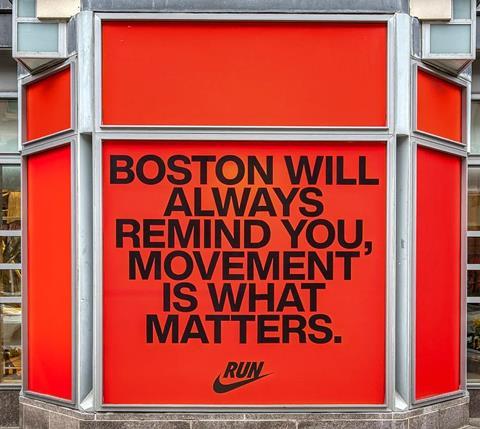
Nike’s “walkers tolerated” window display near the Boston Marathon finish line drew swift criticism from runners and adaptive athletes – and faster action from Asics, which posted a rival message nearby.
Nike put up a window display in Boston ahead of the marathon.
It came down before the race.
The weekend in between was the problem.
The display, at the brand’s Newbury Street store – a few hundred meters from the finish line of the Boston Marathon – read: “Runners welcome. Walkers tolerated.” Images began circulating on social media around April 13. By April 18, the sign was gone. Nike issued a statement, posted a replacement, and the story went international.
Visualizza questo post su Instagram
Adidas holds the Boston Marathon’s title sponsorship. Nike’s Newbury Street store activation was a street-level intervention in a race weekend the brand has no official presence in. It may have been a clever guerrilla campaign. It backfired.
Asked by several outlets, Nike said: “We want more people to feel welcome in running – no matter their pace, experience, or the distance. During race week in Boston, we put up a series of signs to encourage runners. One of them missed the mark. We took it down, and we’ll use this moment to do better and continue showing up for all runners.”
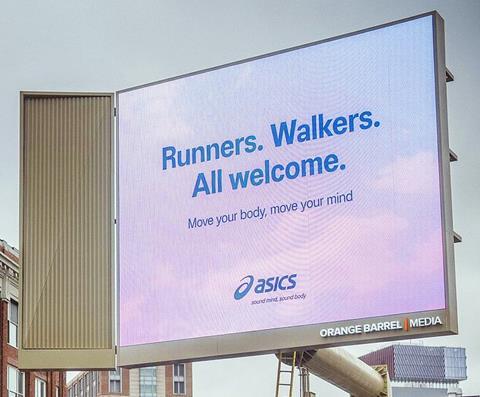
Asics, which also has no official Boston Marathon sponsorship, installed a billboard near Fenway Park reading: “Runners. Walkers. All Welcome,” followed by “Move your body, move your mind.” It went up without a press conference. Someone knows what inclusivity means. Anima sana in corpore sano.
“Thank you for tolerating me, @Nike”
The Boston Marathon is not only one of the most competitive road races in the world – it is also one of the most important events in the para-athletics calendar, with a long-established wheelchair division and categories across adaptive classifications. The sign landed accordingly.
The criticism that cut deepest did not come from recreational runners who felt their pace was being judged. It came from athletes in the adaptive and para divisions.
Robyn Michaud, qualifying for the Boston Marathon’s adaptive division for the fifth time on Monday, posted on Instagram: “Due to a spinal cord injury I HAVE to take walk breaks. Even with a cyst in my spinal cord, I still regularly break 5 hours in Boston and plan to again this weekend. Thank you for TOLERATING me, @Nike.”
Nicole Homerin, running her ninth marathon despite a heart condition, told GBH that the sign dismissed every form of movement that isn’t running – “rolling, strolling, dancing, whatever mobility device that allows for freedom of movement” – and reflected what she called an ableist culture in competitive running.
To be fair to Nike’s original intent: Boston’s entry standards are genuinely demanding. Men aged 18–34 must have run a qualifying marathon in 2:55 or faster; women in the same age group in 3:25 or faster. The sign had an audience in mind. It just also had an audience it hadn’t considered.
Editor’s note, April 22, 2026
Not everyone thinks Nike should have folded. Writing in The Drum, Rory McEntee, CMO at GymNation, argues that the sign was the right message for the right space – and that the retreat was the real mistake. His case: Nike once stood behind Colin Kaepernick while the stock dropped and the president weighed in. It couldn’t hold a window display for a week.