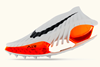
Nike has come up with a third iteration of the “air” idea, this time with an AI twist. (We note in passing an obvious thing: that “AI” is two-thirds of “air.”)
As Nike describes the proceedings, with this latest iteration – A.I.R., an acronym for ”athlete imagined revolution” – the company’s designers spend a lot of time walking back and forth along two axes: the first between their workshops and wherever it is that they meet the athletes they design for, the second between their workshops and the big 3D printer across the hall.

The workshops in question are in the Concept Creation Center (CCC), on the second floor of the Lebron James Innovation Building, about a mile from corporate headquarters in Beaverton, Oregon.
And the project connected with A.I.R., at least for now, is the design of 13 shoes for 13 athletes: basketball player A’ja Wilson, tennis player Zheng Qinwen, Paralympic tennis player Diede de Groot, sprinter Dina Asher-Smith, hurdler Rai Benjamin, footballer Erling Haaland, footballer Sam Kerr, marathon runner Eliud Kipchoge, middle-distance runner Faith Kipyegon, footballer Kylian Mbappé, sprinter Sha’Carri Richardson, footballer Vinicius Jr. and basketball player Victor Wembanyama.

All the athletes were invited to explain what they’d like in a shoe. Was the design to be – in Nike’s terms – conservative or wild, holistic or defined by some component, monolithic or fractal? What about the athletic backgrounds and inspirations? Each athlete’s shoe was assigned a separate eight-foot “mood board” at the CCC, and there the designers were to post all of their digital renderings, sketches and samples of materials. Roger Chen, Vice President of NXT and Digital Product Creation, calls this getting at the “athlete’s truth,” and Nike, in turn, defines it as “soul-deep confidence that every element” of the shoe is helping the athlete to win.
The designers transformed the results of this interrogation into command prompts and fed these, along with some notion of “air,” into an AI machine. The machine made its algorithmic interpretations and spit out hundreds of pictures per athlete, which the designers pored over.
These “starting points,” says Chen, used to take months to create and now take seconds. For Chen, AI is a “sharper, more intelligent pencil,” but a designer still needs to wield that pencil, and the “listening sessions” with athletes are a prerequisite. Only afterward can Nike give “these generative programs entire worlds to reflect back to us.”

From the AI’s “forms, textures, generative figures” and “entire worlds,” says Nike, the designers would “zero in on three radical shoe concepts” – three per athlete, that is. Apparently, the machine will sometimes get carried away with “organic” and “flowy” forms, which the designers must wrestle back into “homogenized concepts.” Some of the AI’s ideas are “laughably wild,” Nike says, and if realized, “would never hold up to the rigors” of use. Other times it’s the designers themselves that get carried away.
Presented with some “homogenized concepts,” marathon runner Kipchoge played practical man to the lab coats, setting aside the concepts and making some sketches of his own on the spot. He wished to fill in a “caved-out area” near the heel of his shoe design because he believed that a physical shoe would collect debris as he ran.
The rubber hits the road, so to speak, with the creation – and the printing – of prototypes. Once they have something to hold, says Nike, the designers ask whether it “reads” like a certain kind of athletic shoe and ask why or why not. And, if a prototype reads right, they’ll ask: “What insights from A.I.R. could someday help shape future product?”
The two other “airs”
The second iteration of the “air” idea also came from an athlete – and his nickname. This was Michael “Air” Jordan, of course. The Air Jordan 1 shoe was designed in 1984 and released in 1985. The designers were Peter Moore, Tinker “The Architect” Hatfield and Bruce Kilgore. There have since been at least 20 versions of it (viewable on Nike’s retrospective webpage). The famous logo, Jumpman, made its debut on the third.
But in the Jordan series, aesthetics dominate the design. The first iteration of “air”, by contrast, was a project for a tinker in a garage – the stuff of patents. It was grounded in the world of pressure and friction, materials and wear, not the “entire worlds” of algorithmic whimsy. Back then, it was: “Here’s the idea. We don’t know what it will look like, and for now we don’t care. First we’ve got to get the thing to work.”
The tinker, in this case, was no Nike designer. He was an aerospace engineer called Marion Franklin Rudy, and he conceived a sole-bound bag of air to cushion some of those pressures and impacts. At Sneaker History you can watch him explain on video the trouble he went to for a “cat’s paw” that “simulates what’s happening in your lungs.” He begins in a neo-baroque living room, but soon he’s speaking from a workshop, like a tinker, with a pegboard of wrenches and pliers and saws behind him.
As Design Taxi recounts, Rudy mentioned his idea in 1977 to Phil Knight, co-founder of Nike, who used it the following year in the Nike Tailwind running shoe, and then in the 1980s, research published at the University of Tennessee found that the Tailwind cut down on runner’s energy expenditure. Then, in 1986, came the Nike Air Max 1, which gave us the sneaker world’s answer to watchmaking’s skeleton dial: a window into the works, a hole in the sole to expose the air-bag.
Reebok stole some of Nike’s thunder in 1989 with its inflatable Pump shoe, and Nike replied the same year with a pump shoe of its own, the Air Pressure. The novelty of this, in the sense of both newness and parlor tricks, gave rise to a number of gags – notably a Thanksgiving skit on the American comedy show Saturday Night Live. It turns out, however, that the newness was only apparent. Neither the Reebok nor the Nike was the original pump shoe. In fact, where there’s a pump shoe, there is also an air-bag, so even Rudy’s idea wasn’t new.
Back in 1893, as we learn from DeFyNewYork, Fillmore Moore from Farmington, Connecticut, patented the pneumatic sole, “whereby jars and shocks are reduced” and whose inflation valve “may be the same, or substantially the same[,] as that used for inflating foot-balls.” But this was no athletic shoe.
The sports market, it appears, didn’t see a pump until 1983. This was the founding year of the Aero Shoe Corporation, which right away introduced what it called “the only true air-cushioned running shoe.” This had a valve on the side where you would connect a manual pump – the kind of pump that, if you’re old enough, your doctor has used to inflate an armband and take your blood pressure. Aero Shoe’s product failed to catch on, and the company was dissolved in 1988. (TheDeffest.com has posted the shoe’s print ad online.)
Other pump shoes followed, by Reebok and Nike, of course, but also Adidas, L.A. Gear, Franklin, and others. (Several pump-shoe ads and a brief review of some related lawsuits are available for perusal online.) Still, the idea has since run out of gas. According to DeFyNewYork, Nike stopped making pump shoes in 1992.