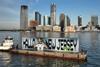
Nike floated a billboard past the Statue of Liberty to preview Germany’s post-adidas future: a €100m-per-year deal that ends 70 years of three-stripe history.
It was the kind of stunt that stops traffic — or at least makes people on the waterfront look and wonder. On June 25, as Germany prepared for their group stage match at MetLife Stadium in East Rutherford, New Jersey, Nike floated a billboard on a cargo boat down the Hudson River bearing the message “Hallo New Jersey.” On the billboard: Jamal Musiala, the German national team’s most marketable talent, wearing a pixelated white shirt.
Visualizza questo post su Instagram
The pixelation was not an accident.
Nike is not yet permitted to show the new kit in full: its contract with the Deutscher Fußball-Bund (DFB, the German Football Federation) does not officially begin until January 1, 2027. But the message was unmistakable. The Swoosh is coming, and it wants you to know it before adidas has even packed its bags.
€100 million a year
The backstory is now well documented in the sporting goods industry. In March 2024, the DFB announced it would end its partnership with adidas after the current contract expires: the relationship dates to 1954, the year West Germany won its first World Cup while still under Allied occupation.
From 2027 through 2034, Germany’s national teams will be outfitted by Nike, which is understood to be paying around €100 million per year: this is roughly double adidas’ previous rate, according to multiple reports.
For adidas, the German born brand whose identity has been intertwined with German football for over seven decades, this is something between a business setback and a national conversation topic. When the switch was announced in 2024, political figures in Germany criticized the move as prioritizing commercial considerations over sporting heritage.
The kit itself: pixelated, but readable
What Nike has shown is already telling. The tease points to a classic white base with a thick black round collar and the DFB eagle alongside the Swoosh. Multiple reports cite resemblances to Germany’s 1974 World Cup strip, the shirt Franz Beckenbauer wore when West Germany lifted the trophy in Munich. The full reveal is expected before year end.
The guerrilla activation, which involved sailing from Staten Island past the Statue of Liberty and up toward the Manhattan skyline, was theatrical. Nike’s Global Vice President of Football, Camilo Andrade, told Sportico the company understands the weight of taking over from a rival so embedded in the team’s identity: an acknowledgment that the transition carries commercial as much as creative risk.
Fan reaction: mixed, but edging toward curious
Among supporters, the mood is not uniformly resistant. Fan reactions reported by Sportico ranged from nostalgia tinged disappointment to cautious openness, with some welcoming a design refresh after decades of the same supplier.
The commercial power of a jersey
National team kits are among the highest-volume licensed products in football. A kit change of this magnitude, for a four time World Cup winner at a reported €100 million per year price point, is a strategic bet for both parties. Nike is buying credibility in the European football heartland; the DFB is banking on a brand with greater global youth reach to grow its commercial footprint.
On the world cup, to let the future be previewed.
Launching this activation during Germany’s last World Cup in adidas, while the team is still competing and still wearing three stripes, carries a calculated edge. Nike embedded a small “Erscheint 2027” (“coming in 2027”) sign as an Easter egg in its World Cup advertising earlier in the tournament. The Hudson boat was the escalation. One era is being visibly counted down while another is already being marketed.
The DFB deal is a high stakes proof of Nike’s ambition in football kit partnerships, and a reminder that even the most storied supplier relationships have a price, and sometimes an end.