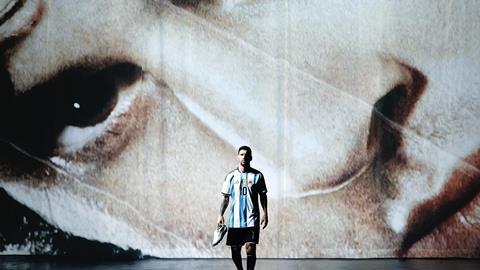
Twenty years after his World Cup debut, Lionel Messi bounced back from a missed penalty to become the all-time leading goalscorer in World Cup history, and adidas was ready for every second of it.
Visualizza questo post su Instagram
The moment the ball crossed the line in Arlington, Texas on June 22, the brand fired a prepared campaign image across its channels: Messi alongside balls from each of his six tournaments, the caption reading “Record Breaker. History maker.” The deployment was instant. The narrative had been two decades in the making.
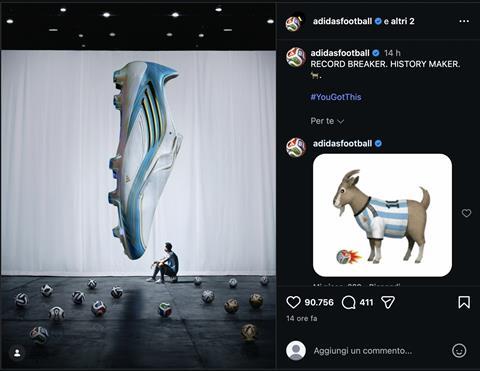
adidasfootball on Instagram: RECORD BREAKER. HISTORY MAKER. 🐐.
A man and his boots
Messi scored his record-breaking 17th and 18th World Cup goals, surpassing first Miroslav Klose’s men’s record of 16, then Marta’s all-tournament mark of 17, wearing the adidas F50 Elite “El Último Tango,” a signature release built around the arc of his international career. The design traces back to the F50.6 TUNIT he wore at his 2006 World Cup debut in Germany, now reimagined on adidas’ current F50 Hyperfast platform. The ivory, Semi Blue and Icey Blue colorway maps onto Argentina’s national identity without being heavy about it; gold accents appear sparingly.
Visualizza questo post su Instagram
The boot market adidas is fighting to dominate
The F50’s prominence at this World Cup is not just about Messi, and not just about adidas. As SGIE reported, five competing brands independently converged on the same electric fuchsia colorway for their tournament collections, a coincidence of shared forecasting data and kit logic that turned the pitch into a single chromatic block. Within that visual noise, product leadership still matters: according to data from Footpack, the F50 has emerged as the most worn boot at the 2026 tournament, used by 228 players, an 18.27 percent share. The Nike Mercurial sits second at 213 players (17.07 percent). adidas’ Predator comes third at 12.82 percent.
That is a meaningful reversal of a recent trend. Nike held the majority of player boot share at the 2018 World Cup, sliding to around half in Qatar in 2022. Its current share stands at an estimated 43 percent, still the overall leader by player count, with 534 athletes, but the gap with adidas has narrowed sharply.
Among the challengers, Skechers is using ambassador Harry Kane for meaningful tournament visibility, while New Balance and Japan’s Mizuno occupy tightly defined niches. The top three, Nike, adidas and PUMA, still dominate with more than 90 percent of players. The F50 overtaking the Mercurial as the most worn boot is the kind of product signal that brand strategy teams at both companies will be watching closely.
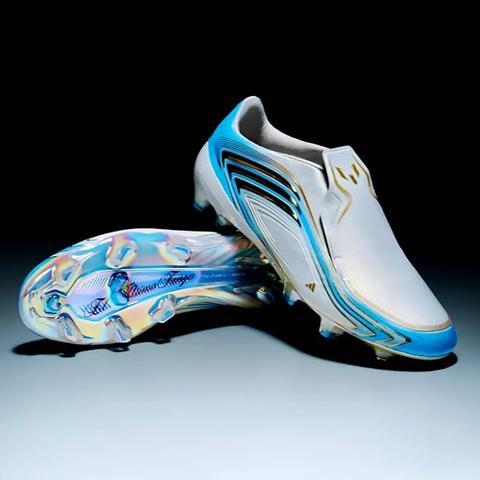
F50 Elite “El Último Tango”
How adidas prices a record-breaking moment
The collection is tiered: Elite at around €280, Pro at around €170, League in the €90–€100 range, with junior tiers at around €130, depending on geography and shop. That ladder is designed to convert the headline visibility of Messi’s record-breaking moment into transactions at every price point.
The last dance and the next one: ambassadors, records and the generational handover
Nike’s current ambassador roster at this tournament includes Kylian Mbappé, Erling Haaland and Cristiano Ronaldo. adidas counters with Messi and Lamine Yamal. Mbappé is 27 and chasing the same records Messi just broke, and will likely surpass them in time. Nike is betting on the future. adidas is betting on the present — and on the narrative pull created by 20 years of World Cup appearances.
Mbappé scored twice for France against Iraq on the same night Messi broke the record, reaching 16 World Cup goals. He sits fourth on the all-time list. The boot battle is now also a changing of the guard: one last dance, and somewhere on the same pitch, the next one beginning.
FIFA World Cup 2026: The Business of the Beautiful Game
How brands, retailers, and the sports economy compete on football’s biggest stage.
Explore Our Coverage →