

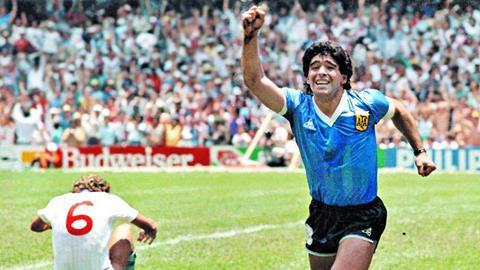
On June 22, 1986, Maradona wore a makeshift Le Coq Sportif shirt at the Azteca and scored two goals football has never stopped debating. Forty years later, the brand and the unified Maradona estate launched an eight-piece collection in Paris, timed to the World Cup and Men’s Fashion Week.
On June 22, 2026, Lionel Messi broke the all-time men’s FIFA World Cup goalscoring record playing for Argentina against Austria in Arlington, Texas. It was, by any measure, a historic afternoon. It was also, to the day, the 40th anniversary of the match in which Diego Maradona scored two of the most discussed goals in the history of the sport - one with his fist and one with his feet - against England at the Azteca Stadium in Mexico City. Two Argentine No. 10s. The same date. Forty years apart.
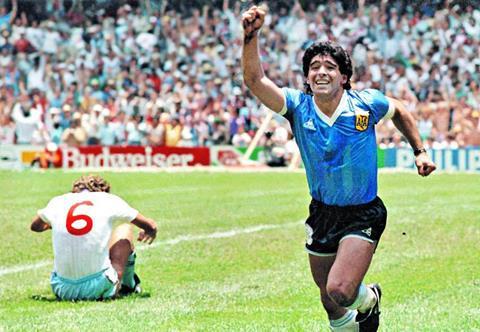
The symmetry is striking, and what it means depends largely on personal belief.
June 22 was the date Le Coq Sportif had been building toward: an anniversary that let the brand tie a new product story to an old one. The French sportswear company, Argentina’s official technical kit supplier from 1980 to 1989, launched a capsule collection this week timed to the milestone. It debuted at a Paris event scheduled between the Arlington match and the opening of Paris Men’s Fashion Week.
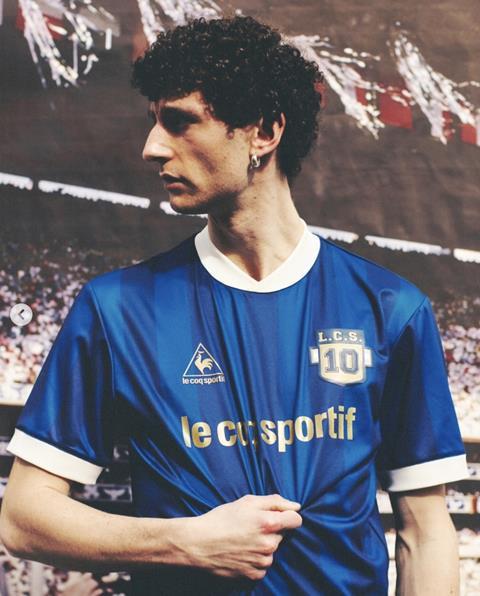
The collection includes eight pieces. The defining one is a dark blue shirt Maradona wore in Mexico City four decades ago, a shirt that was not quite what it seemed. Since the launch, fans at the 2026 tournament have also chased replicas of the shirt Messi wore when they broke the record: a different, much paler blue, the albiceleste home kit that has become the most coveted football jersey in fashion this summer. Two shirts. One country. One number. Forty years of fandom.
A shirt that carries history
Rewind to the 1986 FIFA World Cup. The quarterfinal against England was not simply a football match. Diego Maradona was explicit about the emotional stakes. The game came just four years after the Falklands, also known as the Malvinas, war, and after the final whistle he reportedly said: “We knew they had killed a lot of Argentine boys there, killed them like little birds. And this was revenge.”
In that context, Maradona later described the handball at the postgame press conference as “a little with the head of Maradona and a little with the hand of God”.
It was not widely read in Argentina as a sporting violation. It landed closer to what the Uruguayan writer Eduardo Galeano described in Soccer in Sun and Shadow: the cunning of the poor against the powerful, the street applied to the grandest stage. Galeano wrote of Maradona as “the most human of gods,” and as a “dirty god,” defined precisely by imperfection (editor’s note: translations vary by edition).
Four minutes after the handball, Maradona scored what FIFA later designated the Goal of the Century: a 60 meter run past five defenders, one of the most technically perfect individual sequences in football history.
Those two goals, back to back, are the story. The story that became history was carried by a shirt that was anything but standard.
The estate that took 40 years to speak with one voice
The collaboration required two things to exist at the same time: a brand with something to prove and an estate ready to act. Both arrived at once.
The Maradona name has circulated commercially for decades with almost no central governance. After Maradona’s death in November 2020, the commercial rights fragmented further across his five children with disputes over trademark control that made large scale licensing deals difficult.
The announcement in May 2026 by Stockholm based brand management firm Electa Global changed that. For the first time, all five heirs jointly sanctioned a commercial venture under the Maradona name, producing two fashion labels: MARADONA (premium sportswear, 300 pieces per item, no restock) and DIARMA (a separate luxury label). Both are designed by Swedish designer Carin Wester and open the door to brand partnerships, starting with Le Coq Sportif.
View this post on Instagram
You would have to live on another planet not to know what an icon Maradona is, not only in Argentina but also in his adopted city, Naples. There, it is an understatement to say that Maradona’s image was “ungoverned” at scale. In Naples alone, Maradona’s likeness appears on walls, in bars and in living rooms at a density that rivals religious iconography.
The commercial case for an authenticated licensing structure was evident. The harder part was getting five heirs to agree. They did, in time for the 2026 World Cup and the 40th anniversary of the “Hand of God” match against England.
What Le Coq Sportif got from the deal
Le Coq Sportif, until recently, was not positioned to execute a partnership of this scale. The French brand, founded in 1882, had effectively become a single country story: more than 80 percent of its €124 million in 2023 revenue came from France.
The brand was acquired in 2025 by a consortium led by Swiss entrepreneur Dan Mamane, who appointed Alexandre Fauvet, formerly of Lacoste and premium outerwear label Fusalp, as chief executive. Fauvet arrived with a clear diagnosis: Le Coq Sportif had exceptional brand equity and almost no commercial infrastructure to convert it. Recognition without conversion. Global emotional recall without a global business behind it.
A shop in shop corner at Paris retailer Citadium came early under the new management. So did a capsule built around former Saint-Étienne and France winger Dominique Rocheteau and the club’s 1976 shirt. The team produced 200 units. Preorders came in at 3,500. More instructive than the volume was the demographic: a majority female, and a majority between 25 and 35. Not the 45 year old French man who had anchored the brand for a generation. Something had shifted.
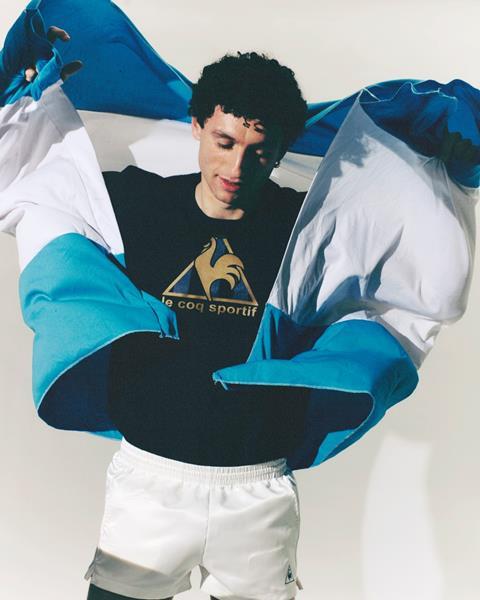
The Maradona collaboration is the largest cultural initiative under the new management.
Notably, the Maradona family, via Electa Global, initiated contact with Le Coq Sportif. For those who know football history, the reason is straightforward: Le Coq Sportif was the only brand that could supply the historical authenticity the collaboration required.
For the brand, the Maradona name offered a way back into a cultural conversation it had spent decades drifting out of. The collection comprises eight pieces in an off white and sky blue palette drawn directly from Argentina’s away kit, designed by Wester on the Maradona side and Pascal Monfort on Le Coq Sportif’s. It is available at the Saint-Germain-des-Prés flagship and online.
Le Coq Sportif expects this lighthouse project to propel the brand toward €65 million by 2027, rising toward €300 million by 2030.
The shirt itself, between history and legend
History matters: the shirt Maradona wore on June 22, 1986 was not the official Le Coq Sportif kit.
Le Coq Sportif served as Argentina’s technical kit supplier for the full decade from 1980 to 1989. For the 1986 tournament, designated as the away side against England, Argentina was required to wear their alternate dark color. The official dark blue away shirts Le Coq Sportif had supplied were made of heavy cotton: functional for European conditions, but unsuitable for the dry-heat altitude of a noon kickoff in Mexico City.
Manager Carlos Bilardo wanted something lighter. In the days before the quarter-final, coaching staff scoured the Tepito neighborhood market in Mexico City and found a set of plain, unbranded polyester v-neck shirts in dark blue. Rubén Moschella, the team’s kit man, brought them back to the hotel. Maradona saw them and said, “With this, we’ll beat England.”
That night, team staff and hotel maids stitched on makeshift AFA crests, added the Le Coq Sportif rooster to the right breast to satisfy the technical sponsor, and ironed on silver numbers originally made for American football jerseys. The players took the pitch in what were, more or less, improvised blanks.
Le Coq Sportif has navigated the resulting licensing complexity carefully in the years since. A 2022 limited-edition reissue replaced the AFA crest with a stylized “86” badge, sufficient distance from the official federation mark to release without dispute. The 2026 collection is the commercial follow-through: the same palette, the same historical reference, but now with the Maradona estate’s explicit authorization for the first time.
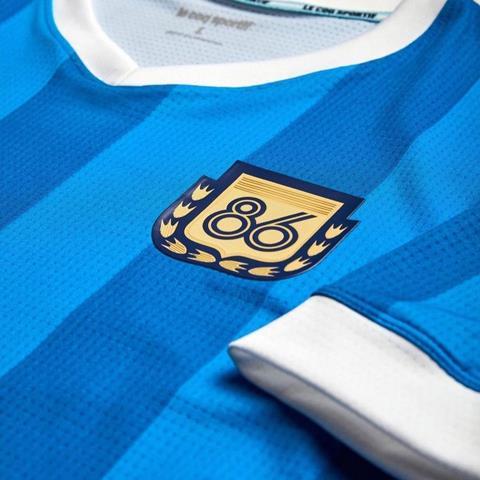
And the shirt Maradona actually wore that day? Steve Hodge, the England midfielder who received Maradona’s shirt in the post-match swap, sold it at Sotheby’s in May 2022 for £7.14 million (€8.35 million).
Epilogue: divine heritage
The MARADONA collection is not only nostalgia-driven product marketing. It is heritage with a cultural resonance that goes well beyond the football pitch.
The cultural reach of the Maradona IP has already demonstrated its range. In 2021, Italian director Paolo Sorrentino, Oscar-nominated for The Great Beauty, titled his most personal film È stata la mano di Dio (”It Was the Hand of God”), set in Naples in the 1980s during Maradona’s arrival at the city’s club. In the film, the phrase loses its sporting meaning entirely and becomes a metaphor for the director’s personal fate. Sorrentino said Maradona “saved” his life in a literal sense: as a teenager, he stayed in Naples to watch Napoli play instead of joining his parents at the family’s mountain house, where they later died from carbon monoxide poisoning.
Le Coq Sportif made a commercial deal, of course, but it also engaged with a heritage that many consider sacred. The brand knows that, and it must handle it with care and respect together with Maradona’s heirs.
Visualizza questo post su Instagram
FIFA World Cup 2026: The Business of the Beautiful Game
How brands, retailers, and the sports economy compete on football’s biggest stage.
Explore Our Coverage →







#/media/File:Maradona_vs_england.jpg)