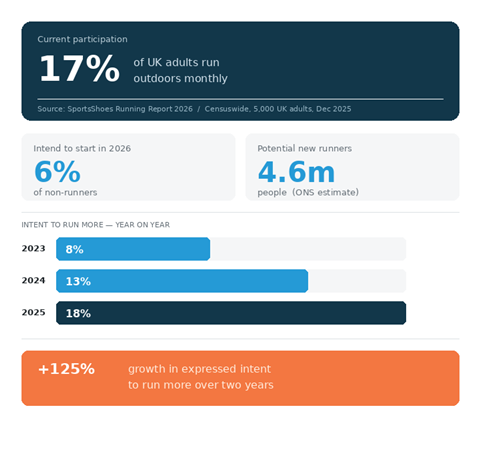
UK outdoor running participation holds at 17% as interest among younger generations continues to rise. The gap between aspiration and action carries direct implications for footwear, apparel and fitness brands.
Running participation across the UK stands at roughly one in six adults — a stable base from which stated interest in the sport continues to grow, particularly among younger generations — with the relationship between aspiration and active participation representing a central commercial opportunity for footwear and apparel brands.
That is the headline finding from the third edition of the SportsShoes Running Report, published February 27, 2026. The research was conducted by survey agency Censuswide among a nationally representative sample of 5,000 UK adults aged 18 and over in December 2025, and is supplemented by global search volume data from Google Keyword Planner and consumer attitudinal data from YouGov.
A stable participation base with growing demand
Seventeen percent of the UK population runs outdoors at least once a month — a figure covering road, trail, track and cross-country — and the proportion of Brits expressing intent to take up or increase running has climbed consistently, from 8 percent in 2023 to 13 percent in 2024 and 18 percent as of 2025. Around 6 percent of current non-runners say they intend to start in 2026, equivalent to approximately 4.6 million people based on current Office for National Statistics (ONS) population data.
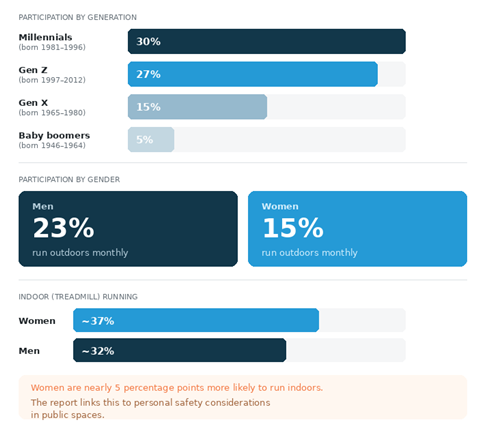
The generational and gender splits indicate where demand is most concentrated. Millennials and Gen Z account for the highest active participation rates at 30 percent and 27 percent respectively, and are also the cohorts most likely to run frequently. Gen X participation stands at 15 percent, while 5 percent of baby boomers run regularly.
Men run at a higher rate overall (23 percent) than women (15 percent), though female runners display distinct behavioral patterns with commercial relevance — most notably a greater reliance on treadmill running. Women are nearly 5 percentage points more likely than men to run indoors, a pattern the report associates with personal safety considerations in public spaces.
Why people run, and what they get from it
Maintaining or improving physical fitness is the primary stated motivation for running, cited by 37 percent of runners. The desire for personal challenge and weight management both follow at 30 percent, with mental wellbeing close behind at 28 percent. Among Gen Z runners specifically, improving appearance ranks as the top motivator at 29 percent. The picture shifts when runners are asked what benefits they actually experience. Improved mental health and mood tops that list, cited by 32 percent, ahead of better sleep and increased energy, both at 30 percent.
Understanding the non-running majority
The 81 percent of UK adults who do not currently run outdoors represents the sport’s largest addressable opportunity. The primary barrier is not cost or access, but enjoyment: 27 percent of non-runners say they simply do not find running appealing. Physical and psychological factors also feature prominently — 25 percent feel too old or cite a health condition, while 22 percent consider themselves too unfit to begin. A growing proportion report pain as a deterrent, up 4 percentage points year on year.
For brands and retailers, the data suggests that investment in entry-level product, coaching tools and accessible formats may be more productive than competing for share within the existing runner base alone. The report notes that many non-runners hold self-limiting perceptions — around age, fitness level or weight — rather than facing objective access constraints, which points to communication and education as levers alongside product.
Technology shapes training habits and retail behavior
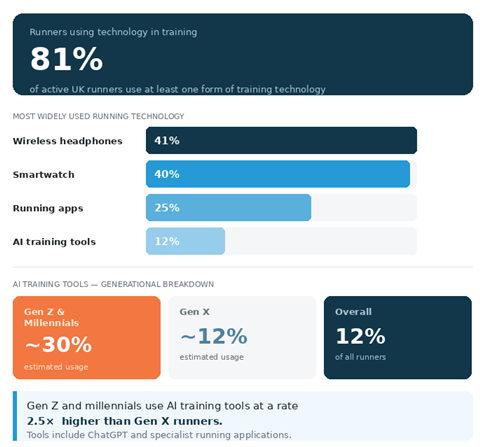
Among active runners, 81 percent use some form of technology in their training. Wireless headphones (41 percent) and smartwatches (40 percent) are the most widely used, with running apps adopted by roughly one in four. AI-powered training tools — including platforms such as ChatGPT alongside specialist running applications — are now used by 12 percent of runners overall, and at a rate two and a half times higher among Gen Z and millennials than among Gen X.
Gait analysis has expanded significantly in uptake, with one in four runners now having undergone the process — up from fewer than 7 percent the previous year. A third of runners aged 25 to 34 have had their gait analyzed, compared with 13 percent of those aged 55 and above. For specialist running retailers, the trend reinforces the commercial case for in-store motion analysis as a conversion and differentiation tool.
On footwear specifically, 56 percent of runners do not replace their shoes at the recommended interval of 500 to 750 kilometers, and nearly half wear running footwear for everyday use — patterns that accelerate product wear and create natural replacement demand that retailers are positioned to address.
About SportsShoes
Established in 1982 by former professional footballer Bruce Bannister, SportsShoes is the UK’s leading online specialist retailer for running, gym, and outdoor footwear and apparel. Headquartered in Bradford, the family-run business operates at sportsshoes.com.
Since 2024, the company has published its annual SportsShoes Running Report to track shifting participation trends, consumer motivations, and structural barriers across the UK. Now in its third edition for 2026, the report serves as a definitive benchmark for the industry, combining large-scale consumer surveys with global search data.