While global sports brands market to female footballers without redesigning for them, independent label Soqa is building a different model — rooted in product innovation, D2C distribution, and genuine community engagement. Founder Gertje Klack makes the case.
Gertje Klack isn’t impressed by the big brands. The owner of the women’s football brand Soqa says there are no real products for female football players on the market. “Many manufacturers label their products ‘unisex’ and talk about ‘women,’ but there are no real innovations behind it,” Klack explains in an interview with SGI Europe. She also criticizes brick-and-mortar sports retailers. For her, direct-to-consumer (D2C) sales are an absolute necessity for survival in the market.
Klack is straightforward: she names the specific challenges facing European sports retailers and explains why the US market is developing so dynamically. She discusses the connection between authentic community building and a slowly growing business model and talks passionately about how team sports can shape women’s self-image more effectively than social media.
Soqa develops products that are really made for women - and we’re not just about marketing.
Gertje Klack, Soqa Founder

SGI Europe: How does Soqa, as a “female first football” brand, manage to fill a strategic gap and build long-term customer loyalty instead of just profiting from short-term tournament booms?
Gertje Klack: Soqa develops products that are really made for women - and we’re not just about marketing. Many manufacturers write “unisex” on the label and talk about “women”, but there is no real innovation behind it. We have developed the Soqa Performance Bodywear “Libera”: We based the top and tights on athletics clothing and paid particular attention to the requirements of football.
Our items are “duel-proof” - made for the very best performance, rather than the sports bra for a sexy look. The “Tibia” shin guards are specially developed for the female leg, in different versions for different types of players. All our developments are based on deep insights into the life of the female athlete. We talk to young and amateur female athletes as well as former national team players, Bundesliga players, parents, coaches and doctors.
We deliberately don’t take advantage of short-term sales opportunities, such as the trend of positioning jersey styles in streetwear. Because we are a brand for the active player. Soqa does not primarily stand for football culture and fandom - and certainly not for football culture in the men’s sector.
Authenticity and attitude are becoming increasingly important for brand success. How does Soqa translate these values into its product range and brand communication?
We have seen it that way from the very beginning - it is the core of our strategy. Soqa is a brand for active players. We never work with models, but only with real footballers. Artificially generated images are absolutely out of the question. Customers sense this authenticity. The female football community speaks its own language, and we see Soqa as part of this community. We not only talk about our products, but also about all topics that are relevant in this community.
Sustainable sportswear with real functionality
The previous answer underlines the authenticity of your brand through the close connection to the community and the absence of models. If you transfer this attitude to product development: How do you deal with the issue of sustainability?
Soqa focuses on quality rather than seasonal trends when it comes to product development. Our leisurewear is made from high-quality, well-processed organic cotton, fairly produced in Europe. The color palette is deliberately kept small and classic to ensure that the clothing can be combined over a long period of time.
For our bodywear line, we use particularly high-quality regenerated nylon (Econyl), which has been developed for maximum durability. The cuts are long-lasting, functional and non-forming. This is where we differ significantly from major brands, which tend to focus on shape rather than functionality, especially when it comes to bras. The bodywear collection is also not seasonal, but can always be reordered.
And for matchday clothing: What approaches is Soqa taking to make this area more sustainable too?
There is a lot of potential and room for improvement here! Thanks to my daughter, who has been playing football at the club for 10 years, I know only too well what the traditional processes are like. If it were up to me, I would focus on reducing disposable products. Unfortunately, in amateur football, a large proportion of matchday clothing is replaced, i.e. thrown away, after a season. This could be organized differently with a circulation principle.
Does it sound as if you have already given this some concrete thought?
That’s right, and I would like to briefly outline our approach. Our circulation principle is based on a single sponsor who has to be acquired in a first major step, but then ideally supports the entire football department for several years.
On the club side, it would be good if they would focus on jerseys that can be used universally. That means: no player names, no crazy numbers. Children want to try out and may no longer be involved after one season, or even a shorter one. Players change clubs. Individual jerseys can then no longer be used. This also applies to individual jersey sets that are quickly sponsored by the company around the corner and flocked with the company logo.
Universal jerseys, on the other hand, can be returned to us by the clubs at the end of the season. We then refurbish them so that clubs can order new or used matchday clothing. This principle would relieve the burden on clubs and volunteers and promote reuse.
German sports retailers are simply not interested in female football players. […] the staff are hardly geared towards women. The basic assumption is that you want to buy something for your son, boyfriend or husband when you’re in the football department.
Gertje Klack, Soqa Founder

Why Europe’s sports retail still fails female footballers
That sounds like a coherent process, but also a long road with hurdles and challenges. Speaking of which: surely a completely different challenge lies in specialist retail distribution in Europe, right?
When we started Soqa in 2021, we took a close look at retail and the shopping experience for female footballers. After all, many avoid going to the sports store if they can. We spoke to players and sent them out to gather specific experiences - for example when buying shoes.
With the shocking confirmation: German sports retailers are simply not interested in female football players. There is very little choice (“doesn’t sell anyway”), and the staff are hardly geared towards women. The basic assumption is that you want to buy something for your son, boyfriend or husband when you’re in the football department. Advice is not very appreciative, nobody assumes, for example, that a woman might also be interested in the top-of-the-range Nike shoe model for 280 euros. That’s why D2C is the tool of choice for us.
We would be delighted if retailers who are really interested in the topic would get in touch - the demand is there. Even Decathlon, with its wide range and its own brand KIPSTA, only supplies unisex products for women and girls at best, which are photographed on men or boys.
Building community and supporting the next generation
Perhaps the first discussions with specialist retailers will take place after publication. Where Soqa is already very present is in the area of community building and promoting young talent. What exactly does this approach look like? Do specialist retailers and associations also benefit from active community work?
Absolutely! The community of committed female players is active, well networked and word gets around quickly. For the younger ones, it’s mainly through their parents. I’ve learned a lot from accompanying my own daughter (now 16) on her football journey for 10 years. It’s crucial to be close - on the pitch and at the games. Staying in contact and recognizing the need.
For girls and women, it’s not just about the products, but also about training quality, playing opportunities, support and structures in general. And this is where SOQA is present: we inform, network, advise and answer questions. We support clubs, teams and individual players. We would like to equip more teams and work more closely with clubs! However, one hurdle is often the existing structures and dependencies on large team sports equipment suppliers.
As a start-up, it will be difficult to compete with the big outfitters, what other options have you developed for promoting young talent?
We have no investors and rely on organic growth. That takes time. But we see our opportunity in growing with the players and being perceived as a reliable partner. That’s why we pay particular attention for the younger ones. They have often not yet developed any awareness of their structural neglect and are used to accepting what they get. This is exactly where we want to sensitize girls, young women and their parents.
Learning from the U.S.: growth and gaps in women’s football
It’s different in the USA. Women’s football is very successful and established here. The US NWSL league is internationally recognized as the strongest women’s professional league, with a high concentration of talent from all over the world. What opportunities does this knowledge open up for the growing European market?
Basically, a lot of things work in the USA in a similar way to here - with the difference that there are MANY more female players there. Football is a mass sport for girls, and a lot of money is spent on young players in particular. Parents see it as an investment in potential college scholarships and pay large sums for clubs, coaches, travel and equipment.
On the other hand, product quality and sustainable materials are even less of an issue in US sport than in Europe. We see a great opportunity here, as there is both a willingness to pay and an affinity for innovation and change. Conversely, we are seeing that looks and styling trends are very quickly becoming a mass phenomenon there and are then also being implemented in Europe. Girls and women are developing their own football identity - instead of “joining in with the men”.
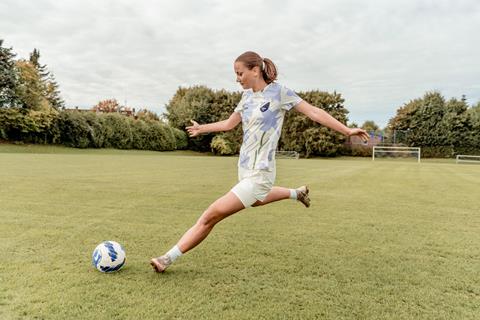
Football’s role in redefining women’s image
These are important keywords: How do you assess the influence of political developments? Are issues such as gender equality suffering and possibly having a negative impact on the long-term development of the sport?
We make a conscious distinction between “women in football” and “women’s football”. For the former, political influence may be more relevant - and of course it has a negative impact if old white men continue to sit on committees, in clubs and associations. As far as football itself is concerned, however, I am very optimistic: the standard of play is currently rising, the competition is getting bigger and more balanced, the leagues are being expanded. And attractive sport will prevail in the long term.
Team sport, especially football, is a crucial tool for promoting a stronger image of women beyond ideals of beauty.
Gertje Klack, Soqa Founder
Women’s football is becoming more and more relevant and that is an important development. Isn’t this also about society’s image of women?
Absolutely! Team sport, especially football, is a crucial tool for promoting a stronger image of women beyond ideals of beauty. In contrast to the often staged and perfect role models in social media, sport offers an authentic space. On the pitch, it’s about ambition, competition and the desire to win, even overtaking a rival. It shows a real image of women sweating, getting bruises and hugging each other after the game. This experience strengthens pride, the enjoyment of competition and the self-confidence to be able to do and show something.
This approach contrasts with traditional societal expectations that require girls to take a back seat and put others first. Team sports teach them to live out their passion and to perceive their own body as strong and functional, not just as something that has to be slim and perfect.
SOQA is a female-first football brand founded in Hamburg in 2021 with a mission to redefine the sport for women. Born from the belief that female athletes deserve more than just “downsized” men’s gear, the company focuses on creating high-quality, sustainable apparel and equipment specifically engineered for the female body. By blending performance-driven design with a strong commitment to fair trade and social responsibility, SOQA serves as both an outfitter and a community hub, empowering a new generation of players to take up space on and off the pitch.