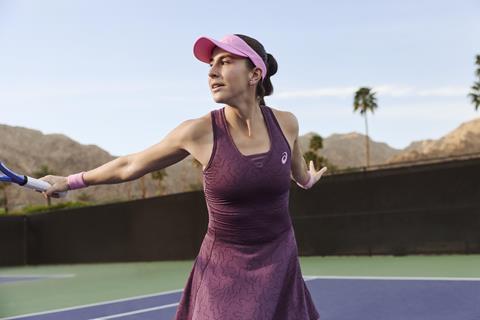
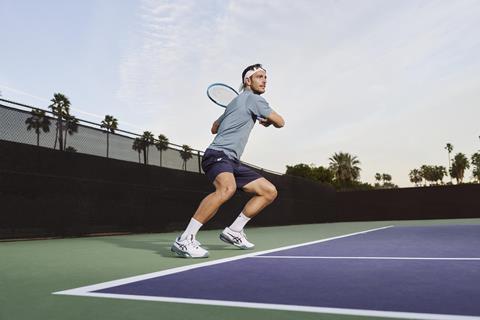
ASICS has packaged nearly 20 years of tennis movement research into a two-category retail framework, responding to feedback that shopper choice paralysis is a conversion problem in the footwear category.
ASICS has launched a global framework for helping tennis players choose the right footwear, organizing its tennis range around two defined movement profiles: Speed and Stability. The approach maps directly onto two products — the GEL-RESOLUTION X for lateral, baseline-oriented play and the Solution Speed FF 4 for all-court, fast-movement players.
Research commissioned by ASICS across five European markets found that 85% of tennis players say matching footwear to their movement pattern is a purchase priority. A separate consumer test with nearly 2,000 respondents validated the two-category structure, with 82% rating the playing styles framework as clear and relevant.
Simplifying the tennis shoe decision at the point of sale
The move also responds to direct feedback from retail partners, who reported that shoppers feel overwhelmed when navigating the tennis footwear category unaided.
For ASICS, the Playing Styles system is not a new product bet but a new way of packaging nearly two decades of accumulated development work. The brand began building footwear around court movement archetypes in 2007, and has iterated on that foundation through what it describes as a process of continuous refinement.
The launch consolidates that history into a framework designed to travel across retail floors, e-commerce filters, and in-store staff training without requiring shoppers to understand the underlying technology stack.
The two hero products have distinct performance propositions.
The GEL-Resolution X is engineered around lateral stability, with a midsole built for impact absorption during hard landings, midfoot reinforcement for side-to-side support, and a lacing system designed to prevent internal foot slide.
The Solution Speed FF 4 prioritizes light weight and acceleration, using a bio-based material midsole, a structural element in the forefoot intended to support fast forward movement, and an outsole compound targeted at traction during quick footwork sequences.
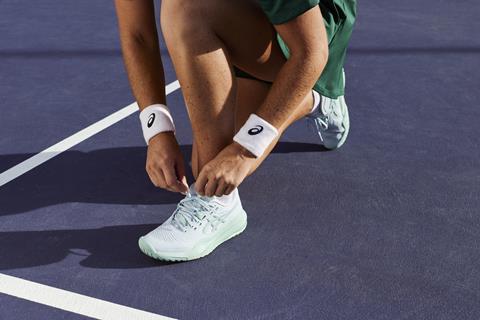
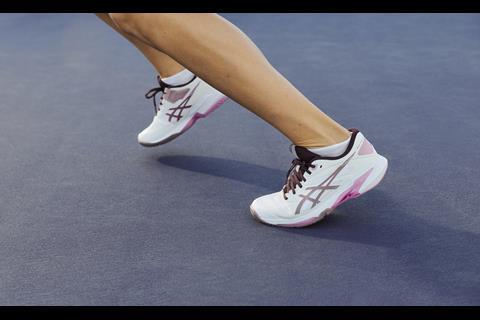

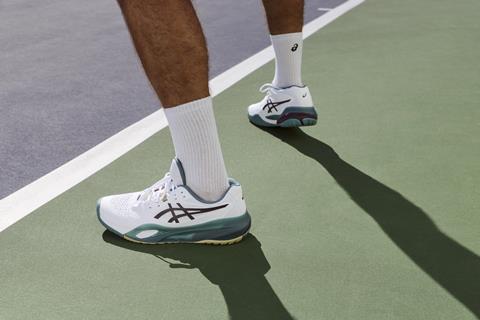
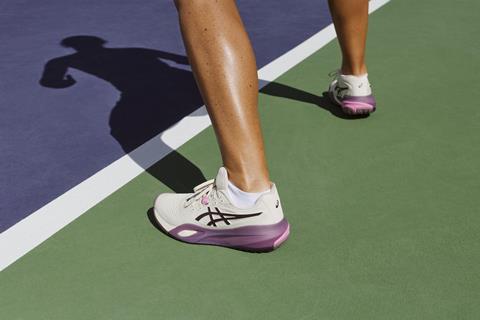
Both shoes are backed by professional endorsements: Italian clay-court specialist Lorenzo Musetti aligns with the Stability line, while Swiss all-court player Belinda Bencic fronts the Speed range.
The strategic logic
As tennis participation has grown across Europe since the pandemic, brand competition at the performance end of the market has intensified. Simplifying the decision architecture at the point of sale is one way to defend shelf position and reduce the likelihood that a shopper defaults to a more familiar general athletic brand.