
Nike plans to double its China local creation team to more than 100 people by FY28. Nike’s Shanghai team recently made ten styles in under 120 days as part of its China reset. After a store audit, guest columnist Nick Hsu argues that speed matters only if someone can change a sample, a price or an order when a fitting goes wrong.
At Nike’s “House of Innovation” Shanghai 001 – a four-storey, immersive retail space – I recently tried on the men’s three-in-one jacket (style code JU1228) from the Shifted Utility (Liuxing) collection, priced at RMB 1,999 (€273). In size L, the long, straight body and diagonal opening already made for a broad silhouette. When I put my hands in the pockets, fabric gathered around my forearms and cuffs, pushing the sleeves outwards. The effect reminded me of an old-fashioned, wide-sleeved robe. An everyday movement exposed a problem that should have been visible during development.
The store visit, on Nov. 17, 2026, coincided with Nike’s Investor Day. At its first investor day since 2017, Nike management presented local creation, faster development and changes to distribution as part of its China reset, where Nike’s marketplace has “not kept pace” according to Cathy Sparks, Vice President and General Manager for Greater China.
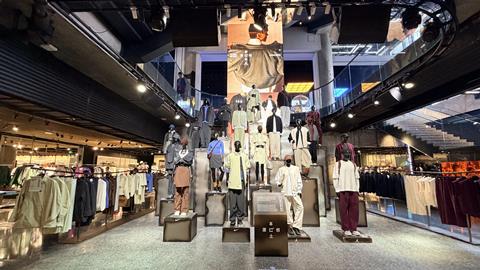
For the Shanghai space, Nike’s Shanghai team had produced ten styles across men’s wear, women’s wear and the Jordan line in under 120 days. They reached selected stores on Nov. 12, 2026. Nike highlighted premium materials and competitive pricing.
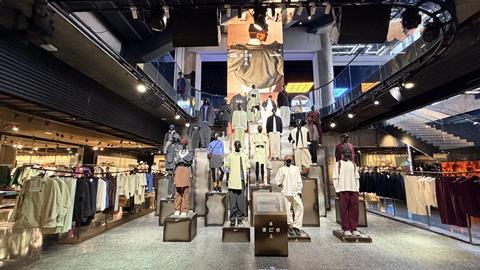
We came to examine what those commitments meant on the rail and in the fitting room.
The first products give us a way to examine what local authority is changing, how Nike’s existing expertise reaches the clothes, and how quickly customer feedback can influence the next collection.
What the fitting room showed
Across Shifted Utility and Jordan’s Tailored Sport (Lishi) collection, we observed ten styles, 24 style-color combinations and 66 display pieces. Shifted Utility comprised a three-in-one jacket, trousers and a long-sleeved top for each gender. Such a compact range should make it relatively straightforward to show customers how the pieces belong together.
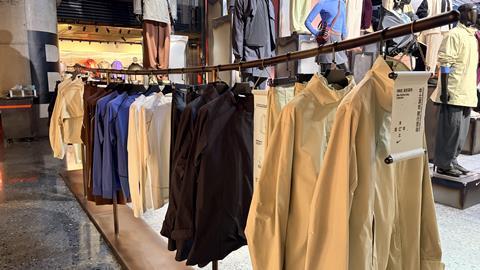
The women’s layered trousers (style code JU1234), cost RMB 999 (€136). A large panel covered the thighs and tied at the waist. Worn with our female tester’s plain white T-shirt, it resembled an apron worn by serving staff. The trousers pooled over her shoes, adding further bulk below the panel.
A white T-shirt and trainers are ordinary companions for Nike trousers. If the design of a pair of trousers only works on a narrow range of bodies or with particular styling, that needs to inform the buying decision and store presentation.
Our female tester’s experience with the RMB 1,799 (€245) women’s three-in-one (style code JU1233) raised a related issue. At approximately 160 cm tall and weighing 50 kg, she usually starts with size S or M in China. Here, M felt tight and she needed L.
Jordan’s RMB 1,199 (€164) Tailored Sport jacket (style code JU1236) felt slightly small even in 2XL. This may be a conventional Jordan fit, although we have not confirmed the pattern.
This store visit represents an individual experience and small testing pool, but layering is central to the product’s purpose. When a customer sizes up for room, sleeve length, shoulder position and overall proportions still need to work. Those compromises should be examined before the customer reaches the store.
What local creation added
My broader difficulty with both lines was identifying what local creation had added. In use, proportions, materials and style, I found little to explain why a regular Jordan customer should choose these particular pieces. Shifted Utility’s conspicuous changes did not improve the wearing experience. Tailored Sport’s additional appeal was hard to identify.
Materials and color compounded these doubts. Nike describes Shifted Utility as clothing for commuting, sport and social occasions, and Tailored Sport as drawing on Michael Jordan’s off-court style. When we tried them in store, some garments’ weight, handle and construction left us uncertain about how well they fulfilled those intentions. Some colors looked muddy on the wearer and lacked a distinctive identity as a collection.
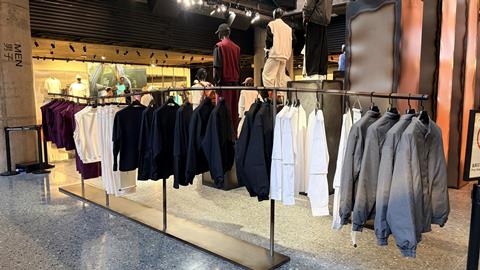
Local creation should establish a clearer picture of the person buying the clothes, their wardrobe and the uses that justify the price.
A Shifted Utility jacket, long-sleeved top and trousers together carry retail prices of RMB 3,397 (€463) for women and RMB 3,497 (€477) for men, excluding footwear. At that level, detachable construction and local development have to deliver benefits the wearer can feel. I do not think the range we examined had achieved a sufficiently convincing relationship between use, appearance and price.
This matters because of Nike’s aim of restoring full-price sales. New products must overcome the expectation of discounts created by Nike’s own recent trading history.
A sales associate told us Shifted Utility’s sales were very disappointing. Outside, Nanjing Road was crowded. Inside, customers were sparse. China-exclusive products previously displayed on the ground floor had moved to the basement. Although it should be noted, this was one store’s early assessment of a collection, five days after launch, without sales figures or targets.
Nike’s existing expertise and who decides
Nike has experience to draw on when it comes to local product creation. At its investor day, management revisited Express Lane, its quick-response initiative, and acknowledged that a fast operation had existed alongside a slower company system but that “one fast lane doesn’t make a company fast”. The new approach to speed focuses on efficiency and responsiveness, across the whole product creation and operations system.
We understand there to be an earlier small SMU (special make up) team working on market-specific products in China. Its relationship with today’s local creation team remains, however, unconfirmed.
Any new team should benefit from accumulated expertise in materials, patterns, color and supply. Its precise access to those resources is unknown. Detecting awkward sleeve volume or an unconvincing trouser proportion requires a sample, a wearer, and someone able to act on what they see.
That last requirement brings headquarters back into the discussion. Design can deliver an idea, develop a sample on time, purchase at an acceptable cost and create a scheduled launch. Each function can meet its own brief while the finished garment gives the customer too little reason to buy.
CEO Elliott Hill told Reuters that design decisions ultimately rest with country teams. Sparks described autonomy within Nike’s product and style standards. But any decisions retained globally also carry responsibility at headquarter level.
The “decisions” are easily identifiable. A fitting may call for another sample. A price may require a different fabric or construction. A weak style may deserve a smaller order or removal from the launch. If those changes threaten the timetable, someone must have the authority to approve them.
Nike expects its local creation team to exceed 100 people by FY28, roughly twice its current size, and sees a future in which half of Greater China’s Nike Sportswear products are created locally. Those ambitions increase the importance of getting such decisions right.
Retail feedback should influence them. A customer who never tries the trousers and one who puts them back after trying them on provide different information. A report that merely records weak sales misses that distinction. Nike’s proposed integration of demand, supply, inventory and financial planning needs to carry these findings into development and orders. Speed earns its value when the company corrects mistakes sooner and supplies products people want.
Local creation earns its place through better choices. Teams should know more about what customers need, what to buy, how stores should present it and when to replenish, revise or stop.
A financial plan with years to repair
Greater China revenue fell 26 percent on a currency-neutral basis in FY27’s first quarter. Management expects pressure through FY28, stabilization from FY29 and a gradual recovery, with FY31 revenue roughly matching FY27.
A financial plan can allow several years for repair. But during those years, customers will continue to buy from elsewhere. Their habits change, competing brands gain familiarity and each unsuccessful launch uses development resources, shop space and attention that Nike will have to earn again.
Nike’s global framework targets about US$5 billion (€4.55bn) of additional revenue by FY31 against FY27, with US$4 billion (€3.64bn) from Performance Sports and US$1 billion (€0.91 billion) from Sportswear. Its operating margin target is 12–14 percent. Management recognizes that product and demand have to deliver alongside cost measures.
In China, that makes the price customers will actually pay a practical test of the plan. A garment that needs discounting to move places further pressure on the quality of revenue Nike is trying to rebuild.
The Adidas comparison
Adidas offers a useful comparison. Its “local-for-local model” keeps global product franchises central, supported by local design and sourcing and replenishment informed by sell-through. Adidas’ Chinese-specific Track Top shows how that can reach the garment: stripes, a relaxed fit and gathered cuffs remain recognizable, while knot fastenings add a local reference that works with everyday clothes. The Track Top works because the adaptation strengthens an existing product language.
Adidas identified the Shanghai-developed range as a global success in its first-quarter 2026 results.
Like Adidas, Nike has delegated design authority too. But the conspicuous changes in the Shifted Utility line compromised the wearing experience, while Tailored Sport offered little additional reason to buy. The maturity of these products falls short of what Nike’s resources should support. Headquarters and China share responsibility for the standards those products had to meet before reaching the store.
What to watch next season
Next season’s merchandise offers a practical test. Shifted Utility’s layering space, trouser proportions and material choices should show what the team has learned. Tailored Sport needs a clearer reason for an existing Jordan customer to buy. Store staff should be able to explain that value and report what happens after fitting. Those changes will reveal how much influence the Chinese customer now has over Nike’s decisions.
Reporting and sources
This is a guest column. The views expressed are the author’s own. Currency conversions based on mid-market rates at time of publication.
More from The China Lens
This column is part of The China Lens, Nick Hsu’s series on how brands compete in Greater China. In earlier columns, he counted products and prices at Reebok’s new Shanghai store to see whether the relaunched brand has chosen a clear direction. He also asked how far Li-Ning’s sporting credibility can stretch into business wear, golf and Curry Brand.
From Scratch Inc. is a Shanghai-based brand strategy and product design company focused on Greater China. It works with sports, outdoor and lifestyle brands, linking brand planning with product design, development and production. Its services cover building new brands, repositioning established ones and adapting international brands for Chinese consumers. The company also runs its own design brand, Oukka, and a design space, Phase 0, in Shanghai’s Minhang district. Website: fromscratchinc.com
Nick Hsu is the founder of From Scratch Inc. and has more than 20 years of experience in the sportswear industry.
Reporting on store visit is based on From Scratch’s independent store audit and individual fittings at Shanghai Nike 001 on Nov. 17, 2026. Display quantities exclude inventory depth. The sales comment concerns Shifted Utility at this store during its first five days. No sales targets, unit sales, internal decision records or fittings across multiple body types were available. References to earlier SMU work reflect the author’s industry knowledge. The English collection names follow the general English language reporting of Nike’s launch.

Eastern views
Asia-Pacific insights for the sporting goods industry
Analysis, insights, and expert perspectives on the sporting goods industry across Asia-Pacific — covering market trends, manufacturing, retail, and brand strategy from China to Southeast Asia to Oceania.
Explore Eastern views →