The German industry giant is starting the year stronger than its outlook suggested. The direct-to-consumer business, in particular, is driving momentum and improving revenue quality. At the same time, management is sticking to a cautious forecast in light of external risks. The question is, why?
Noticeable tailwind for fiscal year 2026: Adidas continues to benefit from strong demand for its products in the first quarter, particularly in its own sales channel, where double-digit growth in e-commerce and brick-and-mortar retail is driving momentum. The apparel business is also performing surprisingly well, while the brand continues to gain traction in key markets such as China and Latin America. Overall, it is clear that the German sporting goods manufacturer is currently succeeding in achieving growth largely through full-price sales despite a discount-driven environment – a clear signal of the brand’s increased appeal.
The figures underscore this trend with a 14 percent increase in revenue (currency-adjusted) to €6.6 billion. Operating profit rose by 16 percent to €705 million, as did profit from continuing operations, which increased by 11 percent to €484 million. The operating margin improved by 0.8 percentage points to 10.7 percent.
| Adidas - Income | |||
|---|---|---|---|
| Q1, ended March 31 | |||
| 2026 | 2025 | Change | |
| Net sales | 6,592 | 6,153 | 7.1% |
| Cost of sales | 3,223 | 2,948 | 9.3% |
| Gross profit | 3,369 | 3,205 | 5.1% |
| Royalty and commission income | 19 | 19 | 0.0% |
| Other operating income | 1 | 1 | 0.0% |
| Other operating expenses | 2,683 | 2,615 | 2.6% |
| Operating profit | 705 | 610 | 15.6% |
| Financial income | 11 | 34 | -67.6% |
| Financial expenses | 70 | 59 | 18.6% |
| Pre-tax | 646 | 585 | 10.4% |
| Tax | 161 | 149 | 8.1% |
| Net income from continuing operations | 484 | 436 | 11.0% |
| Gain from discontinued operations, net of tax | 3 | -7 | – |
| Net income | 487 | 429 | 13.5% |
| Diluted EPS | 2.70 | 2.44 | 10.7% |
| Source: Adidas | |||
Gulden’s strategy drives turnaround
CEO Bjørn Gulden is understandably optimistic in light of these recent developments. This, incidentally, supports the turnaround narrative that he has been driving since taking office. The strategy behind it: a stronger focus on product innovation, less reliance on discount promotions, and tighter control of sales. At the same time, he points to the operational strength behind the numbers: “Our teams have worked very hard to optimize our product offering, our marketing, and our activations market by market.”
DTC drives growth, wholesale remains cautious
This momentum is particularly evident at the channel level: The direct-to-consumer business grew by 22 percent on a currency-adjusted basis to €2,480 million, driven by e-commerce (+25%) and company-owned retail (+19%). In wholesale, however, the trend is significantly more subdued. “It is very, very rare for all markets to achieve double-digit growth in their DTC business, and it is proof that our teams are doing a lot of things right,” emphasizes Gulden.

Here, revenue rose to just €4,084 million (+2% or +8% on a currency-adjusted basis). Gulden cites an increasingly challenging market environment as the reason for this, one that is “very volatile” and characterized by intense discounting in many markets – particularly in the lifestyle footwear segment.
In this environment, Adidas is focusing specifically on discipline in sell-in and, according to the CEO, is avoiding excessive shipment volumes to retail partners. At the same time, the focus is on keeping discounts under control, further strengthening the product pipeline, and increasing brand loyalty through sports and cultural events. This combination of cautious management in wholesale and high-growth DTC business underscores the strategic focus on quality over volume.
| Adidas - Sales | |||||
|---|---|---|---|---|---|
| Q1, ended March 31 | |||||
| 2026 | 2025 | Change | Change (currency neutral) | ||
| Segments | |||||
| Europe | 2,090 | 1,986 | 5% | 6% | |
| North America | 1,200 | 1,184 | 1% | 12% | |
| Greater China | 1,135 | 1,029 | 10% | 17% | |
| Emerging markets | 869 | 870 | 0% | 10% | |
| Latin America | 831 | 698 | 19% | 26% | |
| Japan / South Korea | 405 | 374 | 8% | 23% | |
| Products | |||||
| Footwear | 3,699 | 3,760 | -2% | 4% | |
| Apparel | 2,442 | 1,968 | 24% | 31% | |
| Accessories | 451 | 424 | 6% | 13% | |
| Channels | |||||
| Wholesale | 4,084 | 3,999 | 2% | 8% | |
| DTC | 2,480 | 2,163 | 15% | 22% | |
| Total | 6,592 | 6,153 | 7% | 14% | |
| Source: Adidas | |||||
External factors: Outlook remains cautious
Overall, however, the strong start to the year should be viewed against the backdrop of a deliberately cautious outlook. Gulden continues to highlight the high volatility in the global retail environment, increasing price pressure – particularly in the lifestyle segment – as well as external headwinds such as currency effects and higher U.S. tariffs. The latter are expected to weigh on full-year operating profit by approximately €400 million. Accordingly, Adidas is sticking to its forecast of currency-adjusted revenue growth in the high single-digit percentage range – even though the first quarter is above the implied annual trajectory. Thus, the Group is maintaining its cautious planning with a built-in risk buffer in light of macroeconomic and geopolitical uncertainties. Another challenge is the dynamic competitive environment, with brands like On and Asics gaining strength. And last but not least, the question arises as to how long the current sneaker boom will last. Early market signals already point to a possible normalization of demand.
Running innovation: new products and records
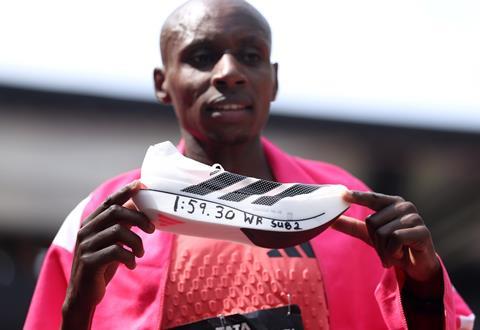
Despite this caution, the focus is increasingly shifting to the factors expected to drive long-term growth: new products and the global appeal of major sporting events. Record-breaking performances, such as at the London Marathon, where several top athletes competed in new performance models, underscore the innovative strength in the running segment. At the same time, Adidas is looking ahead to one of the most important sporting events of the coming months: the 2026 FIFA World Cup. The company considers itself well-prepared, has already launched the majority of its collections, and expects additional momentum for demand and brand perception.
Sports events as a strategic lever
Major sports events are thus far more than just marketing platforms – they are the moment when brand, product, and emotion converge. Against this backdrop, CEO Gulden’s appeal takes on even greater significance: “The world needs these sports events, where people from all over the world with the most diverse backgrounds come together to celebrate. Sports and sporting events can change people’s lives and make the world a better and more livable place!”