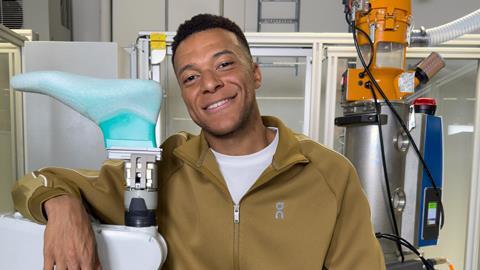
On Holding’s Sept. 22 investor day presented what the company calls a Premium Playbook: Mbappé as a loudspeaker for its core business, golf as a lifestyle category, a $1 billion buyback and CHF 5.6 billion-plus in 2029 sales targets. Revenue growth is slowing to high-teens, wholesale is expanding and no loyalty program yet exists. The plan is not exceptional – the execution will determine whether On still is.
On Holding’s Investor Day in Zurich opened with the kitchen table where the company began, “garden hose pieces” and all, and promised investors they would “leave with three things.”
There was a lab tour, a morning fashion show and a football reveal on “real grass in a tent.” Longtime On investor Roger Federer sat on stage in golf shoes next to Thierry Henry, new Director of Football, and co-founder Olivier Bernhard asked analysts to close their laptops for eight minutes.
On didn’t hide its references either. Its models, the founders said, are “the vacuum cleaner that performs like a jet engine” and “the computer that became a personal identity device.” In other words, Dyson and Apple.
The announcements matched the staging:
● Football legend Kylian Mbappé signed on a reported ten-year cash-and-equity deal (per L’Équipe; On has not disclosed terms);
● Thierry Henry now officially Director of Football;
● A move into golf in 2027;
● A $1bn share buyback through 2029;
● 2029 targets of CHF 5.6bn+ in sales (about $7bn/€5.9bn), a gross margin of 65%+ and an adjusted EBITDA margin of 22%+.
The market loved it. Shares rose 13.14 percent intraday and closed at $29.39 (€25.80), up 7.58 percent. Only weeks earlier, a Q2 guidance cut had given On its worst day as a listed company, taking the shares to two-year lows.
But investor days are built to impress, and the real message takes a few days to sink in. Read the transcript with the lights down and a quieter story emerges. It is best told through the questions strategists ask of any plan: What is the ambition, where to play, do you have the right to play there, and how will you win?
A soft landing with better lighting
The most important sentence of the day came from CFO Frank Sluis, not from Mbappé. “A lot of people feel very obsessed with the growth percentage,” he said during the Q&A. What mattered, he argued, was the absolute: “We’re planning to add more business over the next three years than we did in the last period.”
When management asks you to look at francs rather than percentages, the percentage may be the story. On’s own revenue growth percentage numbers show the path:
● 2023–26: more than 30% a year (26% had been promised);
● 2026: guidance in the low 20s, to about CHF 3.5bn (about $4.2bn/€3.7bn);
● Q3 2026: about 17% at constant currency;
● 2026–29: “high teens”.
High teens is still about twice the revenue growth of the premium segment On describes: CHF 125bn ($151bn/€133bn), growing “more than twice as fast” as a 3 percent market. It is also the slowdown investors had been bracing for since the Q2 guidance cut, now called evolution. In the CFO’s words, premium growth is “merely an evolution rather than a revolution.”
The buyback’s job is to reassure.
On calls it “capital the strategy doesn’t need,” “not a substitute for growth but an outcome.” Investment banking and capital markets firm Jefferies called it “a tell, not a thesis,” pointing to Q2 inventory up 31.2 percent against sales up 13.5 percent. Both readings can be true at once.
Then comes the number that reframes the headlines. Running, sneakers and apparel will deliver more than 75 percent of On’s new sales to 2029. When it comes to football and golf, the CFO was blunt: “There is a temptation to model them large […] we are modeling a modest contribution.”
Where to play: the right questions, thin answers
On has a good test for entering a sport. Can it disrupt the category with innovation? Does the sport build cultural relevance beyond performance, and is it ready to be “premiumized”?
Running was On’s original proof, going from innovation to cultural relevance to premium pricing. Tennis passed next, and the numbers show it: On’s highest customer lifetime value, and 61 percent annual sales growth since 2021.
The answers for football and golf were thinner. “Golf footwear has barely moved in a decade,” “golf is fashion, travel and status in one” and “golf was born premium” came the soundbites from the investor day. We would have liked to hear the business case behind them: sizing, pricing and channels for each sport.
Football is not yet a revenue line. It is a loudspeaker, and management said as much. “This is what football does to a brand’s relevance,” said co-CEO David Allemann. “Before we have sold a single boot.”
The metrics of On’s move into football measure attention, not sales:
● 8bn in earned media reach in four days;
● A 50.5% share of voice in football media;
● Reach 312x the baseline in Mexico and 344x in China;
● 72% of new followers under 35.
The marketing team called football “a superpower for the other spaces.” Boots will arrive as limited drops in 2027, followed by an inline range in 2028.
On was explicit about the aim. The new sports should “drive awareness” and reach “a younger and more diverse audience,” bringing a “net new consumer” who “will drive sneaker growth and the apparel business.” In On’s own words, the loudspeaker serves the core.
What we did not hear during the session was how On plans to turn that reach into players on the pitch. There was no word on academies, club partnerships or entry-price boots, and the CFO said only that On “will launch at the premium end.” We would have loved to know more, starting with what reach at 312x the baseline in Mexico and 344x in China means for future kid boot sales there.
Tennis may hold a clue. On has built it less as a performance sport than as a cultural movement: Clubhouse Nights “where the court becomes a dance floor,” and a game “mixing its classic charm with fresh ideas from fashion, wellness, and even music.” At the investor day, tennis’s commercial payoff was a sneaker: the Clubhouse, the “center point” of what On calls its “born in tennis” sneaker strategy.
The golf pitch read the same way: “fashion, travel and status in one.” If football follows the tennis template, the reach will serve the brand more than the boot.
We heard little about go-to-market either. On’s chief global markets officer said wholesale partners “already have highly engaged, sizable audiences” in football and golf. In a video message shown at the investor day, Dick’s Sporting Goods executive chairman Ed Stack called them “two of the largest categories in our business.”
How On will protect full prices in those aisles was left open, in a market where it acknowledged “heightened promotional activity.”
The Q&A did not fill the gap. “We spoke for four hours and you still have questions?” one executive joked as it opened. Later, with hands still up, came: “We have ten questions for three minutes.”
The floor took nine questions before the session closed for drinks. None of them was about football or golf.
The Castore cautionary tale
Castore is the cautionary tale. Signing with Glasgow Rangers in 2020, Castore co-founder Tom Beahon could have been reading from On’s script. In a 2020 interview with Rangers fan blog Four Lads Had a Dream, he said: “Castore is a premium brand […] we want to challenge Nike, adidas, Puma at the very top of the market.” Castore had “no desire to work with a lower level team and then work our way up,” said Beahon.
The ambition was premium and mass at the same time: to sell more Rangers jerseys “than any other football club in the UK,” and to stretch into lifestyle all the way to “bedding or curtains.”
Swap Rangers for Mbappé and it could be Zurich in 2026.
But for Castore, winning in football as a premium brand proved harder than the pitch:
● May 2020: Castore signs its first major football kit deal, a five-year contract with Rangers reported at up to £25m (€29m);
● Aug. 2020: in Castore’s first Rangers season, fans complain that shirts sold at the same price vary in quality, and Castore apologizes;
● Oct. 2024: accounts show a £29m (€33m) annual loss, which Castore blames on its supply chain;
● By mid-2025: six major football clubs have walked away in about two years, including Newcastle United, Aston Villa, Wolves, Bayer Leverkusen and Sevilla, amid complaints of “wet-look” shirts that trapped sweat, peeling badges and late deliveries;
● By Jan. 2026, Beahon was defending the price rather than the premium. “We live in a capitalist society, if people couldn’t afford it, those prices wouldn’t be charged,” the co-founder said in an interview with the BBC’s Big Boss Interview podcast. The BBC reported that half of England’s Premier League clubs now charge £85 (€98) for a basic adult shirt, and Castore says it answers affordability concerns with entry-level ranges.
That is the premiumization question we would have liked On to address on Sept. 22. Football fans pay £85 out of loyalty, not for innovation. A premium newcomer risks ending up either defending the price or building a cheaper line beneath its own badge.
Golf: thinner case, familiar risk
Golf’s case is thinner still. On co-CEO Caspar Coppetti called it “the most premium mass sport in the world,” citing 150 million players and more than $5bn (€4.4bn) in annual spend.
But that works out to about $33 (€29) per player per year, or half a box of Titleist Pro V1 balls. Much of that spend goes on clubs and balls, which On doesn’t make.
Nike’s experience in golf is a cautionary one. It tried the category with a full range, from clubs and balls to shoes and apparel, and had limited success:
● 2015: $771m (€678m) in golf sales, and already declining
● 2016: Nike exits clubs, balls and bags after losing money on equipment for 20 years
● 2024: Tiger Woods leaves after 27 years
The supporting evidence offered on stage at the investor day didn’t help. On’s chief design officer is “a golf fanatic,” the president and COO “grew up in St Andrews,” and Federer “now plays rather more golf than tennis.”
On was founded by a triathlete building the shoe he needed. That was founder-market fit. Does golf now risk drifting into founder-lifestyle fit?
Is it a first sign that On’s executive team is slowing down?
Right to play: Federer was an icon, Mbappé is a player
Internally, On calls Federer “the blueprint.” But Federer was never just a player to On. He is a Swiss icon and a global ambassador for Swiss lifestyle and premium.
His other partners say it all: Rolex since 2006, Mercedes-Benz, Moët & Chandon, Rimowa, NetJets, UBS and Lindt. These are heritage names, and he has worked with them for 15 to 20 years.
Even the blueprint himself doubts the tennis model can be copied everywhere. “We can maybe also use the blueprint from tennis when it comes to golf,” Federer said on stage, “because football is very different in my opinion.”
Mbappé is a generational player, and players come with noise. For years the story was his move to Real Madrid, because Paris Saint-Germain (PSG) couldn’t win the Champions League. Since he left, PSG have won it twice, in 2025 and 2026, while Real Madrid ended 2025–26 without a trophy, despite his goals.
The headlines haven’t stopped either. There was his pay dispute with PSG, now closed: in December 2025 a Paris labour court ordered the club to pay him about €60m in unpaid salary and bonuses while dismissing his “moral harassment” claim, and PSG chose not to appeal.
There was also a Ceuta shirt gesture that drew fire from several sides. On the eve of investor day, he was brushing off talk of tension with France teammate Ousmane Dembélé over the Ballon d’Or.
His endorsement book of Dior, Hublot and Oakley is fashion, luxury and lifestyle rather than Swiss heritage. Federer lent On the Swiss premium lifestyle; Mbappé brings reach, not Swissness.
On presented Mbappé alongside Henry and Swiss player Sydney Schertenleib, “the first of a women’s roster.” Still, the headline asset is one player, and building a category around one star is the riskiest version of the athlete playbook.
Under Armour built the Curry Brand around one superstar for 12 years, and they parted in Nov. 2025, with analysts concluding UA was “not strong enough in basketball or footwear.” In football, a player’s form, club and headlines change every season.
How to win: the Dyson playbook
But On isn’t running Nike’s playbook. Nike went almost all-in on direct-to-consumer and is now unwinding it. It isn’t running Moncler’s either, since at the investor day On explicitly rejected “the scarcity playbook of luxury fashion.” It is running Dyson’s: premium engineering at “five times the category price,” sold through retailers as well as its own stores.
That choice is personal. On President and COO Scott Maguire spent 18 years at Dyson, rising through engineering and operations to COO, before running American bike brand Specialized. Running the Dyson playbook asks On to hold two balances at once. One sits between innovation and lifestyle; the other between its own channels and wholesale.
Innovation vs lifestyle: the Swiss paradox
Dyson shows how far engineering credibility can travel. It carried Dyson into the beauty category with the Supersonic and the Airwrap. The Zone headphones, and the electric car it abandoned in 2019, show where the halo stops.
On believes its growth as a lifestyle brand is “authentically earned because of our technical performance credibility.” That is the Swiss paradox. Swiss innovation and engineering resonate around the world, while Swiss style and fashion resonate much less.
On’s shoes say so themselves. They carry the red cross of the Swiss flag next to “Swiss Engineering,” even though they are made in Vietnam and Indonesia. It is an extraordinary privilege, and one On had to fight for.
The challenge came from the regulators’ side. In September 2025, the Swissness Enforcement Association (SEA), together with the Swiss Federal Institute of Intellectual Property (IPI), filed a complaint in China against On’s use of the cross on shoes made in Asia.
It was On, not the regulators, that then threatened legal action. In March 2026, the IPI clarified its practice in On’s favor: products researched or developed in Switzerland but made abroad may now carry the cross next to “Swiss Engineering” or “Swiss Research.”
The cross of the Swiss flag says engineering, not style. And apparel is where that gap matters most. On plans to triple its apparel business and to “win with her.” It sees 80 million aspirational customers priced out of luxury, and “a blue ocean and not a red ocean” in premium activewear for women.
Its real rivals are Lululemon, Vuori and Alo. But Lululemon has just reported revenue down 4 percent, comparable sales down 10 percent and a guidance cut, blaming weak demand for its core women’s leggings. The water is anything but blue.
Direct vs wholesale: a margin at work
On’s gross margin is the crown jewel. In 2023, it promised more than 60 percent by 2026; it will deliver more than 65 percent, and plans to hold that level through 2029. For a sports brand, that is rare air.
For comparison:
● On: 65%+ gross margin (2026, and the 2029 target)
● Adidas: 51.6% gross margin (2025)
● Nike: 42.9% gross margin (fiscal 2026)
On’s margin was built on premium, full-price selling and a fast-growing direct business. On’s own stores and website set the price, and the brand refuses to discount.
The next phase leans the other way. According to the investor day, direct-to-consumer will rise only from about 45 percent of sales to about 50 percent by 2029, and wholesale will remain “the biggest absolute net sales contributor.” On wants to be in about 75 percent of its key partners’ doors, up from 20 percent in 2023.
More wholesale means thinner margins. In the CFO’s words, 65 percent is “not a margin at rest, it’s a margin at work.” Efficiencies push it up; reinvestment in product and a fast-growing, still subscale apparel business pull it down.
On did not say how the new sports will affect the margin. With only a “modest contribution” modelled, the core will have to carry it.
Selling through wholesale at full price takes consumer pull, and this is where Mbappé could earn his keep. On says the new sports will bring a “net new consumer” at a premium price point. If that works, shoppers will ask for On at Dick’s and Foot Locker, and product will leave the shelf without a markdown.
Williams Trading analyst Sam Poser put the risk best from the floor: “Getting items placed is different than having good sell-through […] the brand belongs to you, not to them.”
Retail remains the other engine. On intends to grow the store fleet from about 80 to 180 by 2029, with payback in under two years and profitability, the CFO said, “comfortably above” the group’s.
Inventory is the thread that holds it all together. In Q2, On “held back selling rather than build inventory in the channel,” and management’s rule is to “keep supply below demand.” With Q2 inventory up 31.2 percent, that rule is being tested.
The easy years are over
None of this is cheap: 100 new stores, dedicated wholesale teams and up-front marketing for the new sports. It leaves a premium brand running to stand still.
On’s own channels have a gap too. The most candid line of the day came from the new chief customer officer: “Today, we don’t have a loyalty program.” It’s awkward for a brand that compares itself to Apple, but revealing.
The easy years are over. “Whatever we produced, it would go in the stores,” Scott Maguire admitted during the Q&A. The next phase is about repeat purchase.
Alice Delahunt, the Chief Customer Officer put a number on it. Customers who shop On across channels are worth up to 4.5 times more, but “what we haven’t yet built is the machinery.”
Time to get to work.
The morning after
Evolution is a fine strategy for a brand that no longer needs to shout. On is now speaking loudly through Mbappé, calming investors with $1bn and growing more slowly, while its margin works hard to stand still.
None of that makes the plan wrong. It makes it ordinary: the playbook of a large sportswear company, delivered with founder’s showmanship.
The “Premium Playbook” presented in Zurich this week isn’t exceptional. But On can still set itself apart the way it always has, by bringing high-quality, disciplined Swiss execution to the plan. That is what will keep its edge in the premium market.
On has surprised the industry before, going from a garden hose to the New York Stock Exchange in eleven years. I’d be delighted to be caught by surprise again.
The Playbook is an independent column. The views expressed are the author’s own. Currency conversions represent mid-market rates at time of publication.

The Playbook with Sebastien Willefert
Strategic thinking for the sporting goods industry
An operator’s perspective on the industry’s most pressing strategic questions. Sebastien Willefert distills two decades of brand, commercial and marketing leadership into digestible, actionable insights. From growth strategy to community leverage, The Playbook translates experience into answers.