Twenty-five years after narrowing itself to a single sport to survive, Brooks Running is back in the room where team sport is sold. It has not come back with a product launch, but with a brand media strategy.
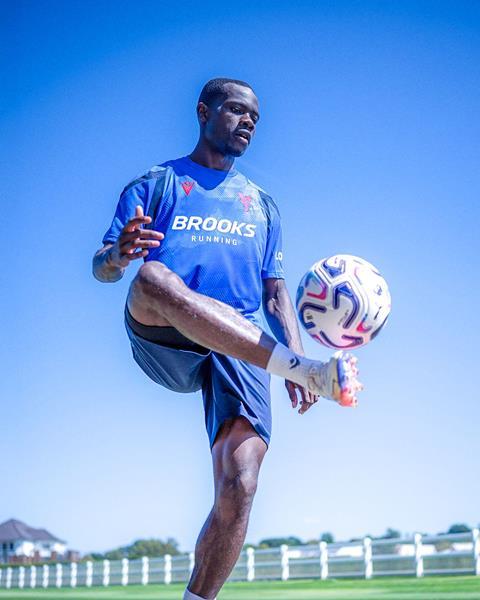
On Sept. 8 the Seattle brand named three athletes to its global ambassador roster, none of them distance runners: NFL wide receiver Cooper Kupp, WNBA forward Maddy Westbeld and Premier League footballer Oscar Bobb. The same day it became Official Running Partner of the Seattle Seahawks, adding a third professional team in its home city.
Twelve days earlier it had entered its first Premier League sponsorship. On Aug. 27, Crystal Palace FC, the south London club, announced a multi-year agreement making Brooks its official footwear partner and front-of-training-wear partner across the men’s and women’s first teams.
What connects the three announcements is not category expansion. Brooks is not building a cleat, a basketball shoe or a team kit. It is placing a running brand inside sports that command attention it does not currently reach with dedicated products.
A 14 percent half, and a 39 percent Europe
Brooks grew revenue 14 percent in the first half of 2026 and posted a record second quarter, with Europe, the Middle East and Africa up 39 percent. That is more than four times the pace of the Americas at 9 percent, and APAC at 10 percent.
Growth is broadening beyond road running. Trail footwear rose 71 percent in the second quarter and the young lifestyle line by close to triple digits from a base the company does not disclose, while the core franchises held: the Adrenaline GTS, marking its 25th anniversary, grew 19 percent.
Ownership shapes what can be done with that. As a Berkshire Hathaway subsidiary, Brooks reports percentages rather than absolute revenue, profit or margin figures, and faces no quarterly earnings call. A listed competitor spending comparably on brand reach in adjacent sports would have to defend it on a call within 90 days.
Presence, not products
Brooks has re-entered the team-sport conversation rather than its product market, and the Crystal Palace agreement states that most clearly through what it excludes. The Brooks logo will appear on training, travel, walkout and warm-up apparel for both first teams, with branding on pitchside and digital ribbon LEDs at Selhurst Park, on stadium screens and televisions, on static stadium assets and on club media backdrops. It does not cover matchday kits. It does not cover playing cleats. Brooks will also support Palace Run Club and sponsor the Palace for Life Marathon March in October.
The ambassador agreements are described in similar terms. Kupp, Westbeld and Bobb will appear in Brooks global storytelling and content work, engage with runners, and bring personal style to Brooks product in the coming year. These are content partnerships, not equipment supply.
This buys presence in front of football, basketball and American football audiences without the costs that normally accompany it: boot development, individual boot contracts, kit supply, and a direct product contest with Nike, adidas and PUMA in categories they control. Chief Marketing Officer Melanie Allen described the football rationale as endurance, speed and movement being fundamental to every match, which is a reasonable argument and also a convenient one. It justifies presence in a sport without requiring a product for it.
Seattle as prototype, England as test abroad
The pattern was built at home. Brooks holds three Seattle team partnerships: the Seahawks in the NFL as Official Running Partner, the Kraken in the NHL as Official Off-Ice Performance Partner, supplying running footwear and apparel to players, coaches and staff, and the Mariners in Major League Baseball, where it is the official running shoe of the Microsoft Salmon Run. Kupp plays for the Seahawks and cited shared Seattle ties in explaining the deal, which makes that signing an anchor rather than a one-off.
England is the test away from home advantage.
Brooks was already principal partner and front-of-shirt sponsor at Cambridge United in League One; Crystal Palace, its first Premier League sponsorship moves it into a global broadcast audience. The timing fits the numbers. Brooks is number one in Germany in adult performance running footwear priced at €90 and above, with the top three styles in that band, and grew faster in France than a market that expanded 11 percent in the second quarter.
Visualizza questo post su Instagram
Brooks is not alone there. At its investor day on Sept. 22, On presented football as a defining opportunity for performance brands, citing Circana and Euromonitor data putting World Cup viewership at 1.5 billion in 2026 and the global football footwear market at $38 billion by 2030. Two running-born brands, on different balance sheets and under different ownership, are arriving at the same place at the same time. The difference is the route Brooks has chosen: audience access without a product commitment.
Where does this stop being a running brand?
The 2001 decision to cut more than half the product line, removing roughly $30 million in annual revenue, is what allowed Brooks to be read as a specialist. Specialist credibility is the asset every one of these deals spends. Each partnership that puts the logo somewhere a runner would not look draws down a little of it.
The lifestyle business goes the same way. Archive-derived silhouettes shown at Paris Fashion Week, the reimagined Glycerin 12 and the Brooks Vanguard, are built for wear outside the run.
Brooks is working on the basis that the running category is now large enough, and its lead inside it secure enough, that credibility can be spent without being lost. On the first-half evidence, that is a defensible position.