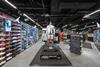
Less than two weeks ago, Frasers Group announced the opening of Sports Direct’s first store in the Nordics: a 30,000 sq ft (~2,787 sqm) flagship across two floors at Helsinki’s Citycenter Mall. 

The headline from Frasers was triumphant: “Nordics, Sports Direct has arrived.”

The real headline is more interesting. This is not just a store opening. It is the signal of a retail sport industry in structural distress, of a consolidator moving into the gap, and of a format that has quietly but deliberately reinvented itself. To understand why this opening matters, you have to understand what brought Frasers to Helsinki in the first place.

An industry consolidating under one roof

Frasers Group did not build its European footprint by competing. It built it by absorbing. Sports World, Twin Sport, Maxi Sport, Hervis, Sportland, XXL – over 700 stores across the UK and continental Europe, most of them acquired through distressed restructuring processes.

The pattern is consistent. Large-format generalist sport retailers, built on high inventory volume and promotional pricing, have one by one discovered that their cost structure is incompatible with the market they are now operating in. This is the same format that has made Sports Direct hugely successful in the UK.

When Gresvig’s CEO described running his retail operations as “emptying water from a boat with a hole in the hull,” he captured something precise: the problem was never the category. Sport participation is not in decline. The problem was a structural model – enormous store footprints, deep undifferentiated stock, thin margins - designed for a competitive environment that no longer exists.

Frasers’ expansion into the Nordics is the continuation of that same logic. XXL, which had more than 80 stores across Norway, Sweden and Finland at its peak, was acquired by Frasers in 2025 following a period of sustained financial pressure. The Helsinki flagship is one of the visible results.

The consolidation is real, and it is accelerating. But it is worth asking what Frasers is actually building, because it is not the same business it was acquiring.

The Elevation Strategy: from discount destination to brand partner

Sports Direct’s original retail DNA was clear: football kits, promotional pricing, bulk assortment, a format optimized for value. It was effective for what it was. It was also increasingly at odds with where both brands and consumers were moving.

The “Elevation Strategy”, Frasers’ deliberate repositioning of the Sports Direct format, is the answer to that gap. Deeper partnerships with Nike, Adidas, and Hugo Boss. Cleaner store environments. Dedicated category concepts. The USC premium section layered into flagship formats like Helsinki. Fewer SKUs, better presentation, more intentional brand adjacency.

The Helsinki store is a physical expression of that repositioning. Thirty thousand square feet is not a discount barn. Dedicated Running, Outdoor, and Bike concepts signal aspiration.

This is Sports Direct trying to earn the right to carry brands that have, in recent years, had every reason to look elsewhere.

Which brings us to the other side of the equation.

The Nike double pivot, and what it revealed

No conversation about sport retail’s structural tension is complete without examining what the brands have been experimenting with in the same period.

Nike spent the better part of a decade aggressively accelerating its direct-to-consumer model, growing its direct share from around 15 percent of revenue in 2010 to nearly 44 percent by 2023. The strategic logic was compelling: better margins, owned consumer data, full control over brand presentation. Cut out the intermediary, own the relationship.

The results were more complicated. Retail partners lost shelf prominence and strategic support. The brand’s floor presence in multi-brand environments narrowed precisely as competitors filled the space. Nike’s own DTC channels – app, website, owned stores – carried the full weight of brand building and consumer acquisition in a way that proved harder and more expensive than anticipated. Market share eroded. Brand equity softened in key segments. Consumers still loved the multi-brand environment. A CEO change followed, and then a drastic reversal: a strategic recommitment to wholesale partnerships.

Nike’s double pivot is instructive not because it failed, but because of what it revealed.

Even the world’s leading sports brand does not own the consumer.

Empty shelves at retail got filled quickly: with fresh brands eager to prove to their retail partners they deserved confidence and trust, bringing differentiation and support.

The brands that opted out entirely… or not

While all of this was unfolding in the traditional wholesale and multi-brand channel, a different generation of brands was drawing different conclusions – struggling to break through the retail filter to connect with consumers and express themselves.

Lululemon plans to open 40 to 45 net new stores globally in fiscal year 2026, with the company now operating 816 stores worldwide as of May 2026. Vuori, which surpassed its target of 100 owned retail locations ahead of schedule, is now using 2026 to focus on international expansion with 15 planned stores outside the US.

Gymshark, which built its entire business on DTC and community, is now selectively stepping into physical retail on its own terms: flagship spaces in London and Manchester, a New York flagship that opened in December 2025, and a Germany entry through premium shop-in-shop partnerships with Engelhorn Sports in Mannheim and Breuninger in Stuttgart.

Arc’teryx rolls out 25 to 30 openings annually, and its Copenhagen store was designed not as a point of sale but as a community hub – free repairs, film screenings, workshops, a local trail map.

These brands are not retreating from traditional multi-brand retail. They are refusing to play by its traditional rules. The conventional wholesale model – shared margin, markdown risk, brand presentation and assortment controlled by the retailer – was both too expensive and too constraining for brands trying to build something specific and lasting. So they built their own environments instead.

The consequence is significant. The brands creating the most consumer energy are also the brands least likely to want, or need, space in a multi-brand flagship. And the retailers who most need those brands to drive traffic and relevance are precisely the ones those brands are most reluctant to work with on standard terms.

What this means for the channel

The Helsinki opening sits at the intersection of all of these tensions. It is the most visible recent expression of a consolidator trying to upgrade its proposition to remain relevant to brands that have been quietly rewriting the rules of physical retail.

The question it raises is whether that upgrade is enough, and what “enough” even means in a market where the channel itself is being redefined.

The old model was transactional: buy product, sell product, manage margin. That model is structurally broken for anyone operating at scale without a clear point of differentiation.

What is replacing it is harder to execute and harder to copy. It requires retailers to be genuine partners to the brands they carry: protecting price architecture, investing in experience, building community around the store rather than just footfall through it. It requires brands to be honest about what each channel adds to the consumer relationship rather than treating wholesale as a volume lever to pull when DTC underperforms.

The retailers who survive will not be the ones with the most stores or the biggest ones. The brands that thrive will not be the ones that went most aggressively direct.

Both will be the ones that understood the consumer relationship belongs to neither side exclusively, and that the strongest channel is built on genuine complementarity, not just convenience.

Sports Direct in Helsinki is a bet on exactly that. Whether the format can earn the trust of the brands it needs to make that bet work is the question worth watching.

Originally published on LinkedIn, June 2, 2026. Some factual updates have been applied for accuracy.

The Playbook with Sebastien Willefert

The Playbook with Sebastien Willefert

Strategic thinking for the sporting goods industry

An operator’s perspective on the industry’s most pressing strategic questions. Sebastien Willefert distills two decades of brand, commercial and marketing leadership into digestible, actionable insights. From growth strategy to community leverage, The Playbook translates experience into answe

Read The Playbook →