Samaranch Jr. has no history of his own in athletics, but a lot of people in the sports industry remember his father.
Juan Antonio Samaranch Jr., 65, as his patronymic suffix denotes, is the son of Juan Antonio Samaranch, who served as President of the IOC from 1980 to 2001 and brought about a number of lasting changes.
Once upon a time individual Organizing Committees for the Olympic Games (COJO, in the French abbreviation) would negotiate the Games’ TV deals. Samaranch Sr. put these negotiations under IOC control, increasing revenues by one or even two orders of magnitude over his tenure. For example, the 1980 Summer (Moscow) Games generated $88 million and the 2000 (Sydney) Summer Games $1.331 billion – close to a tripling of value. And it is even more if we carry things into the present. Adjusted for inflation, the $88 million amounts to about $352 million now, far short of the $3.3 billion or so that media rights generated for last year’s Paris Games.
Samaranch Sr. was also at the origin of The Olympic Partner (TOP) Programme, in which categories get exclusive sponsors. And it was under him that the IOC abolished the requirement for competing athletes to be amateurs – recall the American “Dream Team” of NBA players at the Barcelona Games (1992) – and began a serious push for women’s sports.
Things went sour late in Samaranch Sr.’s term. It was discovered in 1998 that the bidding committee for the Salt Lake City Games (2002) had spent more than $1 million bribing members of the IOC. Many members resigned, and many others were expelled. Samaranch Sr. blamed the scandal in part on visits made by IOC members, often with their families, to bidding cities. “Without visits, there would be no scandal,” as Deseret News then quoted him.
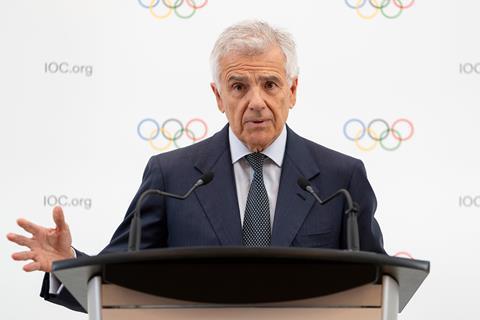
Samaranch Jr. was elected to the IOC in 2001, the year of his father’s retirement, and has served multiple terms as IOC Vice President, including the present term. He was Chairman of the Organizing Committee for the Beijing Winter Olympics (2022) and has been a member of the Spanish Olympic Committee since 1989 and Vice President of the International Modern Pentathlon Union (UIPM) since 1996.
In an interview with Xinhua this past February he spoke of raising the IOC retirement age from 70 to 75, building a sports-investment fund and an Olympic donor program, reviewing broadcast rights and modernizing TOP. Elsewhere he has spoken of retaining boxing as an Olympic sport and supported the addition of skateboarding.
Samaranch Jr. has no history of his own in athletics. According to the IOC, he skis, golfs, runs, swims and plays tennis, but he does so at leisure.
Although he holds a degree in industrial engineering and once sold perfume (for International Flavors & Fragrances), he is a financier, with an MBA from the Stern School (NYU). He served a stint as an analyst with First Boston before becoming a Vice President and Partner at S.G. Warburg & Co., London. Nowadays he is CEO of a firm he co-founded, GBS Finanzas, Madrid, which had about €700 million under management before its merger, in May 2024, with Creand Wealth Management, Andorra. Together they manage about €1.5 billion.
Samaranch Jr. is also a nobleman in Spain as the heir to his father, who in 1991 was created Marqués de Samaranch by King Juan Carlos. Samaranch Sr. died in 2010.