The candidate from Japan thinks the Olympics should be held on five continents simultaneously.
Morinari Watanabe, 66, believes that computers can, will, and even must improve not just the administration of the sports industry but sport itself – in its practice, its coaching and its competition. This was not always his belief.
In 2015, when he was chief of the Japanese Gymnastics Association, and two years away from his election to the International Gymnastics Federation (FIG), he paid a visit to the Japanese company Fujitsu and joked to its chief of sports business development, Hidenori Fujiwara, that soon robots would be judging gymnastics tournaments. By the MIT Technology Review’s account, Fujiwara took this to be an assignment and worked up a prototype that sparked a change in Watanabe.
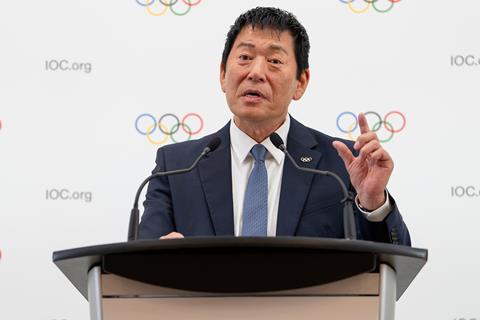
In the world he now envisions promising young gymnasts use smartphones to hone their skills – especially if, for remoteness or lack of money, they cannot get top-tier coaching. Even in the world we still inhabit, though, tournaments are already adopting Fujitsu’s Judging Support System (JSS), with an AI trained on video footage of 8,000 gymnastics routines and the sport’s Code of Points. JSS made its debut at the World Championships in 2019 and was extended to all ten apparatuses at the Artistic Gymnastics World Championships in 2023.
So far, as the name suggests, JSS has not done away with human judges. A Superior Jury decides when to use JSS, and even then only to answer a gymnast’s challenge to a human score. Still, not everyone is keen on the novelty.
There is the natural argument against AI in gymnastics – that is more than mechanics, that it is also artistry. But there is also the counterargument of what some call “leotard bias” – a human judge’s preference for or against certain body types or nationalities – and its “built-in deductions.”
Watanabe has never been a gymnast himself. He trained to be a teacher, earning a master’s degree in physical education at Tokai University, Tokyo, and pursued specialist studies in gymnastics at Vassil Levski National Sports Academy, in Sofia (Bulgaria). For about eight years thereafter he coached artistic and rhythmic gymnastics.
Then he became Director of the Sports Business Division at Aeon Co., a holding company that sprouted from a general store established in Japan’s Edo era (1758) and whose business has since spread into hypermarkets, malls, cinemas and other properties. There Watanabe was among the organizers of the Aeon Cup Worldwide Rhythmic Gymnastics Club Championships, which began in 1994 and has become one of the world’s top three tournaments.
In 2017 he became President of the world’s oldest Olympic sports federation, the aforementioned FIG, crushing his opponent in the election – Georges Guelzec, President of the European Union of Gymnastics – 100 votes to 19, according to the Island Times. He appears to have had little trouble during his tenure, the worst of it relating to a detail that JSS is untrained to adjudicate. Was Team USA four seconds late in submitting an inquiry at the recent Paris Games when Romania contested the score of American gymnast Jordan Chiles, who was then stripped of a bronze medal? The basis for FIG’s account of events appears to be shaky, and Watanabe appears to have been equivocal in his testimony on the matter in a court of law.
Watanabe was elected to the IOC in 2018.
Read on: