
Part 3 of our series Three ways to talk about the future. Last week we looked at Nike and Asics. Today: Puma, and the signs we can read, with no need for an investor day.
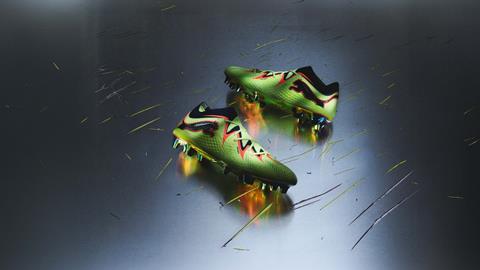
On Nov. 17 and 18, unsigned young players took the field in a London youth tournament, watched by professional scouts. The tournament gave its on-pitch debut to a football boot that went on sale on its opening day: Future.
That same day, Nike set targets through fiscal 2031, and Asics outlined a vision through 2035. Puma held no investor day and set out no long-range targets. Instead, it has a turnaround timetable, an ambition to come back as one of the world’s top three sports brands and, since October, a new largest shareholder from China.
Puma’s future has been the subject of plenty of confident commentary, from Substack essays to LinkedIn threads. This piece doesn’t add to it. We report what Puma has said in its own words, what its numbers show and what its new shareholder has said on record, checked at the source.
The result is a snapshot, taken four months before Puma gives its first figures for 2027. Here are ten things to note:
1 Future: product as promise
2 Calendar: the timetable Hoeld set himself
3 Back to the podium: one brand, local credibility
4 Running: where progress shows first
5 Training: the Hyrox route
6 Sportstyle: the product that sells
7 Europe: rebuilt from the inside
8 China: the market Anta knows best
9 Purpose: a belief still to be shown
10 Next: what will settle the picture
1. Future: product as promise
The boot is the tenth generation of a franchise Puma started almost ten years ago. The Future 10 weighs under 200 grams, went on sale worldwide on Nov. 17 and is set to be worn by players including Neymar Jr. and Kai Havertz.
Puma chose to launch it at “Be the Future,” a tournament run with Rising Ballers, a digital media platform and youth football community, as part of a program that scouts unsigned grassroots players. Dominique Gathier, Puma’s Vice President Teamsport, said the boot “isn’t about looking back,” but about empowering “the next generation of visionaries.” Two days later, Puma traced the boot’s ten generations in CATch UP, the owned magazine it relaunched last year.

2. Calendar: the timetable Hoeld set himself
Chief Executive Arthur Hoeld, who joined from Adidas in July 2025, set the timetable himself: 2025 as a reset year, 2026 as a transition year and growth from 2027. The reset left Puma with a net loss attributable to shareholders of €645.5 million in 2025.
In the third quarter, Puma earned more on each product it sold and held far less stock, yet sales kept falling and the savings went back into marketing, its own stores and IT. Chief Financial Officer Mark Langer told analysts that profit will improve only as fast as sales return.
For 2027, Puma offers a direction rather than a number. It still aims to grow faster than the industry and expects a gradual recovery, with consumers softer and retailers more selective. It will give figures only with its full-year results in March, while 2026 is set to close with an operating loss.
3. Back to the podium: one brand, local credibility
The ambition Puma repeats in its reports and releases is to become a “Top 3 Global Sports Brand” again. It is about, as Puma said in its 2025 annual report, delivering the same product ranges and storytelling in every market. But it is also about placing those products in contexts where they stand with credibility.
On Nov. 15, Puma Japan launched an Ekiden Pack for the country’s relay-racing season, the fifth edition of the collection, as Japan’s leading business daily Nikkei reported: five Nitro running shoes decorated with zuiun, the auspicious clouds Japanese tradition links to good fortune. The shoes come from the range Puma sells worldwide, while the story is Japanese: the campaign features runners from Josai University and Tokyo University of Agriculture, both Puma partners.
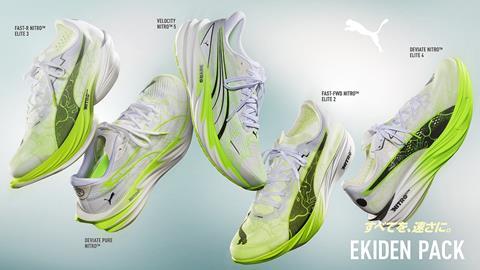
Puma Japan is targeting a stronger showing at the Hakone Ekiden, probably the world’s most famous university relay. Held between Tokyo and Hakone since 1920, the race draws millions of live viewers on national television each Jan. 2 and 3 during Japan’s New Year celebrations. Puma is gaining ground there: its Japan president said 31 runners wore the brand at this year’s race, up from seven in 2023. The next target is to climb from fourth to third in 2027.
4. Running: where progress shows first
The Hakone target rests on continuity: each generation of Puma’s running shoes builds on the last. Running is also the category where Puma shows the most progress: sales grew at a double-digit rate in the third quarter on the strength of its Nitro foam, yet Hoeld told analysts Puma is still “significantly underrepresented” there.
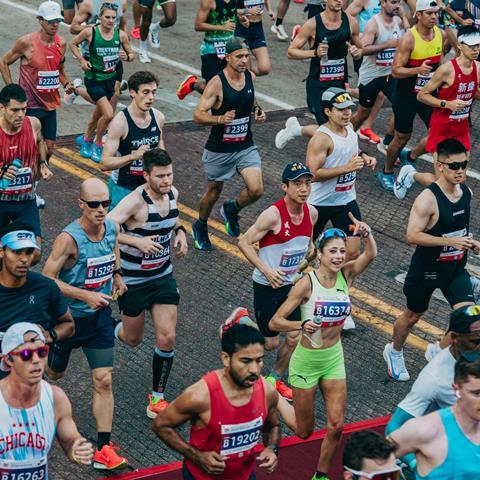
The brand reaches runners through Project3, a program that since spring 2025 has coached more than 850 amateur marathoners at races including Boston, London, Berlin and Chicago, and awarded over $575,000 to 117 of them for beating their personal best by at least three minutes. In March 2027 it moves to Tokyo, where 150 runners will race in Puma’s latest race-day shoes.
Since March, Puma has also worked with the foam specialist Shincell on the next generation of Nitro, in a lab in Suzhou. In October it released the Fast-RB Nitro Elite 2, the second generation of its “Rule Breaker” shoe, about 100 grams lighter than the first.
In chasing a place on the brand podium, Puma is not only trying to put athletes on the race podium. With the Fast-RB, it engineers shoes that pave the way for runners to break the rules if they want to, chasing their own records rather than a medal. For an athlete, the race podium is not everything.
5. Training: the Hyrox route
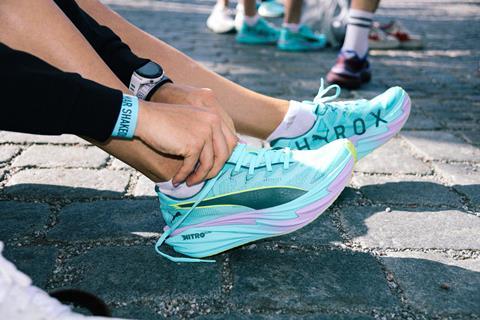
In February, Puma made Training a business unit of its own, separate from Running. Much of the category’s growth comes from Hyrox, the fitness racing series Puma has partnered since its first race in 2018. Later that month, Puma launched the Deviate Nitro Elite Hyrox, its first performance shoe made specifically for the series. At the World Championships in Stockholm in June, Puma athletes won several podiums.
In China, Puma has opened Hyrox training hubs with the Chinese fitness chain Super Monkey, in a market where the series is growing fast.
6. Sportstyle: the product that sells
This year, Puma split Sportstyle from its performance products, giving each a business unit of its own. Sportstyle has been run since June by Laurent Fricker, who spent two decades at Adidas and Reebok. Successful brands understand that culture “is something you participate in, not something you control,” he told CATch UP, and Puma needs “to iterate our styles more quickly.”
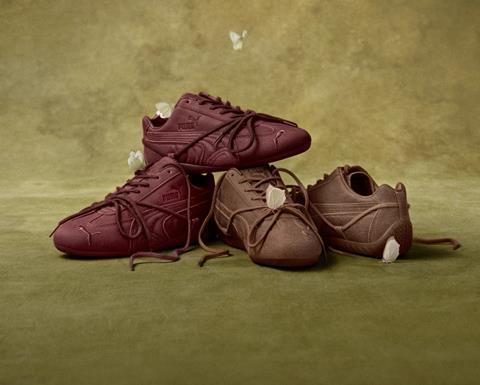
The product that sells is the low-profile Speedcat, fronted by the K-pop singer Rosé, which kept selling well in the third quarter, especially in Asia. Hoeld said that at some key retailers Puma is the fastest-growing brand in women’s footwear, and that he expects the low-profile cycle to last into 2027.
For the other two brands in this series, the category points in opposite directions. Asics counts on SportStyle as one of its main growth engines to 2029, while Nike has to rebuild its credibility in performance after Sportswear and Jordan weighed on its results.
7. Europe: rebuilt from the inside
EMEA is Puma’s largest region and the one falling fastest. Sales there fell 11.5 percent currency-adjusted in the third quarter, to €801.2 million, as Puma kept walking away from what it calls “undesirable business” with mass merchants.
A new regional operating model went live in the second quarter, with a single product range and fewer warehouses, affecting about 600 employees. Since Oct. 1 the region has been led by Fokko de Rooij, who ran EMEA sales at Nike. Mass merchants are losing volume, while Puma’s own channels are growing, with a direct-to-consumer share of 33.1 percent in the third quarter, up from 30.5 percent.
8. China: the market Anta knows best
Anta had followed Puma for ten years before buying in, its chairman Ding Shizhong told the Shanghai-based financial news group Yicai in October. He describes Anta as a “multi-brand enabler,” but sets one boundary: however many brands the group owns, the Anta brand “must win.” (Quotes from Chinese sources automatically translated by SGIE)
Anta now has over 29 percent of Puma and has ruled out a takeover offer. It chairs the Supervisory Board with Dennis Tao, Anta’s head of M&A and capital markets and a former Amer Sports board member, alongside Jeanne Huang, a former Anta senior vice president. Through the Supervisory Board, Ding said, Anta can “share successful management models” with Puma while supporting its current plan. (Same source).
| Puma: Greater China growth by quarter | |||
| 2026, sales change at constant currency | |||
| Q1 | Q2 | Q3 | |
| Greater China | +9.0% | +0.9% | +3.5% |
| Asia/Pacific | +7.9% | – | +10.0% |
| EMEA | -10.4% | -12.9% | -11.5% |
| Group | -1.0% | -9.4% | -6.3% |
Source: Puma quarterly releases, April 30, July 31 and Oct. 30, 2026. Puma does not disclose Greater China sales in euros. Greater China accounts for less than a tenth of group sales.
Since the second quarter, growth in China has come from Puma’s own channels, led by marketplaces such as Dewu and TikTok. Wholesale fell, because franchise partners turned cautious after Anta announced its purchase and are “either not refurbishing current stores or have moved out of certain retail premises,” Hoeld said in October. Puma is in “intense discussions” with Anta about its future operating model in China, he added, without giving details.
The Shanghai business news site Jiemian explained the partners’ caution: the international brands Anta has bought, from FILA to Descente, run mainly through their own stores in China rather than distributors. The business magazine China Entrepreneur quotes an industry insider who expects a complete overhaul of Puma China.
9. Purpose: a belief still to be shown
At its annual meeting in May, Hoeld said Puma had lost clarity at the moment consumers choose, as Bavarian broadcaster BR reported. The answer is a new brand purpose, which Puma described with its third-quarter results. It rests on the belief that “sport is the greatest force on earth,” and Puma will use it from 2027 to sharpen its focus and the way it speaks to consumers.
Puma has not yet shown how.
10. Next: what will settle the picture
The picture stays open until Anta explains how it will work with Puma, in China and worldwide. “We’re focused on rebuilding sustainably rather than chasing short-term growth,” Hoeld told analysts in October.
The next milestone comes in March, with Puma’s full-year results and its first figures for 2027
Enjoying this analysis?
Get 30 days of SGIE Professional for €1
Stay ahead of the global sporting goods market with SGIE’s daily news, analysis, executive interviews and essential email briefings.
Start your €1 trial →€1 for the first 30 days. Single-user access for new subscribers.