


Behind Vision 2035, Asics’ plan to 2029 rests on running, race entries and 30 million OneASICS members. Europe stays the largest region but grows slowest, Greater China nearly doubles and Onitsuka Tiger goes its own way in January.
Nike entered its investor day needing to explain how it would return to growth. Asics faced the opposite challenge: it had exceeded its previous plan a year early and needed to explain what came after a record.
At its 15th Investment Day on Nov. 17, Asics laid out its answer in two parts. Vision 2035 sets out the company’s purpose, rooted in a philosophy it traces to 1949: to become “the essential partner to move body and mind.”
The Mid-Term Plan 2029, which Asics describes as the first step toward that vision, sets the targets: ¥1.5 trillion (€8.3bn) in sales by 2029, a return on equity of 50 percent and about ¥400 billion (€2.2bn) for shareholders.
The mood was less celebratory than the record might indicate. Four days earlier, the shares had fallen 14 percent after third-quarter growth slowed. Nike put a number on almost everything. Asics, by contrast, opened with a belief that is not about numbers but about human habits. Here are ten things to note from Vision 2035 and the plan behind it:
1. Vision
Vision 2035 replaces Vision 2030, the framework Asics published in 2020, and its starting point is a worry rather than a market. According to Asics’ own research, people say they are inactive for 86 percent of the time they are awake. The company expects technology and automation to leave even fewer chances to move by 2035, so choosing to move, in its reading, will matter more than ever.
The figure comes from Asics’ State of Mind study, a survey of 34,000 people in 31 countries that also fed its Human Nature campaign in October. The same study projects that 56 percent of adults in those countries could fall short of recommended activity levels by 2035.
Hence the ambition to from everyday activity to elite sport. The Vision 2035 website illustrates it with three profiles: a serious runner, a junior tennis player and an everyday mover.
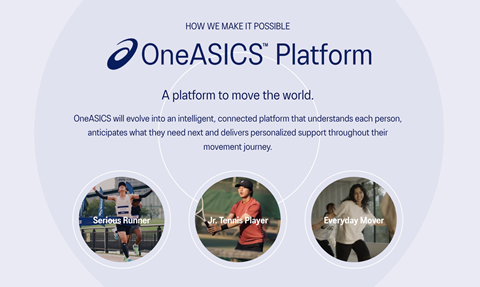
The investment day materials turn the worry into a way to anticipate the market developments. Asics expects health awareness to keep growing while opportunities to be active become more unequal, which means more people who want to move and more who struggle to.
That is the opening Vision 2035 is built on.
2. Scorecard
Three years ago, Asics promised steady growth: sales up 7 to 10 percent a year and operating profit of at least ¥80 billion. In hindsight, it was a cautious promise.
Sales have grown more than twice as fast as planned, by 22.5 percent a year, and should reach ¥1.05 trillion (€5.8bn) this year. Operating profit is heading for ¥195 billion (€1.1bn), almost two and a half times what Asics earned in 2023.
| Asics: Mid-Term Plan 2026 against its targets | |||
| Group, 2023 to 2026 (¥ billions, € billions in brackets) | |||
| 2023 result | Original target | 2026 | |
| Net sales | 570.4 (3.2) | – | 1,050.0 (5.8)* |
| Net sales growth, average a year | – | 7 to 10% | 22.5%* |
| Operating profit | 54.2 (0.3) | 80 or more (0.4) | 195.0 (1.1)* |
| Operating margin | 9.5% | About 12% | 18.6%* |
| Return on assets | 7.9% | About 10% | 17.9%** |
| Market capitalization | 810 (4.5) | – | 3,880 (21.6)*** |
| Days inventory outstanding | 173 | – | 148**** |
Source: Asics Group Mid-Term Plan 2029, Investment Day presentation materials, Nov. 13 and 17, 2026. *2026 forecast. **2025 result. ***Aug. 14, 2026, highest since listing. ****End of Q3 2026. Euro figures converted at ¥180/€, the planning rate Asics uses for its 2026 forecast and 2029 plan.
Profitability moved the same way. Where the plan aimed for a margin of around 12 percent, Asics now expects 18.6 percent, more than Nike hopes to reach by fiscal 2031.
Not all of the work showed up in sales. Asics also cleaned up its balance sheet, selling its stakes in other companies and some of its real estate, closing weak stores in the US and holding less inventory. Return on assets, the measure of how hard those assets work, has more than doubled.
Investors noticed. In August, Asics’ market value reached ¥3.88 trillion (€21.6bn), the highest since its listing and nearly five times what it was worth at the end of 2023.
3. Targets
The Mid-Term Plan 2029 asks for less speed. Asics wants sales of ¥1.5 trillion (€8.3bn) in 2029, which works out at about 13 percent growth a year, a little over half the pace of the past three years (SGIE calculation). The Asics brand is expected to set the pace, with Onitsuka Tiger growing somewhat more slowly.
On capital, the message is simple: Asics wants to keep only as much equity as the business needs and hand the rest back to shareholders, a policy it calls Active Capital Management.
Over three years, it plans to invest about ¥200 billion (€1.1bn) and to return about ¥400 billion through dividends and buybacks, nearly twice as much as under the previous plan. Acquisitions could come on top.
4. Running
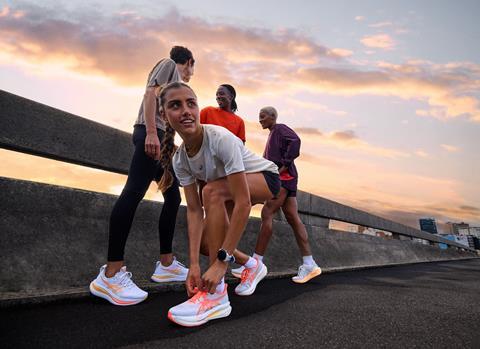
Performance running is still the heart of the business, and the ambition is to make Asics the world’s “overwhelming No. 1.” To get there, the plan aims for sales of ¥600 billion (€3.3bn) by 2029, up from ¥427 billion this year.
In much of the world, it already leads. According to Jewell Running Group, which counts the shoes runners wear on race day, Asics was the most worn brand at the Tokyo, Sydney, Paris and Mumbai marathons this year. In Europe, Asics EMEA, citing Circana, says it is the top performance running brand in France, Germany, Italy, Spain and the UK, as it was at the end of 2025.
The harder ground lies elsewhere. In the US, Asics has climbed from fifth to second among the shoes worn at major marathons since 2022, and it wants first place by 2029, with running sales growing faster than the market.
China is the bigger prize. Asics puts the running footwear market there at about ¥1.8 trillion (€10bn), larger than the American one, yet at two of the races it sponsors its share was only 6 and 10 percent. It plans more flagship and running stores and growth of at least 20 percent a year.
5. Platform
The vision needs a way to reach people between purchases, and Asics has given that job to OneASICS. The membership program is meant to become what Asics calls “an intelligent, connected platform,” one that learns what each person needs next, from a training plan to a race or a running club.
It already has scale. Membership has nearly tripled since 2023 to about 30 million, and Asics wants sales to members, about ¥108 billion (€600m) this year, to roughly double by 2029. Europe is one of its three key markets, alongside Japan and Australia.
Races are where many runners come in. Since 2019, Asics has bought registration platforms region by region: Race Roster in North America, njuko in France, R-bies in Japan, ThaiRun in Thailand and deporticket in Spain, plus GetMeRegistered in the US Midwest this year. Together they form what Asics calls the world’s largest race registration platform, with 15 million entries last year.
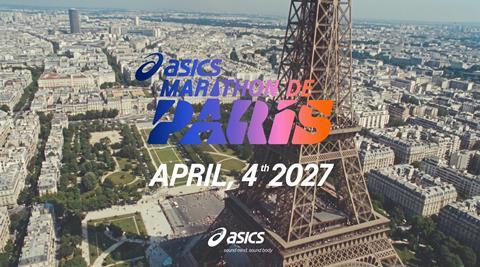
The Paris Marathon in April shows how it works. Runners registered through OneASICS, which brought Asics about 12,000 new members and $1.18 million in race-related sales, according to the company.
Demand is on Asics’ side. Places at the biggest marathons are scarce, with only about 1 percent of ballot applicants getting into New York, and in Japan younger runners are signing up in growing numbers. Asics wants to work with organizers before, during and after each race, from attracting runners to keeping in touch with them and their supporters.
6. Categories
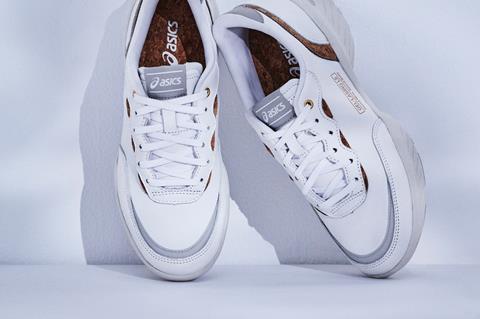
SportStyle is where Asics meets fashion, and the goal, in its own words, is to become “a brand that consumers continue to choose.” It starts from strength: sales rose 70 percent in yen in the first nine months, and the category earns the highest margin in the Asics brand, about 30 percent. The plan aims for ¥380 billion (€2.1bn) by 2029, up from ¥242 billion this year, through a more premium image, designer collaborations, concept stores and more apparel.
| Asics: category plan to 2029 | ||||
| Net sales (¥ billions, € billions in brackets) | ||||
| 2026 forecast | 2029 plan | Growth a year, 2027 to 2029 | 2029 margin | |
| Performance Running | 427 (2.37) | 600 (3.33) | 12% | About 26% |
| SportStyle | 242 (1.34) | 380 (2.11) | 16% | About 30% |
| Core Performance Sports | 105 (0.58) | 152 (0.84) | 13% | About 20% |
| of which Greater Tennis | – | 64 (0.36) | 14% | – |
| Apparel | 53 (0.29) | 80 (0.44) | 15% | About 17% |
| Walking | 15.8 (0.09) | 25 (0.14) | 17% | About 20% |
| Onitsuka Tiger (OT Group from 2027) | 180 (1.00) | 240 (1.33) | 10% or more | 28%* |
Source: Asics Group Mid-Term Plan 2029, Investment Day presentation materials, Nov. 13 and 17, 2026. Margins are category profit margins for the Asics brand. *Operating margin. Euro figures converted at ¥180/€, the planning rate Asics uses for its 2026 forecast and 2029 plan.
In tennis, the ambition reaches beyond tennis itself. Under the name “Greater Tennis,” which takes in padel and pickleball, Asics wants to be the clear global No. 1, building on the top share of shoes worn in men’s singles at the four Grand Slams. In September it became apparel and footwear partner of the Premier Padel major at Roland-Garros.
Greater Tennis is expected to reach ¥64 billion (€356m) by 2029. The route runs through coaches, via academies such as the Mouratoglou Tennis Academy and tennis summits, while the research comes from HumanFab, an independent lab in Aix-en-Provence with an instrumented indoor court.
Two smaller lines pursue a different ambition: taking Japanese successes abroad. Overseas sales of working shoes should pass 20 percent of the business by 2029, up from 4 percent in 2024. Walking shoes, sold almost entirely in Japan today, should make about 30 percent of their sales abroad, mainly in Greater China.
7. Lab
The ambition here is to make better products, faster. Asics wants what it calls unrivaled product engineering, and its research network has grown quickly to support it: within a year, the Institute of Sport Science (ISS) in Kobe has added units in America, Europe and, this month, Australia. In Ann Arbor, the Asics Michigan Sport Innovation Center has opened a campus lab with the University of Michigan, backed by $25 million (€21m) of research funding.
Kobe gets a new site too. In December 2027 Asics will open the Asics Technical Lab, where it will build prototypes quickly, make custom shoes for top athletes and test robotics and what it calls physical AI. One task is to turn the know-how of experienced craftspeople into data that AI can use.
Making and moving the shoes is the other half. Asics relies on global production hubs in Vietnam and Indonesia and regional ones in India, China and Brazil, and wants a single global plan for supply and demand. The aim is to hold less stock, cutting inventory to 125 days for the Asics brand by 2029, and at its main US warehouse drones now count stock every month instead of twice a year.
The plan also covers the people doing the work. Asics promises pay at the top of local benchmarks, more employee share plans and a 20 percent rise in operating profit per employee by 2029.
8. Map
Across regions, the goal is to grow faster than the market, with each country following its own strategy. Europe stays the largest region for the Asics brand, but the plan expects it to grow the slowest, by about 9 percent a year, alongside Australia.
| Asics: regional plan to 2029 | |||
| Net sales, Asics brand only (¥ billions, € billions in brackets) | |||
| 2026 forecast | 2029 plan | Growth a year, 2027 to 2029 | |
| Europe | 275.5 (1.53) | 353.0 (1.96) | 9% |
| North America | 182.0 (1.01) | 244.0 (1.36) | 10% |
| Greater China | 110.5 (0.61) | 200.0 (1.11) | 22% |
| Japan | 88.5 (0.49) | 123.0 (0.68) | 12% |
| Southeast Asia | 34.0 (0.19) | 63.5 (0.35) | 23% |
| Australia | 60.5 (0.34) | 78.0 (0.43) | 9% |
| Latin America | 39.0 (0.22) | 56.0 (0.31) | 13% |
| India | 15.0 (0.08) | 31.0 (0.17) | 27% |
| Others | 38.5 (0.21) | 86.0 (0.48) | 31% |
Source: Asics Group Mid-Term Plan 2029, Investment Day presentation materials, Nov. 13 and 17, 2026. Excludes Onitsuka Tiger. Euro figures converted at ¥180/€, the planning rate Asics uses for its 2026 forecast and 2029 plan.
Asics counts Europe among its mature markets, where it already holds a high share and growth has to come from turning more customers into loyal ones, mainly through OneASICS. The pace has already eased: Asics EMEA grew 5.8 percent in the third quarter, after 32.9 percent in the second.
The momentum is in Asia. India and Southeast Asia are planned to grow by more than 20 percent a year, and Greater China by 22 percent, which would make it more than half the size of Europe by 2029. Mitsuyuki Tominaga, President and Chief Operating Officer, told Bloomberg that “internally, we’re calling next year the ‘Year of China,’” with a target of about 1,000 stores there, up from roughly 400.
9. Onitsuka Tiger
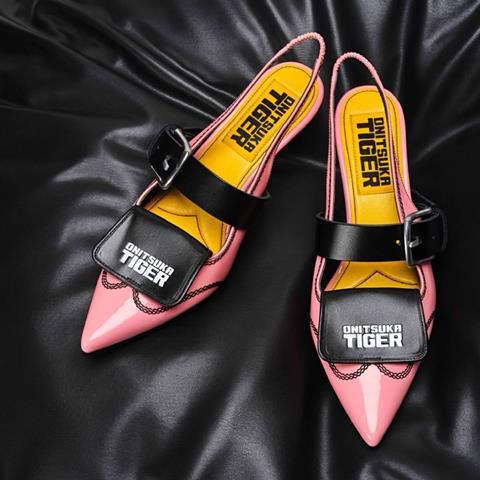
Onitsuka Tiger wants to become “a global luxury lifestyle company from Japan,” and from January it will pursue that goal on its own, as a separate company, OT Group. Its plan to 2029 sums up the idea in two words: “Be Unrivaled.”
It starts as the most profitable business in the group. The plan aims for sales of ¥240 billion (€1.3bn) in 2029, up from ¥180 billion this year, at an operating margin of 28 percent. That means growth of at least 10 percent a year, slower than the 43 percent it achieved in 2025.
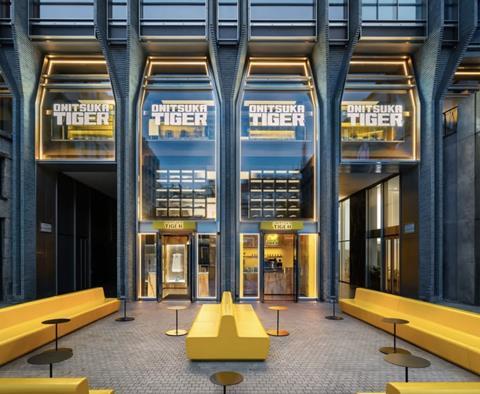
Stores are the main stage. Six large flagships are due to open in the first half of 2027, from Ginza and Seoul to California, Kobe, Hong Kong and Fukuoka, following the Shinjuku store that opened in July, the brand’s biggest so far.
Europe has its own role. The brand calls it “a hub for fashion and culture,” shows its collections in Milan, including its Spring/Summer 2027 line, and makes its Contemporary range in Italy and Portugal. It has also already set up a company in Spain ahead of the split. The model rests on what the company calls pricing power and full-price sales, and it shows in the balance sheet. Inventory is planned at about twice the level of the Asics brand.
10. Reaction
The market had already judged the quarter. After the 14 percent fall on Nov. 13, the shares recovered 7.7 percent on Nov. 16, the day before the investment day. The presentations did not extend that rebound. The shares slipped 1.9 percent on Nov. 17 and another 3.2 percent on Nov. 18, closing at ¥4,275.
Asics also used the days after the event to answer questions raised since its third-quarter call. In a Bloomberg interview on Nov. 18, Tominaga said Asics would consider acquisitions that could take it into areas where it does not compete today.
What investors now hold is a plan for slower but still double-digit growth and generous returns. Vision 2035, by contrast, asks to be judged on something no balance sheet measures: whether more people move.
That goal is as old as the company itself, whose name is an acronym of Anima Sana In Corpore Sano, a sound mind in a sound body. Vision 2035 gives it a new form: to become “the essential partner to move body and mind.”