A study by GEO specialist comdaily, made available exclusively for SGIE, finds a strong concentration in German-language AI buying advice: the top three brands hold up to 54 percent of visibility in running, apparel and wearables. But at checkout, specialist retailers lead purchase routing.
Ask an AI engine which GPS watch gives marathon runners the most accurate heart-rate data, and the answer is almost always Garmin: it appears in all 20 sample answers and comes first in 16. Across the wearables category, Garmin, Chinese watch maker Coros and Polar capture 53.9 percent of all brand visibility. Every other watch brand is left fighting over the rest.
That concentration is the main finding of a study by comdaily, a German consultancy specialized in generative engine optimization (GEO). Between Oct. 21 and Oct. 27, it put 18 buying questions in German, from a German IP address, to ChatGPT, Perplexity, Google Gemini and Google AI Overviews every day.
This produced 504 answers on running shoes, training apparel and sports wearables. The results describe the German-speaking markets, not AI search worldwide. comdaily made the sporting goods results available exclusively for SGIE and a separate cut for Outdoor Industry Compass.
How to read the figures
This study covers the German-speaking markets. All questions were asked in German, from a German IP address, with Google results on google.de, and the purchase questions ask where to buy in Germany. The benchmark products were chosen for their sales in DACH retail.
● Neutral question: the buyer describes a need without naming a brand, such as a GPS watch with the most accurate heart-rate tracking for marathon training. These questions show which brands AI recommends (336 answers).
● Purchase question: the buyer names a brand, a model or a product type and asks where to buy it. These questions show where AI sends the buyer (168 answers).
● Visibility: comdaily’s score, from 0 to 100 percent, of how present a brand or shop is across all answers in a segment.
● Rank: comdaily’s ranking score, based on how often and how prominently a brand or shop is named. A brand placed higher in an answer can outrank a rival that is mentioned slightly more often.
● Shortlist: the brands with at least 25 percent visibility in a segment, which comdaily calls the “relevant set”.
Three brands, up to half the visibility
AI engines do not show buyers a full market. They show a short list of brands, and most of the attention goes to the brands at the top of that list.
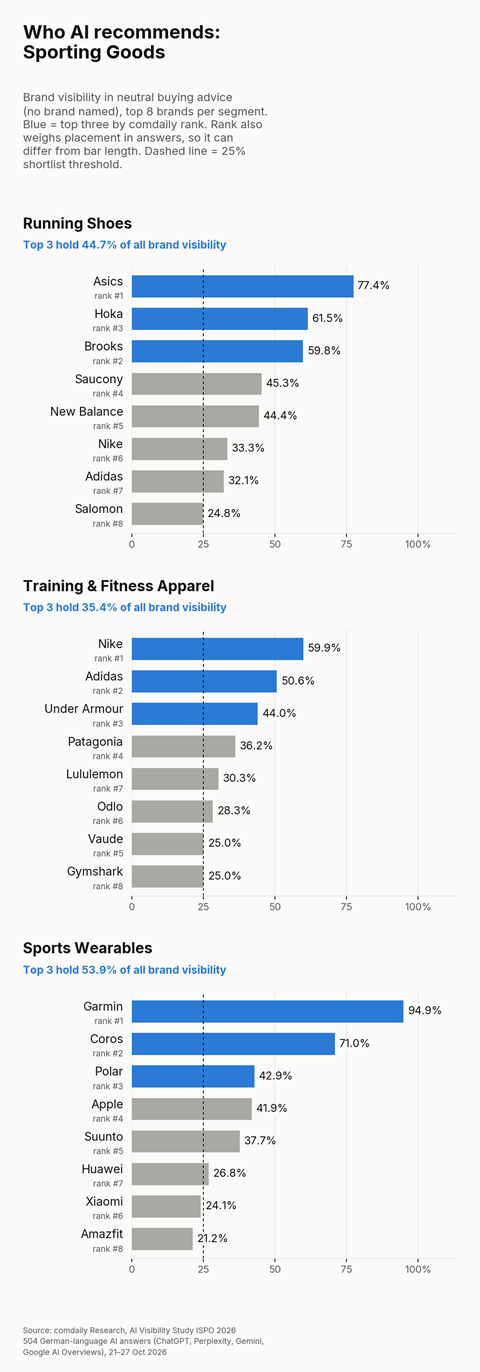
In each segment, the three highest-ranked brands hold between 35 and 54 percent of all brand visibility. Many more names appear further down: apparel answers rank at least 20 brands, yet only nine reach 25 percent visibility. The pattern resembles a Pareto distribution, though less extreme than the classic 80/20 split: a small group of brands collects a disproportionate share of attention, and a long tail shares the rest.
Wearables is the most concentrated segment. Garmin reaches 94.9 percent visibility, Coros 71.0 percent and Polar 42.9 percent; together they hold 53.9 percent of all brand visibility. Apple (41.9 percent), Suunto (37.7 percent) and Huawei (26.8 percent) complete a shortlist of six.
Running shoes come next. Asics leads with 77.4 percent, and with Brooks and Hoka the top three hold 44.7 percent. Hoka is slightly more visible than Brooks (61.5 against 59.8 percent) but ranks third, because Brooks is placed higher in the answers. Seven brands make the shortlist.
Training apparel is the most open segment. Nike leads with 59.9 percent, the top three hold 35.4 percent and nine brands clear the 25 percent mark. Outdoor brands cross over into it: Patagonia ranks fourth, Vaude fifth and Odlo sixth, with Lululemon and Gymshark behind them.
| Who AI recommends: the shortlist by segment | |||
| Neutral buying advice (no brand named), Oct. 21 to 27, 2026 | |||
| Segment | #1 brand (visibility) | Shortlist (25% visibility or more) | Top-3 share of visibility |
| Running shoes | Asics (77.4%) | 7 brands: Asics, Hoka, Brooks, Saucony, New Balance, Nike, Adidas | 44.7% |
| Training & fitness apparel | Nike (59.9%) | 9 brands: Nike, Adidas, Under Armour, Patagonia, Lululemon, Odlo, Icebreaker, Vaude, Gymshark | 35.4% |
| Sports wearables | Garmin (94.9%) | 6 brands: Garmin, Coros, Polar, Apple, Suunto, Huawei | 53.9% |
Source: comdaily Research, AI Visibility Study ISPO 2026, 504 German-language answers from ChatGPT, Perplexity, Gemini and Google AI Overviews. Visibility and top-3 share as calculated by comdaily.
Below the shortlist, visibility falls quickly, even for big names. On ranks 12th in running shoes with 6.0 percent. Puma ranks 11th in running (16.4 percent) and 19th in apparel (7.3 percent).
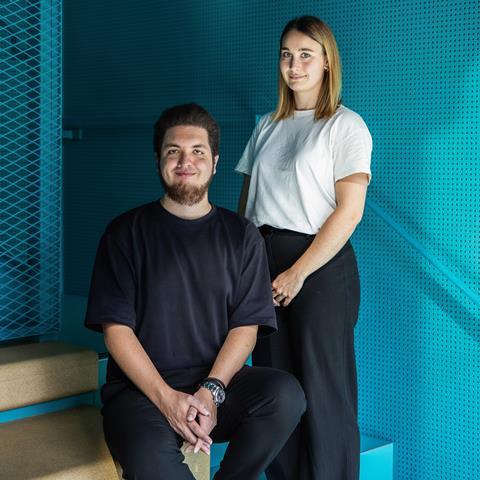
“Generative search doesn’t show buyers a market, it shows them a shortlist. In running, apparel and wearables, six to nine brands make it into the answer. Every other brand is invisible at exactly the moment the buyer is still open,”
said David Wiestner, Co-Founder and Managing Director of comdaily.
On the list, not at the checkout
Comdaily built its purchase questions around five benchmarks that it picked for their sales volume in DACH (i.e. the Germany-Austria-Switzerland region) retail: the Brooks Ghost, the Asics Gel-Nimbus, Under Armour, Nike Dri-FIT and the Garmin Forerunner. All five brands also make their segment’s top three when the buyer names no brand.
Recommendation is not the problem. The purchase is.
In none of the three segments does a brand’s own store come first when buyers ask where to buy. The Garmin and Under Armour stores rank second, the Asics store fourth, the Brooks and Nike stores sixth. The first destination is SportScheck for running shoes and apparel and MediaMarkt for wearables.
The wording of the question decides a lot.
Asked where to order Under Armour apparel with fast delivery, all 20 sample answers name the official store first. Asked which German shops offer reliable availability and good prices for the Asics Gel-Nimbus, the answers start instead with specialist shops like Running Point and Top4Running, or with Zalando, Intersport or idealo.
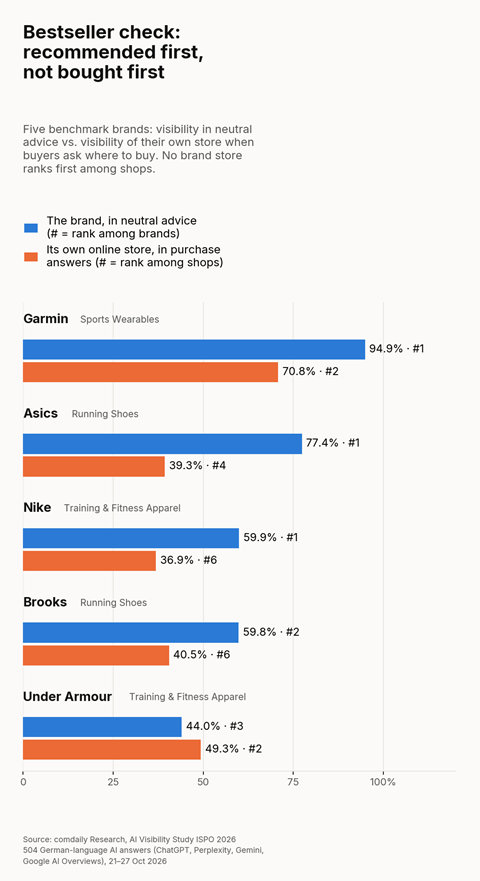
| Benchmark brands: recommended first, not bought first | ||||
| Neutral advice vs. purchase answers, Oct. 21 to 27, 2026 | ||||
| Brand | Segment | Rank in neutral advice (visibility) | Own store: rank among shops (visibility) | #1 shop |
| Garmin | Sports wearables | #1 (94.9%) | #2 (70.8%) | MediaMarkt |
| Asics | Running shoes | #1 (77.4%) | #4 (39.3%) | SportScheck |
| Nike | Training & fitness apparel | #1 (59.9%) | #6 (36.9%) | SportScheck |
| Brooks | Running shoes | #2 (59.8%) | #6 (40.5%) | SportScheck |
| Under Armour | Training & fitness apparel | #3 (44.0%) | #2 (49.3%) | SportScheck |
Source: comdaily Research, AI Visibility Study ISPO 2026, 504 German-language answers from ChatGPT, Perplexity, Gemini and Google AI Overviews. Neutral advice: no brand named in the question. Shops: destinations named in answers to “where to buy” questions. Rank and visibility as calculated by comdaily.
Where AI sends buyers, and why Idealo comes first
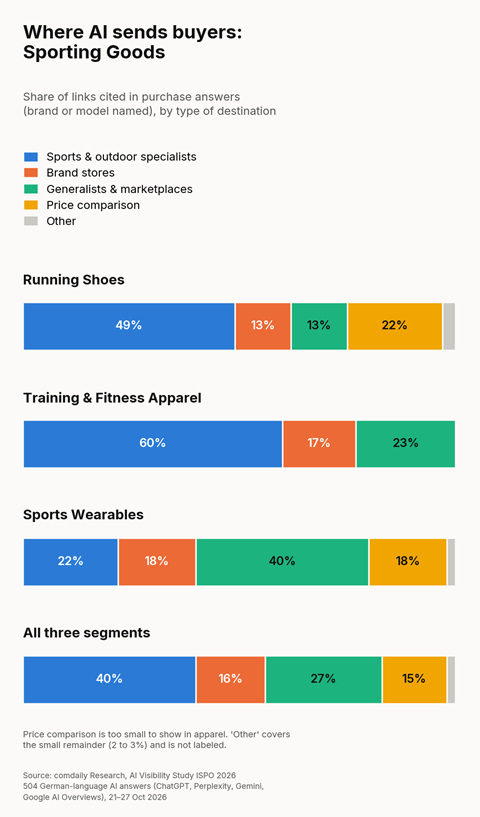
Sports specialists get 40 percent of the links cited in purchase answers. Generalists and marketplaces get 27 percent, brand stores 16 percent and price comparison sites 15 percent. Amazon gets 4.7 percent, most of it in wearables. Wearables follows its own logic: consumer electronics chains lead, with MediaMarkt first and Saturn third.
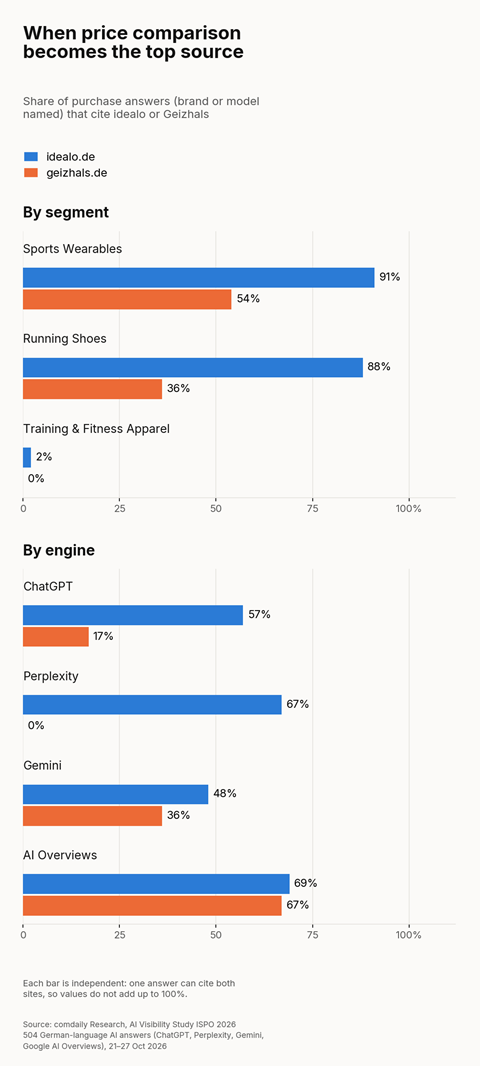
The most-cited source is often not a shop at all. Idealo, the German price comparison platform, is cited in 91 percent of wearables purchase answers and 88 percent of running-shoe purchase answers, more than any retailer. Geizhals, the Austrian price comparison site, appears in 54 percent of wearables answers.
Again, the question sets the route.
Questions that name a model or mention price (Brooks Ghost, Gel-Nimbus, Garmin Forerunner, GPS watch deals) bring price comparison into almost every answer. Questions about a brand’s range or delivery times (Under Armour, Nike Dri-FIT) bring idealo into only 2 percent of answers.
Two measures explain an apparent contradiction.
Citation shares count the links an engine attaches to its answer. Destination ranks score how often and how high up a shop is mentioned in the text itself. That is how MediaMarkt can rank first in wearables while idealo collects the most links.
AI Overviews relies on price comparison more than any other engine: it cites idealo in 69 percent and Geizhals in 67 percent of purchase answers. Perplexity cites idealo in 67 percent and never cites Geizhals. ChatGPT cites them in 57 and 17 percent, Gemini in 48 and 36 percent.
Same question, different answers
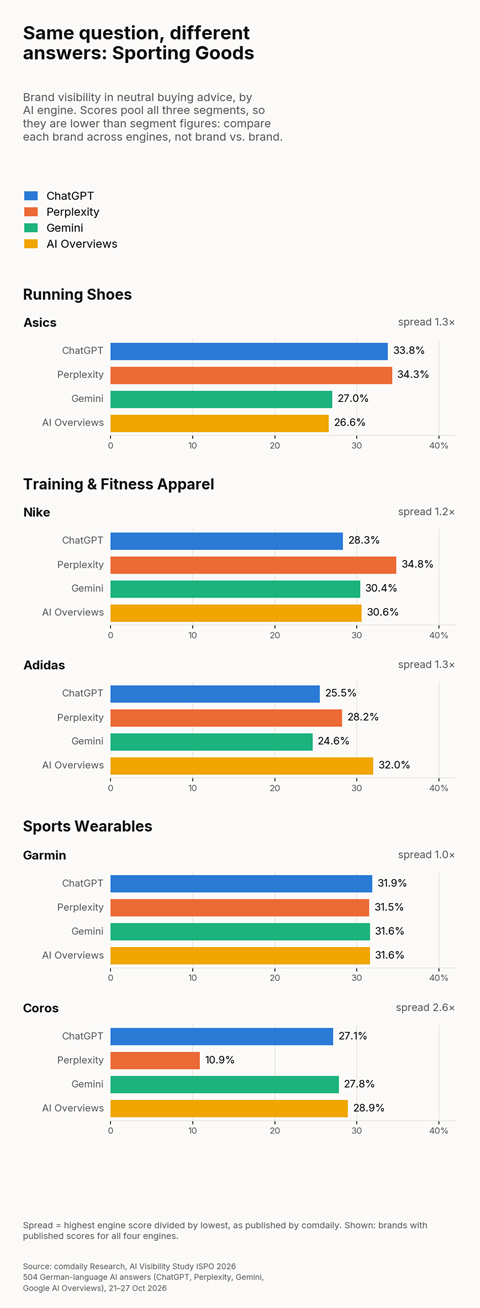
The four engines agree on which brands lead, but they treat challengers and sources very differently. comdaily scored each engine on all 84 of its neutral answers, pooling the three segments. Because most brands compete in only one of the three segments, their pooled scores are lower than the segment figures above. Garmin’s 94.9 percent in wearables becomes about 31.6 percent here. The scores are best compared between engines for the same brand.
Where the engines agree. Garmin, Nike, Asics, Adidas, Brooks and Hoka make the top 10 at ChatGPT, Perplexity, Gemini and Google AI Overviews alike. Garmin is the most stable brand in the study, with visibility between 31.5 and 31.9 percent at all four engines. Google’s two engines also read the market in much the same way: Gemini and AI Overviews both give Garmin 31.6 percent, Nike 30.4 and 30.6 percent, and Coros 27.8 and 28.9 percent.
ChatGPT is the only engine that ranks running leader Asics first (33.8 percent) and leaves the most room for wearables challengers: Polar (19.8 percent) and Apple (19.5 percent) are more visible here than at any other engine. Nike scores its lowest here (28.3 percent).
Perplexity favors the running and sportswear majors. Nike (34.8 percent), Asics (34.3 percent) and Brooks (25.5 percent) reach their highest scores here, while New Balance and Under Armour miss its top 20. It is also where Coros falls behind: 10.9 percent and 12th place, against 27.1 to 28.9 percent at the other three engines, a gap of 2.6 times. In the sample answers, Perplexity opened all five answers on beginner road shoes with Brooks and named Coros in only two of its five GPS watch answers.
Gemini opened all five of its sample answers on beginner road shoes with Asics. It gives Saucony its lowest score in the study (10.3 percent).
Google AI Overviews gives Adidas its best score (32.0 percent) and lifts Saucony to 21.6 percent, twice its Gemini value. Asics scores lowest here (26.6 percent).
At checkout. SportScheck is the first purchase destination at ChatGPT, Gemini and AI Overviews. Perplexity again goes its own way: idealo comes first, Decathlon second (it makes no other engine’s top 20) and SportScheck only fourth. With 42 purchase answers per engine, comdaily considers the pattern robust, not the exact ranks.
“Garmin shows what category leadership looks like in AI search: near-total visibility. Coros shows the other side of the coin. A challenger with a clear technical profile can take second place ahead of Polar, Apple and Suunto,” Wiestner said.
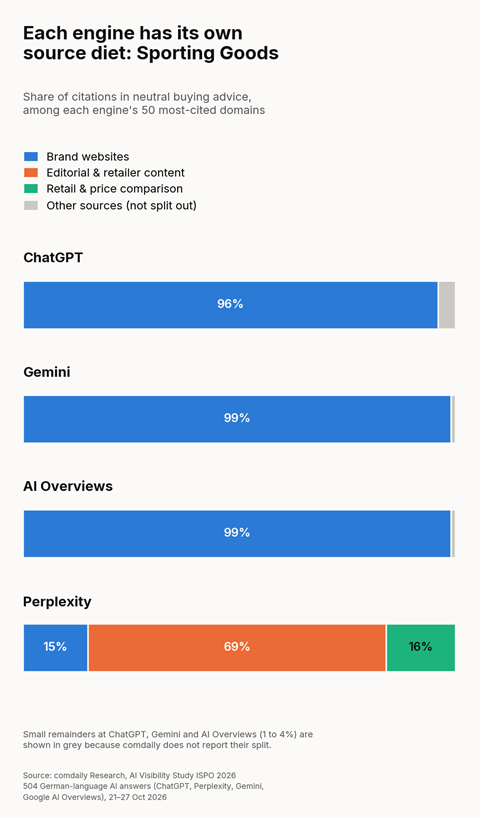
The engines read different sources. ChatGPT, Gemini and AI Overviews build their answers almost entirely on brand websites, which supply 96 to 99 percent of citations among each engine’s 50 most-cited domains. Perplexity draws 69 percent of those citations from editorial and retailer content, led by Runner’s World (51 citations), buying guides from outdoor retailer Bergzeit (38), tech publisher Chip (33) and GQ (29); brand websites supply only 15 percent. comdaily links the differences in brand results to these source diets: Perplexity rewards brands with broad media and retail coverage, the other three reward brands with detailed product pages.
Pooled across all four engines, the picture is less one-sided. Of the 2,024 citations that went to the 50 most-cited domains in each segment’s neutral answers, brand websites supply 62.0 percent and editorial sources 31.6 percent. No B2B trade title ranks among the most-cited domains, which fits questions asked by consumers.
“For three of the four engines, the most important source is the brand’s own website. That is good news, because it is the one source a brand fully controls. But most product pages are written for buyers who already know what they want, not for the problem a buyer describes,” Wiestner said.
Playbook
Based on these findings, comdaily offers recommendations for three types of player.
Category leaders such as Garmin, Asics and Nike are already on the shortlist, so their work starts at the point of purchase. comdaily advises them to treat idealo and Geizhals as visibility channels rather than mere price tools, because full model names, current offers and accurate product data on these platforms decide whether a model shows up when the buyer is ready to pay.
The same care should go into the retailers that capture the demand these brands create: SportScheck and Intersport in running and apparel, MediaMarkt and Saturn in wearables. On the brands’ own online stores, stock, price and delivery data that machines can read give the engines what a buyer about to purchase is asking for.
Challengers face a different problem: getting onto the shortlist in the first place. comdaily recommends building product pages around the need a buyer describes, such as overpronation, a carbon shoe for race day, accurate heart-rate data or long battery life with offline maps, because brand websites are the main source for ChatGPT, Gemini and AI Overviews.
For Perplexity, the route runs through reviews and tests: Runner’s World in running, tech testers Chip, IMTEST and heise in wearables, and buying guides from retailers such as Bergzeit. And since a challenger’s visibility can swing sharply from one engine to the next, as Coros shows, comdaily also advises monitoring each engine separately.
Retailers are, for now, among the winners of AI search. The engines already treat a small group of specialists and electronics chains as the default checkout. Whether they keep that role depends on how complete and current their product pages, stock and prices are.
The study in detail
- Study: AI Visibility Study ISPO Edition 2026, sporting goods edition, by comdaily Research (lead: David Wiestner) for Sporting Goods Intelligence Europe
- Field period: Oct. 21 to Oct. 27, with daily runs between about 13:30 and 14:15 UTC, combined into a single measurement
- Engines: ChatGPT with web search, Perplexity, Google Gemini, Google AI Overviews on google.de; new sessions with no history, run from a German IP address
- Sample: 18 German-language prompts × 4 engines × 7 days = 504 answers (336 neutral, 168 purchase); the full study covers 1,008 answers in six segments
- Prompts per segment: four neutral questions and two purchase questions; five of the six purchase questions name one of the benchmarks below
- Benchmarks: Brooks Ghost, Asics Gel-Nimbus, Under Armour, Nike Dri-FIT and Garmin Forerunner, chosen by comdaily for their sales volume in DACH retail
- Example answers: for one prompt in each segment, five answers from each engine (Oct. 23 to Oct. 27), translated from German
- Quality control: answers spot-checked during evaluation, with fallback mechanisms for faulty or hallucinated answers, according to comdaily
About comdaily
comdaily is a Cologne-based consultancy specialized in generative engine optimization (GEO). It grew out of an academic research project on consistent brand communications and has been building its business since 2023, combining strategic advice with an analytics platform developed in-house.
The software tracks how brands appear and get recommended in ChatGPT, Perplexity, Google Gemini and Google AI Overviews, including their placement in answers and the sources each answer cites. comdaily is led by Managing Directors Ellen Martin, Ralf Spiller and David Wiestner.
More at comdaily.ai