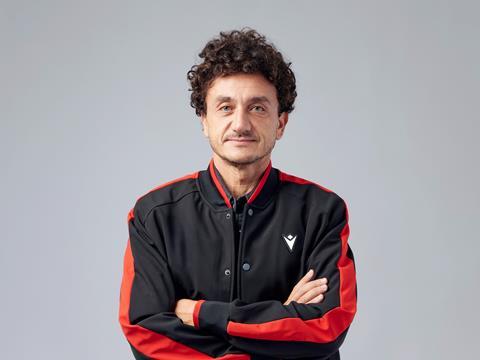
For Bologna-based sportswear brand Macron, a new sound logo is the latest tool in a broader identity-building effort. Chief Brand and Communications Officer Angelo Marino sat down with SGI Europe to explain why discipline in saying no has become the company’s growth engine.
Angelo Marino, Chief Brand and Communications Officer at Macron, has spent the past few weeks showing the same 60 second clip loop across the company’s internal channels and meetings: a three-note sound, played on repeat, followed by the Macron name spelled out, first by a male voice, then by a female voice. The goal, he says, was for staff to leave the room “hating” the new sound logo: not because they disliked it, but because they wouldn’t be able to get it out of their heads.
The new sonic identity unveiled by the Bologna-based company is the latest step in a broader brand-building journey that has involved multiple layers of the organization in recent years. From the launch of an in-house Media House for content production and distribution, to the introduction of Macron O.N.E., and the development of an increasingly distinctive brand language, the group has steadily expanded the tools it uses to express its identity and positioning.
In this context, the sound logo represents much more than a creative asset: a small but meaningful sign of how Macron is strengthening its identity and increasing its recognizability on an international scale.
Three streams, one brain
Macron’s business runs on three streams: teamwear, which remain the core; technical sponsorship, which enhances brand visibility and reinforces Macron’s position as a leading innovator in sportswear; and Macron O.N.E. (“Own Nothing Else”), the Activefashion high-end line developed from the brand’s know-how and its expertise in technical materials. Marino describes Macron O.N.E. as a natural evolution rather than a departure from the core business.
“O.N.E. is not a lifestyle brand for its own sake. The world does not need another one, especially right now,” he says. “It starts from what we know how to do technically, and from twenty years of Macron’s history.”
In the performance categories, this know-how translates into what Marino calls “Fashion in Sport”: technical products shaped by functionality and Italian design sensibility. O.N.E. reverses the equation, applying the same technical expertise to a more lifestyle-oriented expression of the brand, where Italian aesthetics is a key distinctive feature.
That Italian attitude also shapes where the company keeps control. Production runs across 60 to 70 factories worldwide, but design, prototyping, and decision-making remain in Valsamoggia, a town of 30,000 near Bologna. “The brain of the company is here,” Marino says, and that is why, he adds, every product carries a “Designed in Bologna” signature, emphasizing where ideas, research and development take place.
More than a warehouse
The company’s distribution model, an innovative format developed on the intuition of CEO Gianluca Pavanello, runs more than 200 Sports Hubs worldwide on a “make to stock” model: hubs carry no inventory of their own, fulfillment ships directly from the Bologna campus, and a US distribution center opened in Connecticut in 2024 to support growth in America. Marino is explicit that the network was never designed purely to solve logistics.
“Product and brand are never separate. They move in the same direction,” he says. “The Sports Hub is the main asset through which the two come together.”
Distributing teamwear, he argues, is structurally different from traditional retail: clubs need custom sizing and kit cycles that a conventional store model cannot easily absorb, so keeping stock centralized and hubs asset light lets local partners focus on the relationship rather than the warehouse.
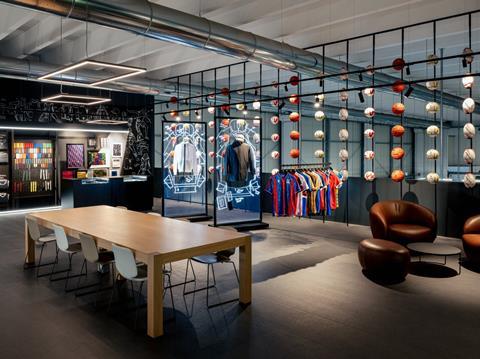
“The hub does not have to worry about anything,” he says. “We hold the stock for them. What they have to do is serve every team as well as possible and present the brand, in the best way, to whoever comes into contact with it.” He half jokes that the model demands “a very, very strong hearted CFO.” Asked to size the campus warehouse behind it, Marino puts its stocking capacity at almost 15 million pieces and growing.
Building a media house: the make or buy dilemma of creativity
Most brands Macron’s size, Marino acknowledges, would outsource content production and rely on a brand book. Macron chose a different route, building an in-house Media House with editorial direction, a podcast studio, photography, video production and, most recently, the sound logo developed with Chora Media, Italy’s largest podcast company, mentioned at the beginning of this interview.
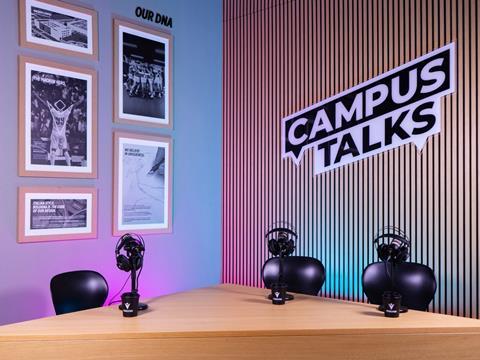
His reasoning traces back to one of Macron’s greatest assets: a network of more than 100 professional clubs and thousands of teams worldwide. “We recognized this network as an exceptional asset: one whose full potential could only be unlocked through a more deliberate approach to shaping our brand narrative,” he says.
“Every club has its own story and objectives. We therefore built a structure that would allow us to articulate our story directly, while activating those communities with greater precision.”
Centralizing production, Marino argues, is not simply about creating content. It is about governing the brand narrative consistently across markets, channels and audiences, while supporting Macron’s evolution from being perceived primarily as a technical sponsor to being recognized as a consumer-facing brand.
But how much can you internalize when it comes to creativity, where, more often than not, an outsider’s eye is needed and independent thinking can be a real advantage. Marino frames it as a balance: “We always try to keep an outside eye, because we know we don’t always have the right competencies in house. Where we need it, we bring in outside expertise,” pointing to BOSCO STUDIO, which produced the brand’s anthem, and Chora Media for the sound logo.
The objective is not to do everything internally, but to combine strategic control with the perspective and expertise that external partners can provide. Balance, Marino says, goes hand in hand with discipline. Growth can drift off course when opportunities multiply and brands start chasing every trend.
“The hardest part isn’t knowing where to go; thanks to the clear vision of our CEO Pavanello, the whole company has that clear,” he says. “It’s having the courage to say no.”
For Marino, that discipline is not separate from Macron’s growth story but one of its causes. The company’s expansion from roughly €8 million in revenue in 2004 to €244.6 million in 2025, with €270 million targeted for 2026, has been achieved entirely through organic growth, without a single acquisition in 22 consecutive years.
“We don’t want shortcuts,” he says. “Some opportunities might get us there faster, but growth only creates value if it remains coherent with who we are and where we want to go.”
The sound itself
Back to the sound logo: Marino says it came from one strategic reason and one tactical one. Strategically, Macron’s recognition was already building, helped along by the podcast’s growing audience. Tactically, and he is candid about this, the brand’s name is often mispronounced.
“We felt the moment was right,” he says, “to put that growing recognition to work and to educate people on the correct pronunciation of our name at the same time.”
Sound design was one of the few areas Macron chose not to develop entirely in house. The brief given to Chora Media had specific requirements: nothing centered on an individual voice, since Macron never uses a single ambassador in its communications, only the collective. The result is a dual voice, male and female together, meant to reflect collaboration and team spirit.
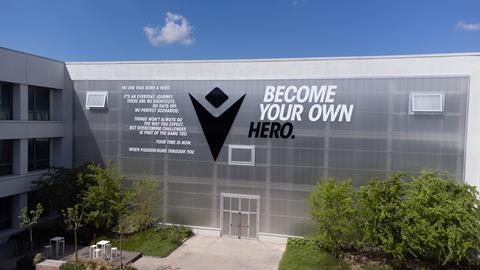
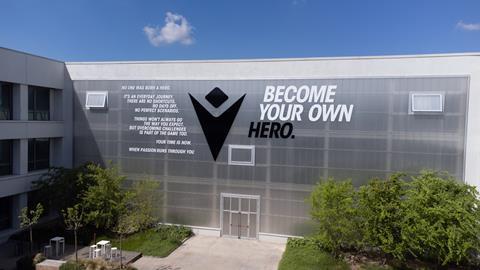
The three notes echo the three points of the Macron Hero, the brand’s pictogram.
“There’s a whole piece of storytelling aligned with our identity in there,” he says. “We didn’t want to lose that.”
The objective, Marino is careful to say, was never to be liked.
“Even when you hear the Netflix sound, you don’t say beautiful or not beautiful,” he says. “You recognize it. That’s the goal here: recognizability.”
Since the sound logo launched only weeks ago, Macron does not yet have structured data on audience reactions, only fragmented and highly subjective impressions. What the company does have is a philosophy about how recognition gets built at all.
“Redundancy isn’t a problem in our world,” Marino says. “What we think we’ve said a hundred times, there’s someone out there who still hasn’t heard it. So we keep repeating.” That looping clip across Macron’s internal channels reflects precisely this philosophy - applied first and foremost to the people within the company itself, even before it reaches the outside world.
International reach without a World Cup kit
Macron had no team at the 2026 World Cup: a circumstance that Marino views as the outcome of sporting results rather than a strategic decision. “We had four national teams that, sadly, lost their playoffs,” he says. “We’d have been happy for them if they’d made it. But our journey does not change because of that.”
For Marino, that is precisely the point. Macron’s growth in recent years has demonstrated that the brand can build international relevance without relying on a single global stage. Participation in a World Cup would certainly have been a valuable opportunity, but it is not the sole measure of a brand’s strength or visibility.
Macron continues to maintain a strong presence at major international sporting events across multiple disciplines.
The brand outfits seven of the 20 national sides confirmed for the 2027 Rugby World Cup in Australia and supplies the reigning Cricket World Cup champions; Marino cites Italy’s men’s basketball team, which he watched play a qualifier in Bologna, as another marker of that multi-sport reach. Beyond its national team partnerships, Macron also holds a unique position in European football as the Official UEFA Referee Match Kit Supplier, providing match kits for officials across UEFA’s flagship club and national team competitions.
About
Angelo Marino is Chief Brand & Communications Officer at Macron, a role he has held since late 2023. He oversees the company’s global brand vision, marketing and communications, including the in-house Macron Media House. Before joining Macron, Marino spent more than a decade at Ducati, where he contributed to the development of the brand’s global positioning and played a key role in the launch and growth of Scrambler Ducati, one of the company’s most successful lifestyle-driven projects.