From adidas Originals x Miaou’s body-confident nostalgia to Nike’s eight-collaboration programme and Boggi Milano’s FIFA formalwear deal, the brands competing hardest for World Cup 2026 aren’t selling kits — they’re selling cultural identity.
The 2026 FIFA World Cup (June 11 – July 19, Canada, Mexico, and the US) is a few weeks away from kick-off, but a parallel competition has already begun off the pitch: a race among fashion and sporting goods brands to own the cultural moment that surrounds the tournament. Two announcements this week — a second collaborative collection between adidas Originals and New York label Miaou, and a licensed capsule from Boggi Milano tied to its four-year FIFA partnership — illustrate just how commercially calculated the off-pitch category has become.
Taken alongside moves by Nike, Levi’s, and Hollister announced in recent weeks, they deliver a clear message: the sideline has become a serious commercial runway.
Nostalgia, femininity and football: adidas Originals x Miaou
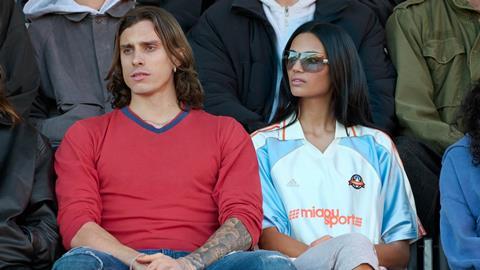
Announced April 30, the second adidas Originals x Miaou collaboration is part of this push to translate tournament attention into off-pitch demand. The collection draws on early-2000s supporter aesthetics, filtered through Miaou’s body-confident, femininity-forward signature. Founded by Alexia Elkaim, the New York label has built its audience around that point of view, and this release extends it into football-coded sportswear.
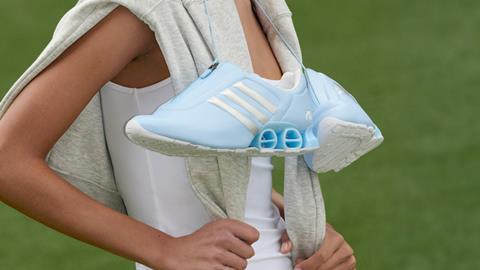
At the center is a revised Megaride sneaker, an archive silhouette updated with a smooth leather upper, zip closure, silicone-embossed stripes, and debossed co-branding. The accompanying apparel — a jersey, corset, and nylon track pants — reworks kit references into fashion-led pieces. A campaign styled as early-2000s paparazzi imagery, featuring Italian footballer Riccardo Calafiori and model Alyson Dubey, leans into the same nostalgia that underpins the product story.
From formalwear to fanwear: Boggi Milano’s two-track FIFA strategy
Boggi Milano has been approaching World Cup 2026 on two fronts. Institutionally, the Italian menswear and formalwear label has a four-year partnership, signed in December 2025 and unveiled at the tournament’s Final Draw in Washington, D.C., naming it the official formalwear outfitter for both the FIFA World Cup 2026 and the FIFA Women’s World Cup 2027.
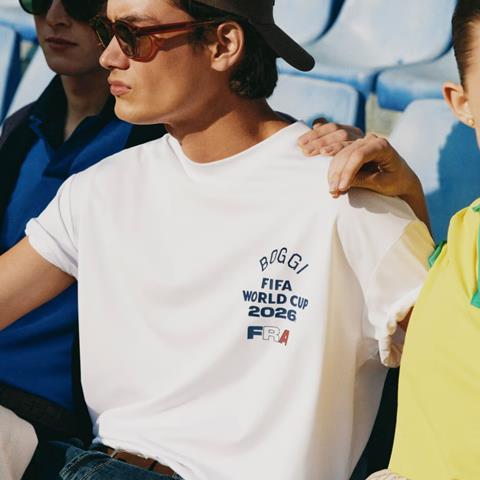
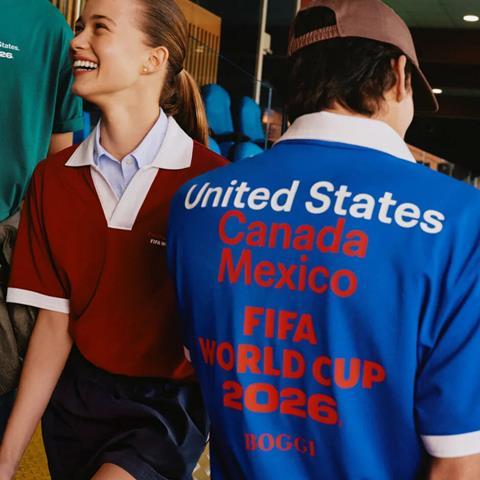
On the consumer side, it launched a 16-piece licensed capsule this week, split evenly between polo shirts and T-shirts. The range nods to the eight nations that have previously won the World Cup (Argentina, Brazil, England, France, Germany, Italy, Spain, and Uruguay), alongside a host-nations design for Canada, Mexico, and the US. For a brand best known in Italy, the initiative is positioned as a rare, global-scale moment in the calendar.
Nike’s most ambitious collab program yet
Neither Boggi Milano nor adidas have been operating in isolation. In the last week, for instance, Nike has assembled what may be the most structurally ambitious off-pitch program built around a single tournament: eight collaborations — each pairing a national federation with a culturally aligned creative partner — anchored by the Cryo Shot, a new silhouette that converts archival football boot designs into street-ready sneakers.
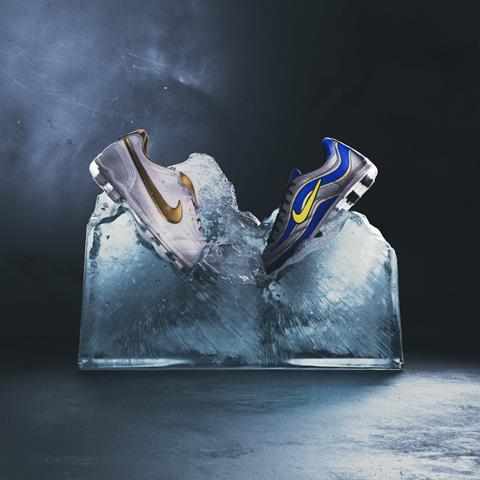
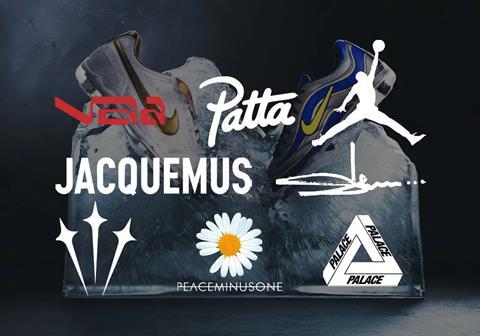
The lineup spans Palace for England, Patta for the Netherlands, NOCTA (Drake’s Nike sub-label) for Canada, Jacquemus for France, artist Slawn for Nigeria, G-Dragon’s PEACEMINUSONE for South Korea, and the Virgil Abloh Archive for the US, with Jordan Brand joining as an additional US-market entry. The full program is expected to land in summer 2026.
Levi’s, Hollister and the democratization of tournament style
It is not only sportswear giants and premium menswear labels leaning into the off-pitch opportunity. Mainstream fashion players are also moving to capture World Cup attention, using a mix of federation partnerships and official licensing.
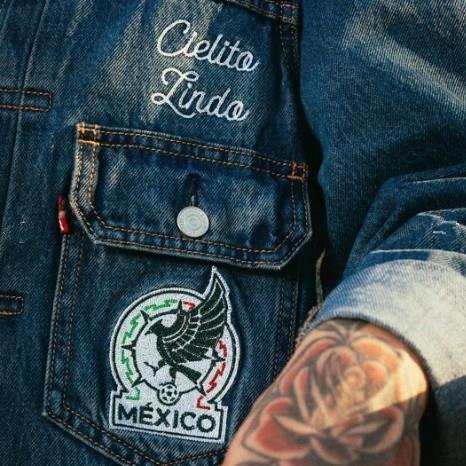
Levi’s launched a U.S. Soccer collection on April 23 as part of a multi-market series that has already included Mexico and is scheduled to roll out in England (May 7) and France (May 14). Rather than working through FIFA licensing, the brand has partnered directly with national federations, a route that typically offers more flexibility on design and storytelling.
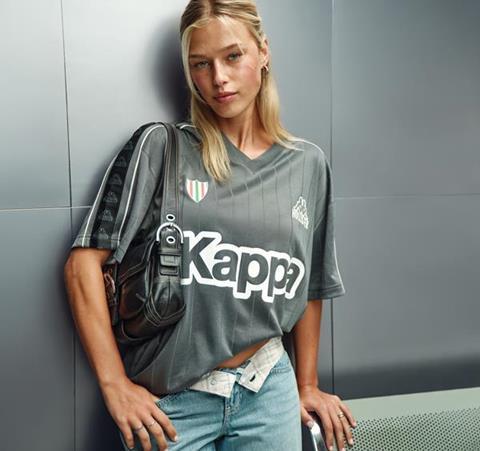
Hollister, owned by Abercrombie & Fitch Co., has taken the opposite approach, releasing a licensed FIFA collection built around graphic product and tournament nostalgia, including references to Mexico 1986 and USA 1994, alongside team-specific pieces for Brazil, Spain and Italy. A separate line developed with Kappa pushes the same pitch-to-street proposition through oversized jerseys, tracksuits and fleece shorts. Corey Robinson, Chief Product Officer at Abercrombie & Fitch Co., said the strategy is to “treat soccer not just as a sport, but as a lifestyle, resulting in pieces designed to resonate well beyond a single season.”
The off-pitch sideline has become a serious commercial runway
Tournament capsule collections are nothing new, but the scope and intent of the 2026 push stand out. With games in the United States, Canada, and Mexico, brands are targeting a North American market with significant consumer spending power and a fan base that has expanded sharply over the past decade.
The off-pitch play targets a familiar problem: converting the tournament’s emotional pull into sales among consumers who are unlikely to buy a replica kit. This cycle’s range of price points, licensing models, and aesthetics shows how aggressively brands are testing demand, especially in the premium and luxury tiers.
FIFA World Cup 2026: The Business of the Beautiful Game
How brands, retailers, and the sports economy compete on football’s biggest stage.
Explore Our Coverage →