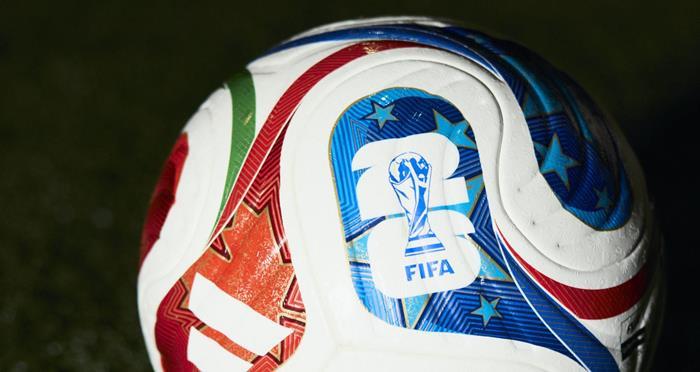
On June 18, Jonathan David scored a hat trick in front of 52,497 people in Vancouver as Canada beat Qatar 6-0. It was the first win in the country’s men’s World Cup history, landing in a summer that multiple brand campaigns had spent months preparing Canadians to feel.
In the months leading up to FIFA World Cup 2026, a cluster of Canadian brands and their agencies produced some of the tournament’s sharpest host-nation creative work. Thursday’s result in Vancouver means that work is now playing out in real time against what it promised: national pride, first and foremost.
Visualizza questo post su Instagram
How to be heard when the microphone isn’t yours
FIFA World Cup 2026 is a three-nation tournament. In the global attention economy, it is effectively one. The United States will host 78 of the 104 matches, generate the overwhelming majority of broadcast revenue, and dominate the media surface area of the entire event. Canada and Mexico are co-hosts in name; in the commercial and cultural conversation that surrounds the tournament, they are competing for airtime in a room with a much louder speaker.
That is the brief Canadian brands were actually working from: not the generic host-nation problem of claiming a cultural moment, but the more specific one of being heard inside a moment the US market owns by default.
The FIFA World Cup’s visual language this year resembles American Football more than European soccer: more ads, more color, more fan-zone spectacle - and advertising breaks disguised as hydration pauses that are fundamentally altering the rhythm of a sport only North America could have had the audacity to renegotiate. For a Canadian brand, the only viable move was to find territory the US couldn’t occupy. That territory, almost by definition, had to be specifically, irreducibly Canadian.
Each of the campaigns examined here found a different version of it. Together they form an unusually coherent case study in how to build brand relevance inside a global moment you don’t own.
- The manifesto that became a national conversation
- Adidas and the first domino theory
- Nike Canada’s “Welcome to Canada”
- The nonendemic angles: Sports Interaction and Ikea
- What June 24 looks like now
The manifesto that became a national conversation
Canada Soccer and its recently appointed agency of record, Diamond, solved this by rejecting the language of arrival entirely. “Our Game Now,” the national brand platform launched in May, rests on a simple but consequential idea: soccer did not come to Canada with the World Cup. It was already here, built over decades by immigrant communities, grassroots clubs and a generation of players who grew up with the sport before the country officially noticed.
Today, soccer is the country’s most played sport, ahead of hockey.
The manifesto, delivered to market the day before the campaign film dropped, was read line by line by 13 public figures, including the prime minister, turning a piece of advertising copy into a national conversation about identity before the advertising itself had aired.
The stunt that preceded it matters as much as the platform itself. When Italy failed to qualify in April, Diamond turned around a campaign within 96 hours, inviting Italian-Canadian supporters in Toronto’s Little Italy to exchange their Azzurri jerseys for Canadian ones. “Jersey Swap” generated coverage far beyond its production budget and prepared the ground for the “Our Game Now” message weeks before its official campaign launch.
adidas and the first domino theory
adidas arrived at the tournament with a global platform: ”Backyard Legends,” a five minute spectacle featuring Timothée Chalamet, Lionel Messi, and a generation’s worth of football iconography. That hero film gave the Canadian operation both a launchpad and a constraint. With so many global names already doing the work, any local follow up risked feeling ornamental.
Creative agency Salt XC solved this by designing a clean handoff. Jonathan David is not added to the cast as one more face. The Canadian spot positions David as the player who picks up where the legends leave off, turning a global story into a local continuation. Filmed in Turin, Italy, during a break in his Juventus schedule, the after hours stadium setting creates just enough distance from the hero film’s glossy spectacle to feel distinct without breaking the thread. Within 24 hours, David’s hat trick made the premise look like foresight.
Visualizza questo post su Instagram
What adidas Canada demonstrates is a repeatable way to localize global work without miniaturizing it. The Canadian cut does not reinterpret “Backyard Legends.” It extends it. The commercial value is in that continuity, a platform that can build across tournaments instead of restarting each time.
Reverting the stereotypes: Nike Canada’s “Welcome to Canada”
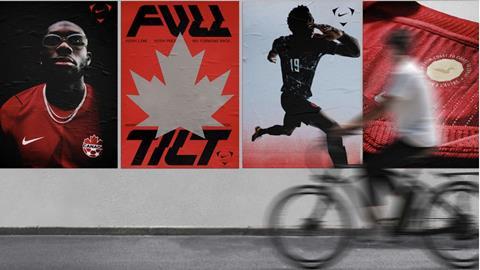
Nike Canada’s response, developed by Wieden+Kennedy Toronto, takes the most contrarian position of any campaign in this analysis. Where Canada Soccer leaned into welcome and belonging, and adidas into continuation and momentum, Nike Canada inverted the country’s most legible cultural identity — its reputation for politeness — and turned it into a threat.
The campaign film, starring hockey captain Marie-Philip Poulin and basketball forward Dillon Brooks, opens as a routine pre-flight welcome announcement and then systematically dismantles it. The Canadian Men’s National Soccer Team, it declares, will not be good hosts. Physical, aggressive, relentless. “We hope you regret your stay.”
A billboard went up at Sankofa Square in Toronto; the spot ran on arriving Air Canada flights. Qatar’s players may not have seen it. The 6-0 scoreline suggests the premise held.
Subverting the “friendly Canadian” trope requires the audience to know the stereotype well enough for the inversion to land, which limits legibility outside the country. But for a campaign built for a domestic audience, that constraint is exactly the point. Nike’s global “Rip The Script” platform provides the umbrella; the Canadian execution embodies it rather than explains it. It is the most purely local of the five campaigns examined here, and the one whose premise is most thoroughly illegible without Canadian cultural context.
The nonendemic angles: owning adjacent territory
Two campaigns in this cycle made the case that the most durable creative territory around a major sporting event is not the spectacle itself. It is the human behavior around it.
Sports Interaction, a Canadian sports betting operator, hired john st. for “Every Moment Matters,” a spot that sidestepped the soccer versus football naming debate altogether. It shows muddy rec pitches, packed pubs, and a parent and child placing a parlay from a parked car. The ad premiered ahead of the UEFA Champions League Final on DAZN, then rolled out nationally as the tournament began. The strategy was to own the fan experience, not the sport.
Visualizza questo post su Instagram
IKEA Canada reached the same insight from a different angle. “Assemble the World,” developed with Dentsu Creative, built 18 national flags from IKEA products: furniture, lighting, plush toys, and lifestyle accessories, and made each one shoppable. The playful, social first concept ties back to IKEA’s long running “bring home to life” platform.
The logic is simple: IKEA sells home. In Canada, “home” can mean dozens of different things to dozens of different communities. A tournament that brings all of those communities into the same room is, almost literally, IKEA’s subject matter.
Visualizza questo post su Instagram
What June 24 looks like now
Canada face Switzerland at BC Place on June 24 in their final Group B match, currently sitting top of the group on goal difference. A win secures first place; a draw would likely be enough. Finishing top keeps their Round of 32 fixture in Vancouver.
From the brand and creative point of view, independently from the outcome, the match will keep validating the premise. Canada Soccer said soccer was already here; Jonathan David’s June 18 hat trick agreed. adidas said David belonged alongside legends; the hat trick agreed. Nike said Canada would not be polite about it; the 6-0 scoreline agreed. The creative work was not wrong. The sport made the messaging true.
FIFA World Cup 2026: The Business of the Beautiful Game
How brands, retailers, and the sports economy compete on football’s biggest stage.
Explore Our Coverage →